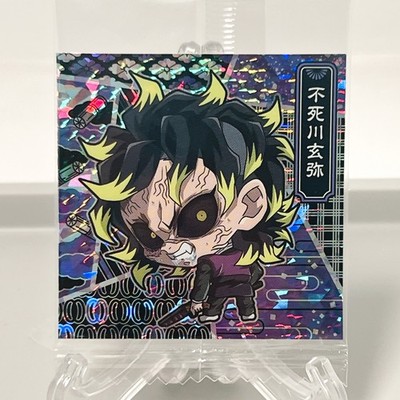
Genya Shinazugawa Demon Slayer Holographic Wafer Card

A Holographic Wafer Card from Japan’s Food-Toy Tradition
This card belongs to the Japanese shokugan category — a long-standing tradition of small collectibles sold packaged alongside candy or snacks. The word shokugan combines the Japanese terms for “food” and “toy,” and the format has been a staple of convenience stores and toy shops in Japan for decades. Individual packages are sold blind: the buyer doesn’t know which card is inside until they open it. That element of chance turns a simple purchase into a collecting game and keeps an active trade running among fans.
The card itself is a square-format wafer card printed with a character illustration and treated with holographic (prism) processing — meaning the surface shifts in color and sheen depending on the angle you hold it. Within most shokugan card series, holographic treatment appears on only a portion of the total set, which makes those cards a particular goal for completionists. The “11-19” in the product name almost certainly refers to the card’s assigned number within its series, though the exact release wave cannot be confirmed from the listing information alone. The likeliest publisher for Demon Slayer wafer cards matching this description is Bandai, whose holographic square-format numbered series closely align with what’s shown here — but that attribution remains unconfirmed.
Genya Shinazugawa and What Sets Him Apart
Genya Shinazugawa is a member of the Demon Slayer Corps and the younger brother of Wind Hashira Sanemi Shinazugawa. Unlike virtually every other fighter in the series, Genya cannot master Total Concentration Breathing — the fundamental technique that underpins a Demon Slayer’s strength. In place of that ability, he draws on something far stranger: he can eat demons and temporarily absorb their physical power, transforming his own body in the process. His weapon of choice is a modified shotgun loaded with buckshot, which stands in sharp contrast to the swordsmanship that defines almost every other character in the story.
Visually, he’s recognizable by his black hair with yellow-tipped spikes, the scars marking his face, and a habitually fierce expression. His role deepens significantly across the Swordsmith Village chapters and the Infinity Castle battle, and the complicated relationship between Genya and his estranged older brother gives him emotional weight that extends well beyond action sequences. He isn’t the franchise’s most prominent face, but he’s earned consistent loyalty from fans drawn to characters with an unconventional edge and a genuinely difficult backstory.
Demon Slayer’s Global Reach and the Appeal of Japanese Imports
Demon Slayer: Kimetsu no Yaiba was serialized in Weekly Shonen Jump from 2016 to 2020, spanning 23 volumes. The anime, produced by ufotable, launched in 2019 and built an enormous international audience. The 2020 theatrical film Mugen Train became the highest-grossing film in Japanese box office history at approximately 40.3 billion yen, and subsequent seasons set in the Entertainment District and Swordsmith Village expanded the story and the fanbase further.
Shokugan cards are sold through Japanese domestic food retail channels and have no equivalent distribution overseas. That limits access to direct import or purchases from Japan-based sellers. The vertical Japanese script printing Genya’s name on the card is characteristic of its origin — something collectors who seek out authentic Japanese merchandise tend to notice and appreciate as a mark of the real thing.


Shipped directly from Japan by a small shop
$10.11
Ships worldwide from Japan • Full photos and details on the listing