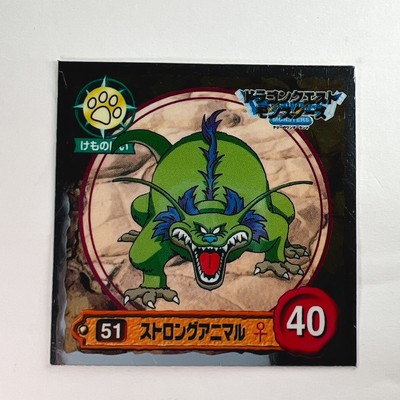
Drackal Sticker No. 051 from Dragon Quest Monsters (1998)

The Game and the Monster Behind the Sticker
Dragon Quest Monsters: Terry’s Wonderland launched on September 25, 1998, for the Game Boy Color — the first entry in Enix’s spin-off line that let players capture, raise, and breed monsters rather than simply battle them. It entered a market already energized by the monster-collecting genre that Pokemon had established two years prior, and it found its own audience both in Japan and abroad. In North America it arrived in 2000 as Dragon Warrior Monsters, reflecting the brand name the series carried in the West at the time.
Drackal — known in Japan as Strong Animal — is monster No. 051 in the game’s roster, classified as Beast type. That classification matches the “kemono!” icon printed in the sticker’s upper left corner. The creature itself is immediately recognizable: a green, four-legged beast with a bluish mane-like coat, a wide-open mouth, and prominent fangs. The design is textbook Akira Toriyama, who served as character designer for the Dragon Quest series from its very first game in 1986 — the same artist the world knows as the creator of Dragon Ball. The female gender symbol on the sticker directly reflects the game’s breeding mechanics, where a monster’s sex determines which pairings are possible. A red circular emblem stamped with “40” in the lower right likely represents one of the monster’s in-game stats, giving the card the feel of a miniaturized character screen.
Japan’s Collectible Sticker Tradition
Collectible stickers trace their roots in Japanese pop culture back at least to the Bikkuri Man format of the late 1970s, which established the template still recognizable today: themed sets with built-in rarity tiers, distributed in small random packs alongside candy or snacks. By the late 1990s the format had attached itself to virtually every major game and anime franchise. Distribution routes varied — food-toy inserts, loose sales at dagashi-ya candy shops, gachapon machines, stationery store packs — though which channel applied to this particular item is not documented.
What “Silver R” designates is not fully confirmed; it most likely indicates a Silver Rare tier within the product line’s rarity hierarchy, though the official product line name has not been pinned down. The sticker’s manufacturer is similarly unidentified — 1990s game stickers were frequently produced by licensees such as Bandai, Takara, or Epoch, but none has been verified for this piece. The rarity structure itself was central to the appeal: children and collectors would chase specific characters or rarities, trading toward complete sets in a culture of deliberate incompleteness that drove the market forward.
Why Dragon Quest Collectors Around the World Take Notice
Several threads of interest converge on an item like this. Akira Toriyama passed away in March 2024, prompting worldwide appreciation for his decades of work across both Dragon Ball and Dragon Quest. For fans of his visual legacy, original merchandise from the 1990s — primary-source material bearing his character designs — carries particular resonance. Dragon Quest’s international footprint during this era was also limited; outside Japan the series had narrower reach, which means Japanese-language originals circulated primarily at home and saw little formal distribution abroad.
At roughly 28 years old, well-preserved examples from this period have become increasingly difficult to find. The broader collecting market for 1990s Japanese game merchandise has expanded noticeably in recent years, partly driven by renewed attention to Pokemon-era items. Dragon Quest Monsters occupies the same cultural moment, with its own distinct fan community that follows the series separately from the mainline games.


Found in Japan, packed by hand, sent worldwide
$7.86
Worldwide delivery from Japan • See the listing for condition and size