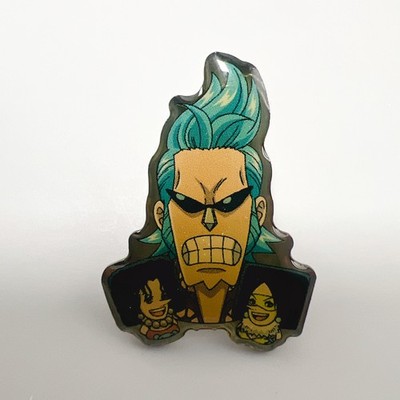
Franky Die-Cut Pin Badge — One Piece, Japan

One Piece and a Format Built for Fans
One Piece, created by Eiichiro Oda, has run continuously in Weekly Shonen Jump since 1997. By 2025 it spans more than 110 volumes with no end in sight, and the anime — which began in 1999 — remains in active broadcast. With over 500 million copies in circulation worldwide as of 2024, it stands among the best-selling manga series ever produced. The official merchandise ecosystem, built through Bandai, Toei Animation, Shueisha licenses, and others, is correspondingly vast.
This badge takes the form of a die-cut pin: rather than the standard circular format, its outline follows Franky’s own silhouette, so the badge itself is shaped like the character. The surface appears to be a hard, glossy material — likely acrylic or enamel-type — based on available images, with a pin fastening on the reverse.
Franky’s Backstory and Why the Quote Hits Hard
Franky — real name Cutty Flam — is the shipwright of the Straw Hat Pirates. His look is immediately recognizable: spiky blue hair, dark sunglasses, and a powerful cyborg body that runs on cola. He first appeared during the Water Seven and Enies Lobby arcs of the manga, corresponding roughly to volumes 32 through 46, with those anime episodes airing around 2006 to 2007. He joined the crew at the conclusion of that arc.
The quote on the badge, “Existing Is Not a Sin,” is rooted in Franky’s personal history. He was abandoned by his parents as a child, and the line surfaces directly from that emotional thread in the story. Among One Piece fans — in Japan and in the English-language community alike — it’s recognized as one of the more affecting lines in the series. The sentiment carries cleanly in translation, which is part of why it registers with international readers even without knowing the Japanese original.
Two small chibi-style figures appear at the bottom of the badge design. Based on available images, their specific identities can’t be confirmed with certainty — details like hair and accessories suggest the figures might be Usopp or Zoro, but nothing definitive can be said from the visual information on hand.
Japan’s Pin Badge Tradition and the International Collector
Character pin badges are a well-established format in Japanese anime merchandise. Alongside gashapon and blind-box items, they’re among the most common collectible categories — individually affordable and well-suited to accumulation. Die-cut versions, shaped to the character rather than contained within a circle, became widespread in the Japanese market during the 2010s. They appear regularly at major events such as Jump Festa and Anime Japan, and through specialty retailers like Animate and Gamers. Items sold through these channels often become available only on the secondary market afterward.
A distinct subcategory emerged around the same period: merchandise built around specific lines from a series, sometimes called “quote goods.” Items in this format tend to appeal most to core fans who attach emotional significance to a particular scene or moment. A Franky badge anchored to “Existing Is Not a Sin” sits squarely in that tradition.
The listing indicates Japanese domestic distribution and limited availability, though whether that means event-exclusive, regionally restricted, or time-limited release has not been confirmed from available information. The manufacturer is likewise unconfirmed, and whether the item is an officially licensed product or an independent release is not certain either. Japanese domestic One Piece merchandise of this type rarely appears through international retail in the same form — which is part of the reason dedicated collectors look to direct-from-Japan sources.


Listed in our eBay store and sent from Japan
$14.07
International shipping available • Ask us anything before you buy

