Fujiko Mine Roots Figure, First Lupin III TV Series

A Painted Static Figure Built Around an Original Design
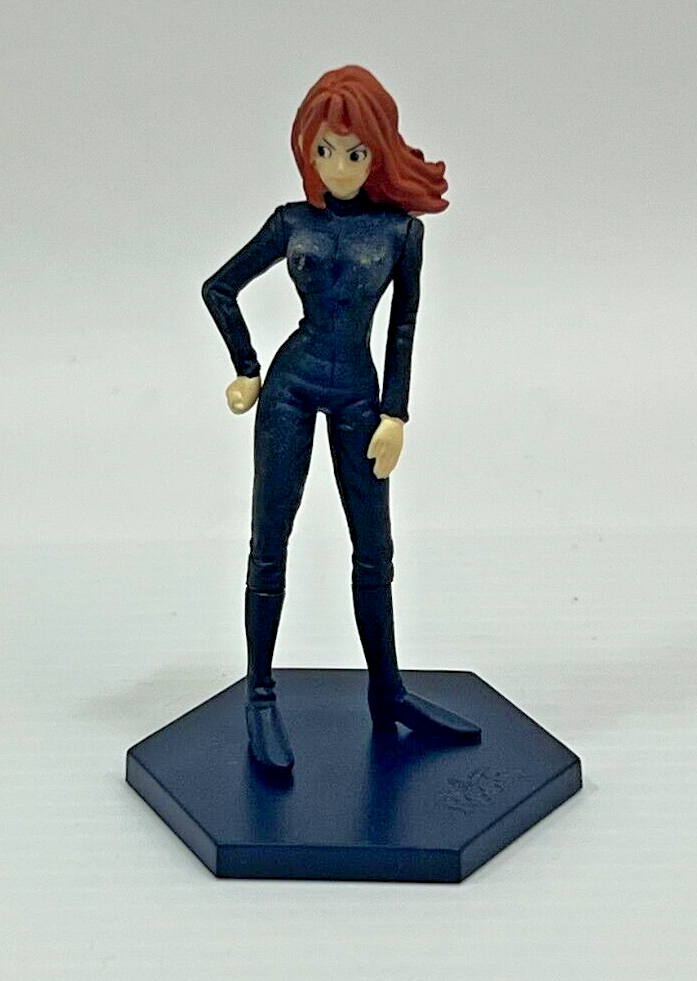
This is a small-scale, fully painted static figure of Fujiko Mine, one of the central characters of Lupin III — the long-running Japanese anime franchise based on Monkey Punch’s manga, in publication and production since 1967. The figure sits on a hexagonal display base and belongs to a line called “Roots,” a name pointing deliberately back to the character’s earliest look.
The sculpt depicts Fujiko as she appeared in the first TV series (1971–1972): reddish-brown hair, a black catsuit, and black boots — details that distinguish her first-series design from the different costumes and hair colors she carries in later installments. No manufacturer logo is clearly identifiable from available information, so it isn’t possible to confirm which company produced this piece. Companies including Banpresto, Union Creative, MegaHouse, and Good Smile Company have all released Lupin III figures over the years; the hexagonal base suggests a slightly higher-grade product format than the most basic capsule toy, though that remains an inference. The listing indicates the item has been opened.
The First TV Series and Its Unusual Place in Anime History
The first Lupin III TV series aired from October 1971 to March 1972, running 23 episodes on Yomiuri TV. It holds a distinctive position in anime history: production began under director Masaaki Osumi before creative control shifted mid-run to Hayao Miyazaki and Isao Takahata, who would later found Studio Ghibli.
The first series is tonally darker and more adult than the ones that followed. Because protagonist Lupin wears a green jacket throughout — not the red one that came to define the longer second series — collectors commonly call this version the “Green Jacket” edition. Fujiko Mine in this era is a femme fatale whose relationship with Lupin alternates between rivalry and mutual attraction, forming one of the series’ central dynamics.
Why This Era Has a Dedicated Collector Following
Lupin III has been broadcast in Europe, the Americas, and Italy, giving it broader international recognition than many franchises of its generation. Hayao Miyazaki’s 1979 film The Castle of Cagliostro extended its reach further still. Within that global fanbase, a dedicated segment focuses on the first series as the version closest in spirit to Monkey Punch’s original manga, and tends to treat first-series merchandise as a distinct collecting category rather than interchangeable with later designs.
Fujiko Mine independently draws interest as one of early anime’s most fully realized female characters — morally complex, self-directed, and not reducible to a supporting role. A figure styled on her first-series look, under a line name invoking a return to origins, resonates with collectors who track which specific era of a franchise they’re representing. For international fans, sourcing items distributed primarily within Japan carries its own appeal, as domestic releases often don’t make their way overseas through conventional retail channels.


Boxed and cushioned for the trip from Japan
$14.07
Ships internationally • More photos on the eBay listing