A Showa Era Yokai Menko Card from Gegege no Kitaro

What Menko Are — and How Showa Kids Played With Them
Menko are thick cardboard game cards with roots reaching back to the Edo period. By the time anime arrived on Japanese television in the 1960s, round menko — typically four to six centimetres across — had become one of the defining toys of the Showa era. Children bought them at dagashi-ya (penny sweet shops) and toy stalls, then took them outside to play: slam your card down hard enough to flip or scatter an opponent’s, and whatever you knocked over was yours. The game was fast, physical, and entirely social.
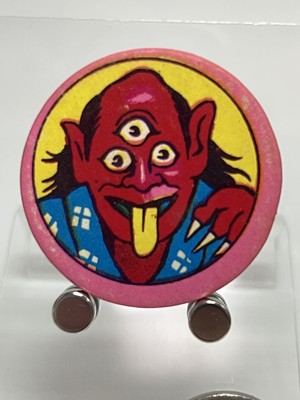
When anime character menko arrived, the format gained a second life as character merchandise. Manufacturers such as Amada (Amada Printing) and numerous smaller companies produced anime menko in large quantities throughout the Showa period. This card features a pink border on a yellow background — a bold, eye-catching design typical of the era — with a yokai character on the face. The maker of this specific card has not been confirmed from the available markings, and whether a license credit appears on the reverse is also unknown.
Gegege no Kitaro and the Showa Yokai Boom
Gegege no Kitaro is the creation of manga artist Shigeru Mizuki and stands as one of Japan’s most enduring fantasy franchises. It began in the early 1960s as a rental manga titled Hakaba no Kitaro, was retitled in 1967, and reached television the following year through Toei Animation. Three separate anime series aired during the Showa period alone: 1968–69, 1971–72, and a longer run from 1985 to 1988. Each new series triggered a wave of licensed merchandise, with menko among the most widely distributed items.
The yokai depicted on this card has red skin, three eyes — two in the conventional position and one placed below the nose — long black hair, pointed ears, visible claws, and a blue-and-white patterned garment. These features place the character firmly within the supernatural ensemble that surrounds protagonist Kitaro: creatures drawn from Japanese regional folklore and rendered in Mizuki’s earthy, sometimes unsettling graphic style. Pinning down a specific name from the image alone is difficult; the Gegege no Kitaro universe contains many yokai sharing overlapping visual codes, and red skin combined with three eyes echoes traditional oni iconography that appears across several characters in the series.
What Draws International Collectors to Showa Menko
Interest in Gegege no Kitaro has grown steadily outside Japan as yokai culture, Japanese folk horror, and Mizuki’s broader body of work have reached international audiences. The franchise holds a place in Showa popular culture comparable to Astro Boy or Ultraman — it shaped how an entire generation of Japanese children understood the supernatural world.
Round menko present an unusual format to collectors outside Japan: small, circular, and printed in the graphic idiom of mid-to-late Showa commercial art. Paper toys were consumables — played hard, bent, left in pockets — which means well-preserved examples from the original run are no longer abundant. The menko game itself has largely faded from everyday Japanese life, leaving these cards as artifacts of a specific moment in the country’s postwar childhood. The yokai imagery, rooted in pre-modern folk belief, carries a folk-art dimension that draws interest beyond the anime and manga collecting world.


Comes straight from Japan — no middleman
$7.86
Ships internationally • More photos on the eBay listing