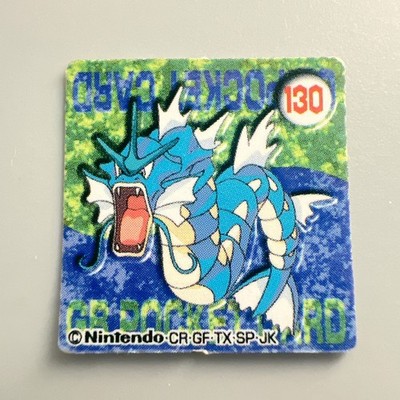
Gyarados GB Mini Card No. 130: A First-Generation Pokemon Collectible from Japan's 1990s Pokemon Boom

What This Card Is and Where It Comes From
This item is a Pocket Monsters GB Mini Card (series label: “POCKET CARD”), a small, rounded-corner flat card produced during the first wave of Pokemon merchandise in Japan. The “GB” designation links it directly to the original Game Boy software — Pokemon Red and Green, released in Japan in February 1996, followed by Blue in September 1996 and the Pikachu edition in 1998. Featuring Gyarados, Pokedex No. 130, the card displays that number in a red circle in the upper right, and carries an official copyright line reading © Nintendo CR·GF·TX·SP·JK along the bottom edge.
That copyright string is a meaningful detail. Each abbreviation represents one of the rights-holders active in early Pokemon: Nintendo (game hardware and IP), Creatures Inc. (CR), Game Freak (GF), TV Tokyo (TX, the anime broadcaster), ShoPro — Shogakukan Productions (SP, licensing), and JR Kikaku (JK), a company that held Pokemon merchandising rights specifically during the 1997–2000 period. The presence of “JK” firmly places this card within that founding era of Pokemon merchandise.
Gyarados: The Sea Dragon Behind the Card
Gyarados is a Water/Flying-type Pokemon and one of the more visually commanding entries among the original 151. Its back story within the games is built on contrast: it evolves from Magikarp (No. 129), a notoriously weak fish Pokemon, at level 20 — a sudden transformation into a 6.5-meter serpentine sea dragon with white fins and fangs. That dramatic reversal made Gyarados memorable in both the games and the anime, and its strong Attack and Speed stats gave it genuine competitive weight in the original titles.
The character’s profile grew further in the second generation (Gold and Silver, 1999), where a red Gyarados appears at the Lake of Rage as a shiny variant tied to the main story — the moment that introduced many players to shiny Pokemon as a concept. That connection means Gyarados carries significance not just as a Gen 1 Pokemon, but as a landmark character across the franchise’s early history.
The Collectible Context: Japan’s First Pokemon Boom
In the late 1990s, Japanese stores were flooded with small-format Pokemon goods aimed at children and collectors alike. These included Bandai’s Carddass vending machine cards, capsule toys, candy inserts from confectionery brands, and independently sold mini cards like this one. The GB Mini Card series appears to be a standalone line distinct from Carddass, sold individually through toy shops and stationery stores rather than through vending machines or candy packaging — though the exact distributor has not been confirmed from available records.
Items from this period carrying the JR Kikaku copyright were produced exclusively for the Japanese domestic market and were not distributed internationally through official channels. For collectors focused on first-generation Pokemon, early Japanese merchandise, or franchise history, this type of card represents physical documentation of Pokemon’s earliest commercial expansion — made at the moment the anime had just launched and the property was becoming a cultural phenomenon in Japan.


Price: $13.99 | View on eBay