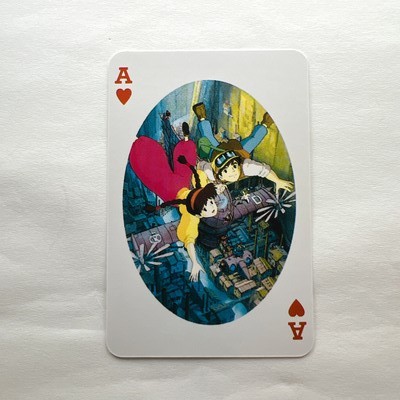
Laputa Ace of Hearts Playing Card by Animage, 1986

This is the Ace of Hearts from a playing card deck produced by Animage magazine in the summer of 1986, timed to coincide with the Japanese theatrical release of Castle in the Sky (Laputa: Castle in the Sky). Whether it was distributed as a reader bonus, sold through the magazine’s mail-order pages, or included as a supplement is not confirmed — Animage used several channels for goods of this kind, and the card appears to be one from a complete deck rather than a standalone item. The card’s central illustration, framed in an oval, shows Pazu and Sheeta together in an airborne scene, with the intricate architecture of the sky fortress visible behind them. It is exactly the kind of image the film used as a visual emblem from the moment of its release.
The Film This Card Was Made to Celebrate
Castle in the Sky opened in Japan on August 2, 1986, distributed by Toho, and it was the first theatrical feature to carry the Studio Ghibli name. The studio had been established with significant backing from Tokuma Shoten — Animage’s publisher — so the magazine’s involvement in the film’s promotional rollout was more than a standard media arrangement. Animage editor Toshio Suzuki worked closely with director Hayao Miyazaki through this period and later became one of Ghibli’s most consequential producers. The film is set in a fictional world inflected by nineteenth-century industrial romanticism: coal-mining towns, propeller-driven airships, and a mythical floating city locked in the clouds. Pazu is a mechanically gifted boy who carries his late father’s dream of reaching that city. Sheeta — full name Lusheeta Toel Ul Laputa — is the girl whose ancient crystal pendant, the Flying Stone, ties her to the city’s forgotten royal lineage. The film’s initial box office was modest, but repeated television broadcasts and home video built it a devoted following. Its “Balse!” climax has since become something of a global internet phenomenon, and the film is now distributed internationally through Netflix and GKIDS, reaching audiences well beyond Japan.
Animage and the 1980s Print Collectible Tradition
Founded in 1978, Animage was among Japan’s first dedicated anime monthly magazines, and through the 1980s it competed with rivals by pairing its editorial coverage with printed goods for readers. Playing cards, posters, stickers, calendars, and shitajiki (clear plastic desk mats) were among the formats regularly produced. Playing cards suited this format well — each card could carry a different illustration, making a single deck a compact showcase for characters and scenes across a film’s visual range. Items produced under the Animage brand during this period are understood in Japanese collecting circles as genjibutsu: officially licensed merchandise from the original release window, not later reprints or reproductions. Because Animage was never distributed outside Japan, its official merchandise remained effectively inaccessible to international audiences at the time of publication. For a collector in Europe, North America, or elsewhere, an item like this one offers direct contact with how the film was first received and celebrated in Japan — through a format that communicates across any language barrier.


Listed in our eBay store and sent from Japan
$8.82
International shipping available • Ask us anything before you buy