Son Goku Dragon Ball Coca-Cola Campaign Figure

Goku, the Kame Emblem, and the Dragon Ball Legacy
Dragon Ball began as a manga by Akira Toriyama, serialized in Weekly Shonen Jump from 1984 to 1995, and ran in two consecutive anime adaptations on Fuji TV: Dragon Ball (1986–1989) and Dragon Ball Z (1989–1996). Son Goku — a Saiyan raised on Earth who grows through martial arts training and an unshakeable sense of justice — is the franchise’s central figure and most recognized character. Shueisha reports that the manga has sold over 260 million copies worldwide, placing it among the most widely read comics in history.
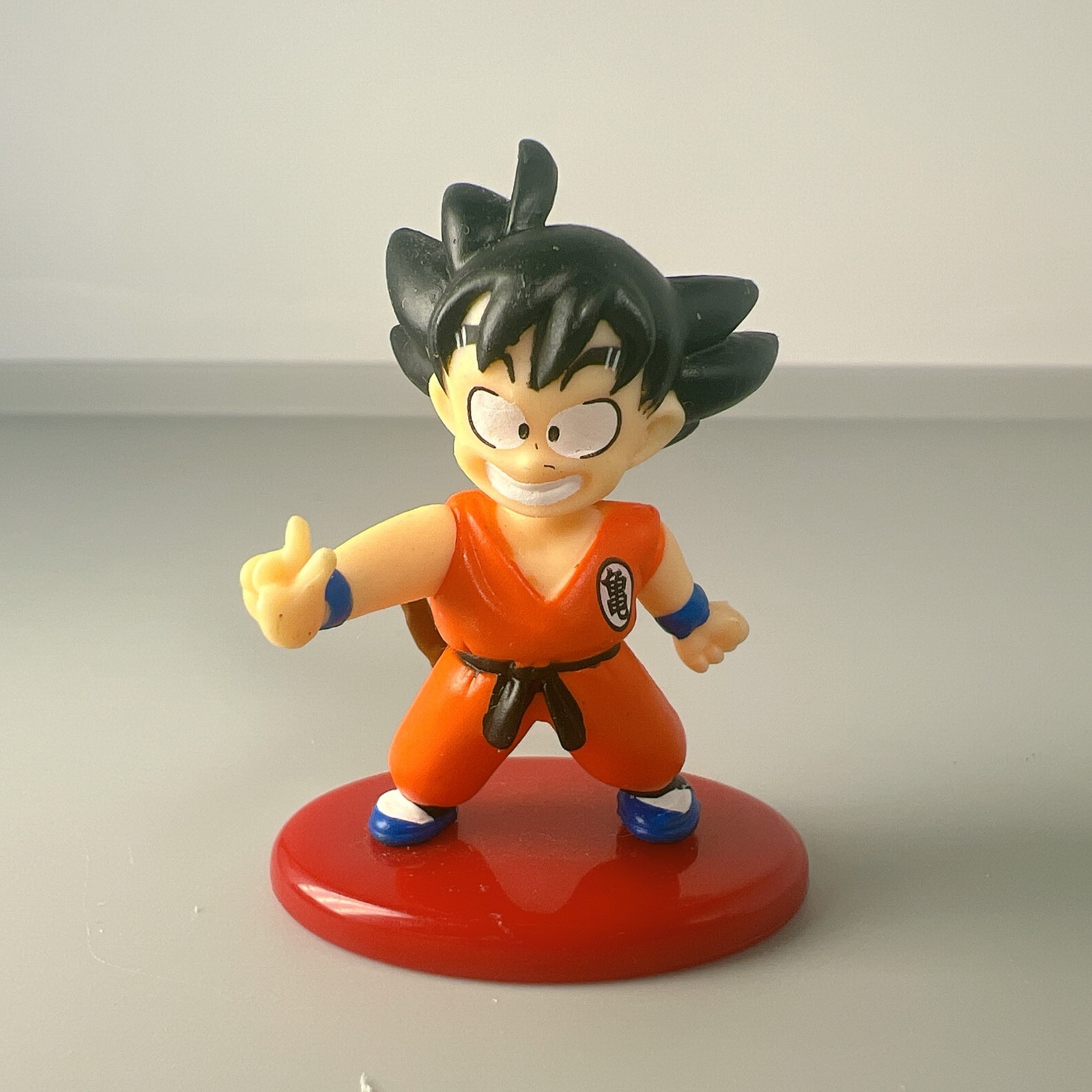
This figure captures Goku in his definitive costume: the orange martial arts gi, black belt, blue wristbands, and white shoes with blue tips. The emblem on his chest is the mark of the Kame-sen’ryu — the Turtle Hermit School — the discipline he studied under his first master, Muten Roshi. It is one of the most iconic visual symbols in the entire franchise. Goku is shown with his characteristic black spiky hair and a relaxed smile, his right hand forming a casual raised-finger gesture. The proportions and expression point to the younger Goku of the early Dragon Ball era; the listing uses “Dragon Ball Z” to reflect how the campaign categorized the product, but the design corresponds to an earlier stage of the character.
Japan’s Campaign Premium Tradition
This figure belongs to a category of Japanese promotional merchandise known as campaign premium figures — items distributed by food and beverage brands to buyers of their products. The tradition dates to the 1980s and sits alongside related formats such as shokugan (figures packaged with candy) and bottle cap figures as one of the most prolific sources of character goods from that period.
Coca-Cola Japan ran promotional collaborations with anime IP throughout the late 1990s and into the early 2000s, and Dragon Ball featured in several of those campaigns. The visual style of this figure is consistent with premiums from that era, though the specific campaign name and release year cannot be confirmed. It is made from hard rigid plastic, pre-painted, and mounted on a small red circular base — construction typical for this category. Dragon Ball Z ended its original broadcast run in 1996, but merchandise campaigns continued well after, so the figure may date to the post-broadcast period.
These pieces were produced for a limited campaign window and distributed domestically within Japan. After campaigns ended, most items were used, discarded, or simply lost over time. Good-condition examples that have survived become harder to come by as the years pass, which is what the “Japan Rare” note in the listing title reflects.
Why Overseas Fans Seek Out Pieces Like This
Dragon Ball Z reached broadcasters across North America, Europe, Latin America, and Southeast Asia, building a generation of fans who never had access to domestic Japanese campaign premiums. Items distributed only within Japan represent a category that overseas collectors can reach only through import.
Son Goku’s place in that collector interest is specific: as the face of the entire franchise, his classic orange-gi appearance is immediately recognizable to fans regardless of when or where they first encountered Dragon Ball. Pieces from the late 1990s and early 2000s also carry a generational appeal — the sculpting and hand-applied coloring style of that era has a distinct quality that differs from modern production, and for many collectors, it connects a piece directly to the original broadcast period of the series it celebrates.


Boxed and cushioned for the trip from Japan
$14.07
Ships worldwide from Japan • Full photos and details on the listing