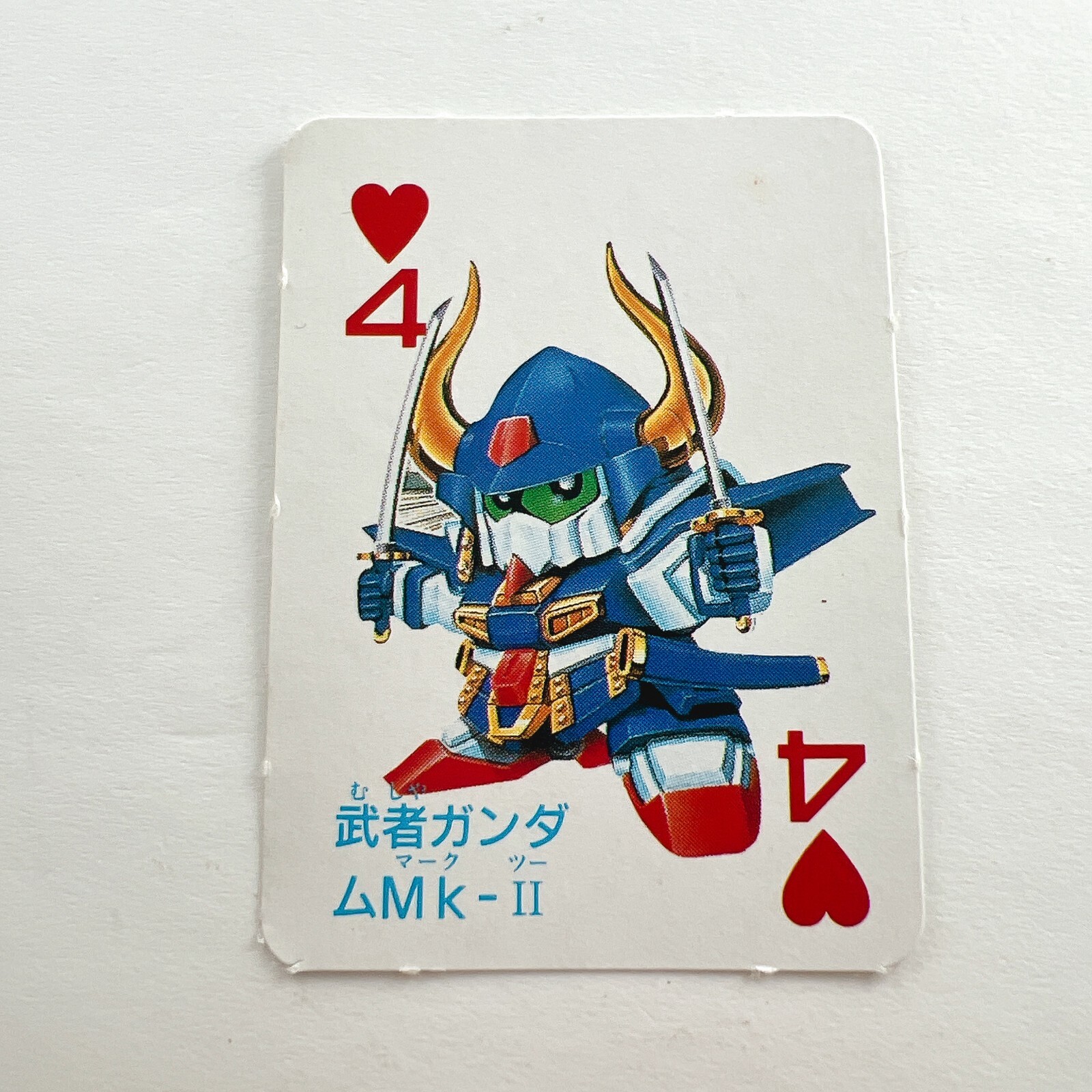
Musha Gundam Mk-II SD Playing Card, Comic BomBom 1990 Bonus Insert

A Magazine Bonus from the Peak of the SD Gundam Boom
This single playing card — the 4 of Hearts — was not sold in stores. It came bundled inside Comic BomBom, Kodansha’s monthly manga magazine for boys, as the February 1990 bonus insert. Comic BomBom, which ran from 1981 to 2007, was well known for its furoku: printed extras, card sets, stickers, and mini-games tucked into each issue. Readers often bought issues specifically for these bonuses. This card was likely part of a full playing-card deck distributed that month, though the complete set configuration cannot be confirmed from a single card.
February 1990 fell at the peak of the SD Gundam craze. The SD (Super Deformed) style — characters and robots redrawn with oversized heads and compact, rounded proportions — had spread from Bandai’s gashapon capsule toys in the mid-1980s through the BB Senshi plastic model line launched in 1987. Comic BomBom was one of the franchise’s main media homes, regularly running SD Gundam manga timed to Bandai toy releases.
Musha Gundam Mk-II: Samurai Armor Meets Mobile Suit Design
The character on this card comes from SD Sengoku Den, the branch of SD Gundam set in a world modeled on Japan’s feudal Sengoku period. Characters here wear samurai helmets, carry katana, and are clad in feudal armor — all filtered through Gundam’s mechanical design language, blending Japan’s warrior tradition with Western science-fiction imagery.
Musha Gundam Mk-II is the successor to the original Musha Gundam and appeared during the Musha Shichinin Shu arc (circa 1988–1989). The card’s illustration reflects this lineage: a blue, white, red, and gold figure with a gold-crested helmet and twin katana, rendered in the rounded SD proportions that defined the franchise’s look at its height. Bandai produced a corresponding BB Senshi plastic model kit, and Comic BomBom ran related content alongside those releases.
What This Card Means for International Collectors
Comic BomBom furoku were distributed only to readers who purchased the magazine in Japan — no international edition, no licensed overseas version. Any surviving piece exists because someone kept it for more than thirty years, and paper items from this period face the ordinary risks of aging.
For Gundam fans outside Japan, the SD Sengoku Den series holds particular appeal: it merged one of Japan’s defining sci-fi properties with the imagery of feudal samurai culture, producing something distinctly Japanese while remaining accessible to collectors familiar with either tradition. BB Senshi kits from this era continue to draw interest across Asia and beyond. A playing card from a 1990 magazine insert occupies a different category from plastic kits or figures — it is a piece of how deeply the franchise had embedded itself in everyday Japanese children’s media at the height of the boom.


Comes straight from Japan — no middleman
$8.82
Ships internationally • More photos on the eBay listing