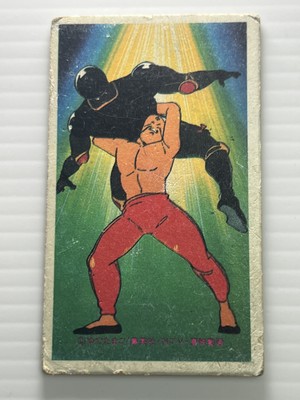
A Licensed Kinnikuman Menko Card from the 1980s Anime Era

A Paper Game Rooted in Japanese Street Culture
Menko are a distinctly Japanese form of card-based play with roots stretching back centuries. The game is straightforward: players slam their cards against the ground, using the resulting force and air displacement to flip an opponent’s card face-up. Whoever collects the most cards wins. Rectangular menko — the kakugata format — became the dominant shape from the 1970s onward, gradually replacing the earlier circular and square versions that older generations grew up with.
During Japan’s postwar economic boom, menko became tightly woven into the culture of dagashiya — the small neighborhood candy-and-toy shops that served as after-school destinations for generations of children. Cards printed with baseball players, pro wrestlers, and anime characters sold at low prices alongside penny sweets. By the early 1980s, television anime had taken over as the primary subject matter, and Kinnikuman was one of the era’s most prominent faces on menko cards.
Kinnikuman: The Wrestling Hero of Jump’s Golden Age
Kinnikuman began as a manga by Yudetamago — the shared pen name of Shimada Takashi and Nakai Yoshinori — launching in Weekly Shonen Jump in 1979. What started as a wrestling-themed science-fiction comedy, following a clumsy alien prince through increasingly outlandish bouts, gradually evolved into a serious superhuman battle series. By the time Toei Animation brought it to television on Fuji TV in 1983, it ran for 137 episodes over three years and became one of the defining titles of Shonen Jump’s golden era.
The four copyright holders printed on this card — Yudetamago, Toei Animation, Fuji TV, and Shueisha — are exactly the parties you would expect on licensed merchandise from the anime’s broadcast period (1983–1986) or shortly after. Their presence confirms this is an officially licensed product. Kinnikuman himself appears in his characteristic orange and red trunks, the visual shorthand that made him instantly recognizable across toy aisles nationwide. The spotlight-style composition placing the characters against a dramatic background was a common design language for wrestling-themed menko of the period. The second character depicted — a figure in a dark suit — is consistent with the many “choujin” opponents who populate the series, though identifying them specifically from image alone isn’t possible without the card’s printed text.
A Format That Rarely Left Japan
Unlike the rubber Kinnikuman figurines released abroad as M.U.S.C.L.E. by Mattel in North America in 1985, menko cards were almost entirely a domestic Japanese product. They moved through candy shops and toy wholesalers within Japan and rarely traveled overseas. For collectors outside Japan, that means the format itself carries a layer of cultural weight beyond the franchise: these cards are physical artifacts of a specific time and place — the dagashiya economy of early-1980s Japan.
Kinnikuman’s foothold in Western pop culture through M.U.S.C.L.E. has given collectors in North America and Europe a point of entry into the broader franchise. Many who grew up with those small pink figures later trace the source material back to Japan and discover the wider world of licensed merchandise it generated. Menko cards, hand-sized and built for actual play, represent a category of that merchandise that most Western fans have never encountered in person — a corner of 1980s Japanese collecting culture that stayed resolutely local even as the characters themselves traveled the world.

Shipped directly from Japan by a small shop
$8.15
Ships worldwide from Japan • Full photos and details on the listing