Kinnikuman Vintage Menko Card: A 1980s Japanese Anime Collectible Explained

What Is a Menko Card — and What Makes This One Special
This card is a menko — a traditional Japanese paper game piece with roots going back to the Edo period. In the postwar decades, menko evolved into something kids could find at corner candy stores (dagashi-ya) and festival stalls: thick, brightly printed cardboard cards featuring baseball players, wrestlers, and eventually anime characters. The game was simple and physical — players slapped cards against the ground, trying to flip their opponent’s cards with the resulting gust of air. Because they were cheap, consumable, and played hard by children, well-preserved examples are genuinely uncommon today.
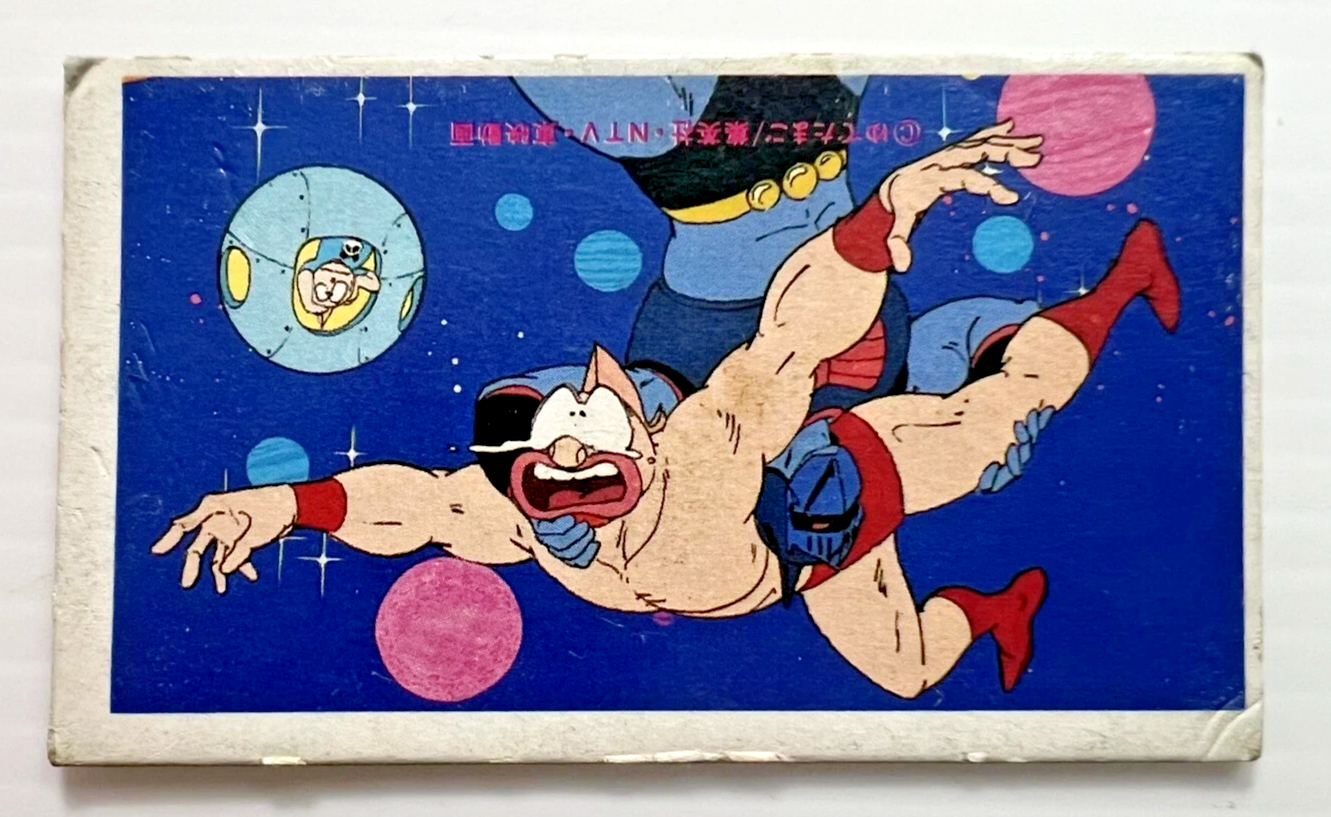
This particular card features characters from Kinnikuman, the manga created by the duo Yudetamago (Takashi Shimada and Yoshinori Nakai) that began serialization in Weekly Shonen Jump in 1979. The illustrated scene is set in outer space — stars and celestial bodies fill the background — placing it within the cosmic storylines of the anime. The card depicts Kinnikuman himself (the protagonist Suguru, shown unmasked and grimacing), a large blue-skinned character with golden ornamentation that appears to be an antagonist super-human from the early-to-mid series, and a smaller figure inside what looks like a flying pod, possibly Kinkotsuman, a recurring low-level rival from the beginning of the series. The specific identities of the supporting characters are difficult to confirm from the card art alone, and that nuance is worth noting.
The Franchise and Its Era
Kinnikuman centers on a race of super-powered beings called chojin (super-humans) who compete in outlandish pro-wrestling-style battles, blending physical comedy with escalating tournament action. The television anime, produced by Toei Doga (now Toei Animation) and broadcast on Nippon TV from 1983 to 1986, ran for 137 episodes and cemented the franchise as one of the defining properties of 1980s Shonen Jump.
The copyright line printed on this card — crediting Yudetamago, Shueisha, NTV, and Toei Doga — is a precise dating clue. Toei Doga changed its name to Toei Animation in 1998, so any licensed merchandise bearing the “Toei Doga” mark was manufactured before that name change, pointing solidly to production during or shortly after the anime’s broadcast run in the 1980s. During this period, character menko were produced by numerous small toy and confectionery manufacturers under license, which means individual card series were rarely catalogued systematically — unlike the famous Kinnikuman rubber figures (Kinkeshi) released by Bandai, menko from this era lack a comprehensive collector’s numbering system.
Why International Collectors Take Notice
Kinnikuman has a foothold in North American pop culture through M.U.S.C.L.E., the Mattel line that adapted the Kinkeshi rubber figures for Western markets in the late 1980s. Fans who grew up with M.U.S.C.L.E. and later discovered the original Japanese source material tend to seek out licensed goods from the anime era. Menko occupy their own collecting niche — sometimes compared loosely to Pogs, though the format, origins, and artwork style are quite distinct. The cel-animation aesthetic of the illustration here, reflecting the hand-drawn style of Toei Doga’s animators, carries a visual character that digital illustration cannot replicate. For collectors interested in the tangible material culture of 1980s anime, a menko card with a clear licensed copyright notice offers a direct, physical connection to how Japanese children experienced the franchise at its peak.

Price: $7.67 | View on eBay