Luigi Tanooki Suit Pepsi Bottle Cap Figure No. 18

A Beverage Promo From Japan’s Bottle Cap Era
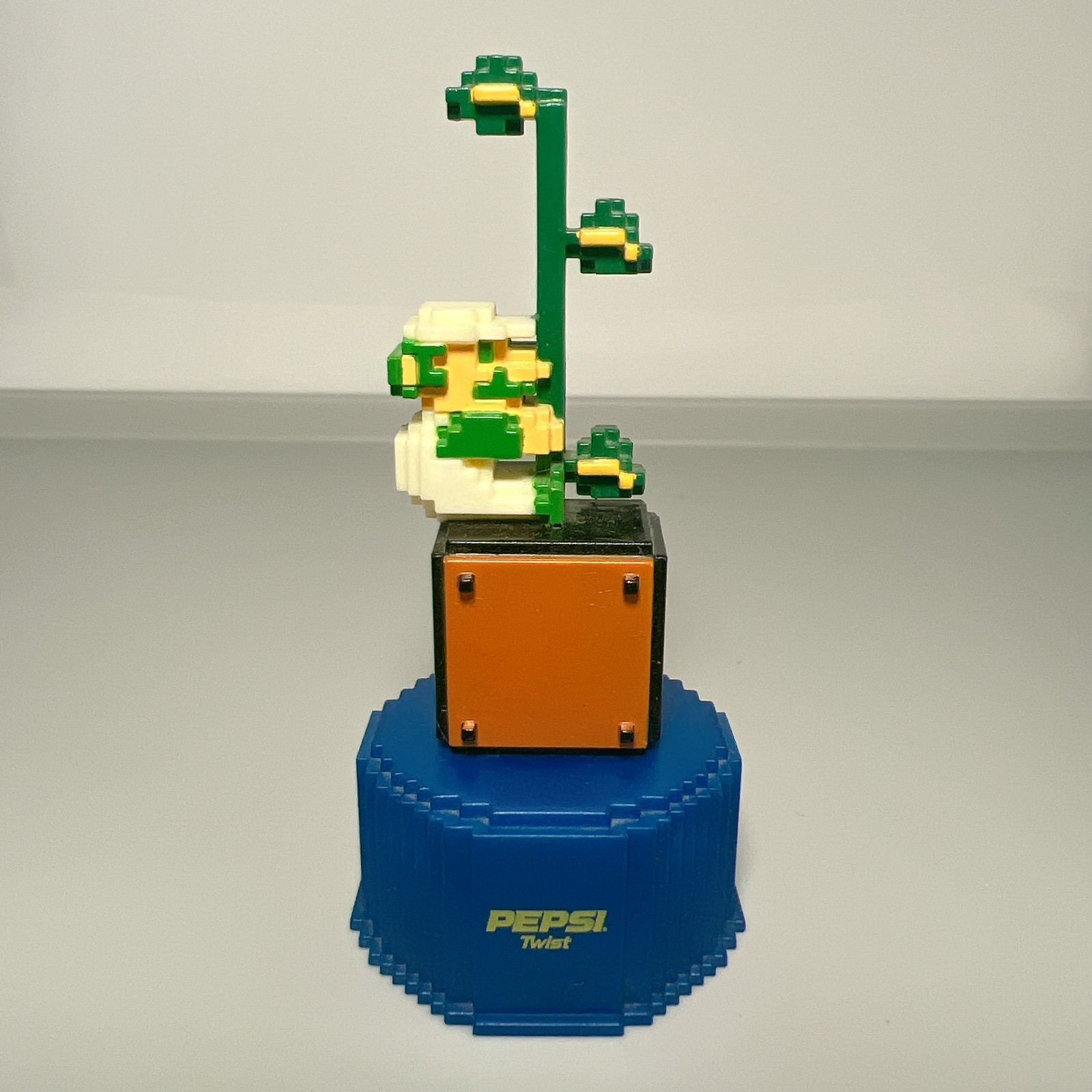
This piece belongs to a Nintendo-licensed series of bottle cap figures produced as promotional items for Pepsi Twist in Japan. The blue octagonal base stamped with the Pepsi Twist logo identifies the campaign immediately. Above it sits an orange intermediate block, and on top stands Luigi dressed in his Tanooki Suit against a backdrop of green pixel-art vines — all rendered in an 8-bit aesthetic that references Famicom-era graphics directly. The “No. 18” designation marks the figure’s position within the series, confirming at least eighteen different character designs were produced under the same promotion.
Pepsi Twist — a lemon-flavored cola variant — was active in Japan most likely in the early 2000s, with 2001 to 2003 the probable window based on the product branding, though the exact campaign dates are not confirmed. During this period, Japanese beverage companies frequently partnered with toy manufacturers to produce small collectible figures packaged with their products, and Nintendo characters were a recurring subject for those collaborations. The specific manufacturer is not identifiable from the piece alone; companies such as Bandai, Yujin, and Takara all produced commissioned runs of this type during the era.
Luigi, the Tanooki Suit, and the Vine Backdrop
Luigi first appeared in the 1983 arcade game Mario Bros. as Mario’s twin brother. His standard design — green hat, green shirt, blue overalls — has remained consistent for decades, and his Tanooki Suit form follows the same color logic. The Tanooki Suit itself debuted in Super Mario Bros. 3, released in Japan in 1988. In standard play, Mario wears a brown raccoon-dog costume; in the second-player role, Luigi’s version shifts to the white-and-green variant shown here — a 2P color scheme pulled directly from the game.
The vine element forming the backdrop — “TSURU,” from the Japanese word for climbing plant — represents the beanstalk and vine stages found throughout the Mario series. It is rendered as stacked pixel blocks, translating the flat sprite graphics of the original game into three-dimensional form while preserving the tile-based look of the source material.
What Draws Mario Collectors to This Figure
Super Mario Bros. has sold hundreds of millions of units globally since 1985 and has been accompanied by licensed merchandise since the late 1980s. Within that catalog, Luigi has historically received far fewer solo appearances than his brother — a disparity Nintendo itself acknowledged when it declared 2013 the “Year of Luigi.” Early 2000s figures featuring Luigi as the central character are consequently uncommon relative to Mario equivalents.
The Tanooki Suit in Luigi’s specific color scheme adds further specificity, representing a game state that cooperative players on the original Famicom would recognize. The 8-bit sculpting style also holds independent appeal for retro game fans, since the figure translates pixel graphics into physical form rather than reimagining the character in a modernized style.
Because these figures were distributed through Japanese beverage promotions, they were never available through retail channels outside Japan, making them effectively import-only for international collectors. The numbered series format — No. 18 within a set of at least eighteen — also gives set-focused collectors a defined target to work toward.


Boxed and cushioned for the trip from Japan
$14.07
Worldwide delivery from Japan • See the listing for condition and size