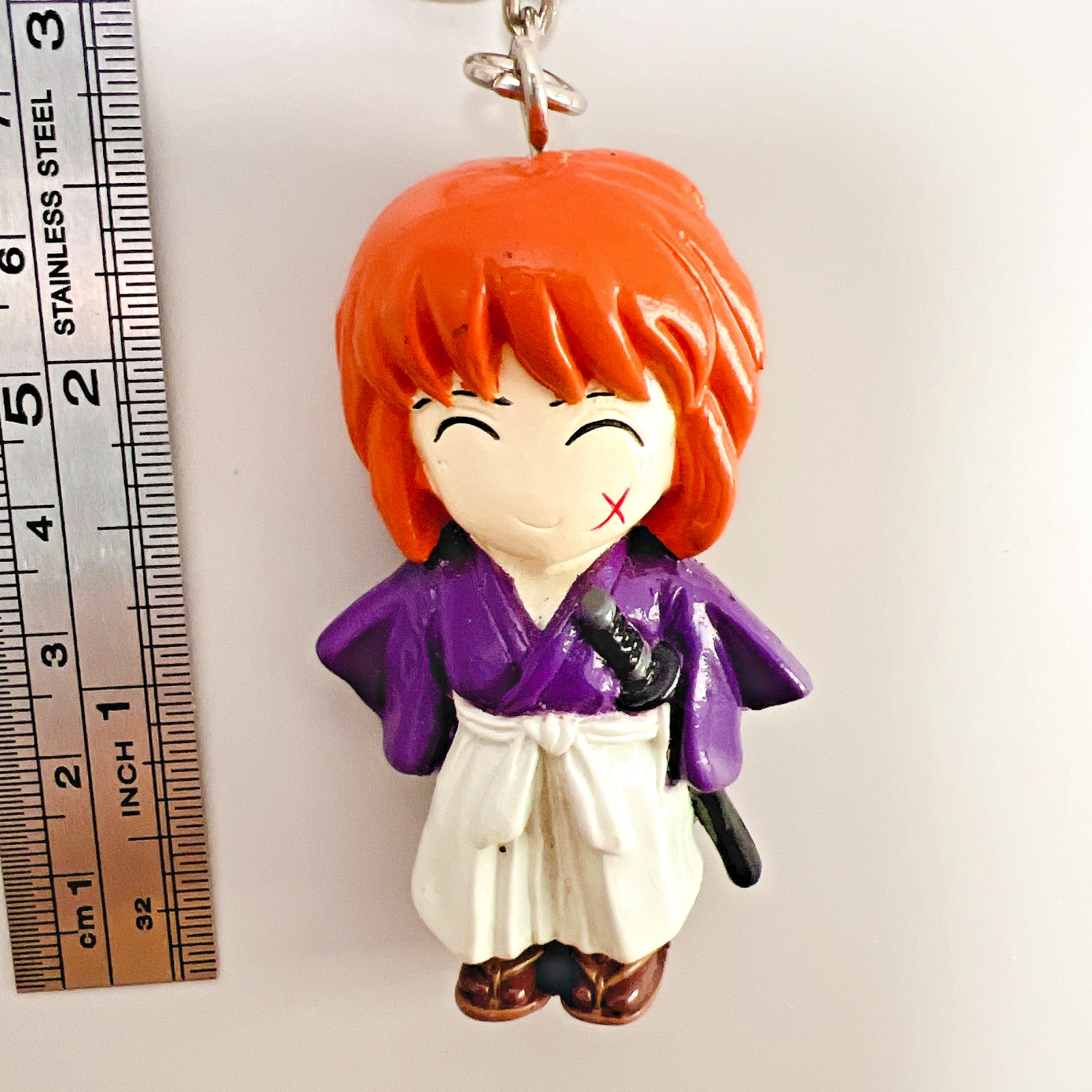
Kenshin Himura Smiling Ver. Figure Keychain from Rurouni Kenshin

A Manga and Anime That Spans Three Decades
Rurouni Kenshin — the manga by Nobuhiro Watsuki — ran in Weekly Shonen Jump from 1994 to 1999, filling 28 volumes with a premise unlike most of its peers: a samurai action story set in the actual historical moment of Japan’s Meiji Restoration, not an invented fantasy world. The first anime adaptation, produced by Studio Deen, followed in 1996 and ran through 1998, finding an audience well outside Japan. OVAs followed, including the Tsuioku-hen release of 1999, which earned lasting praise for the quality of its animation, music, and direction. Five live-action films between 2012 and 2021 brought the story to successive waves of viewers. A new anime series by Liden Films began airing in 2023. Internationally, the series reached a milestone when it aired on Cartoon Network’s Toonami block in North America in 2003, placing it firmly in the memory of a generation of Western anime fans.
The Wanderer Behind the Cross-Shaped Scar
Kenshin Himura has one of the most immediately recognizable designs in anime. During the Bakumatsu, he was Hitokiri Battosai — a feared assassin. After the Meiji Restoration, he gave up killing, took up a sakabato (a sword with blade and spine reversed, a physical emblem of his vow not to harm), and became a wandering rurouni with no fixed home. The cross-shaped scar on his left cheek — two overlapping wounds whose history the story eventually explains — and his long reddish-orange hair make him identifiable at a glance, even to viewers who have only a passing familiarity with the series.
This particular figure presents the “Smiling Ver.” — his warmer, more unassuming expression, in contrast to the focused intensity of a battle pose. That duality is central to who Kenshin is: an outwardly gentle man who carries a violent past. Figures and merchandise featuring different expressions and poses have long been one way that character goods explore that contrast, giving collectors a choice in which side of the character they want to represent.
Japan’s Anime Figure Keychain Tradition
Small PVC character figure keychains were a standard format in Japan’s late-1990s anime goods industry, produced through several distinct channels: gashapon (capsule vending machines), shokugan (figures packaged with candy or gum), arcade prize lines, and randomized trading figure sets. The Rurouni Kenshin merchandise wave during the original anime broadcast involved multiple manufacturers — Bandai, Yujin, and Epoch among them — releasing numerous character variants across these formats. The specific manufacturer of this piece is not confirmed from the item alone.
Its construction style is consistent with what was typical of late-1990s to early-2000s Japanese anime goods, though the 2023 anime has generated new merchandise as well, making the precise era of this piece difficult to pinpoint with certainty. What the “Smiling Ver.” label suggests is that multiple expression or pose variants were offered within the same product line — a common practice for popular characters during that period, when a single hit series could generate dozens of distinct character configurations across merchandise formats.


Boxed and cushioned for the trip from Japan
$14.07
Worldwide delivery from Japan • See the listing for condition and size