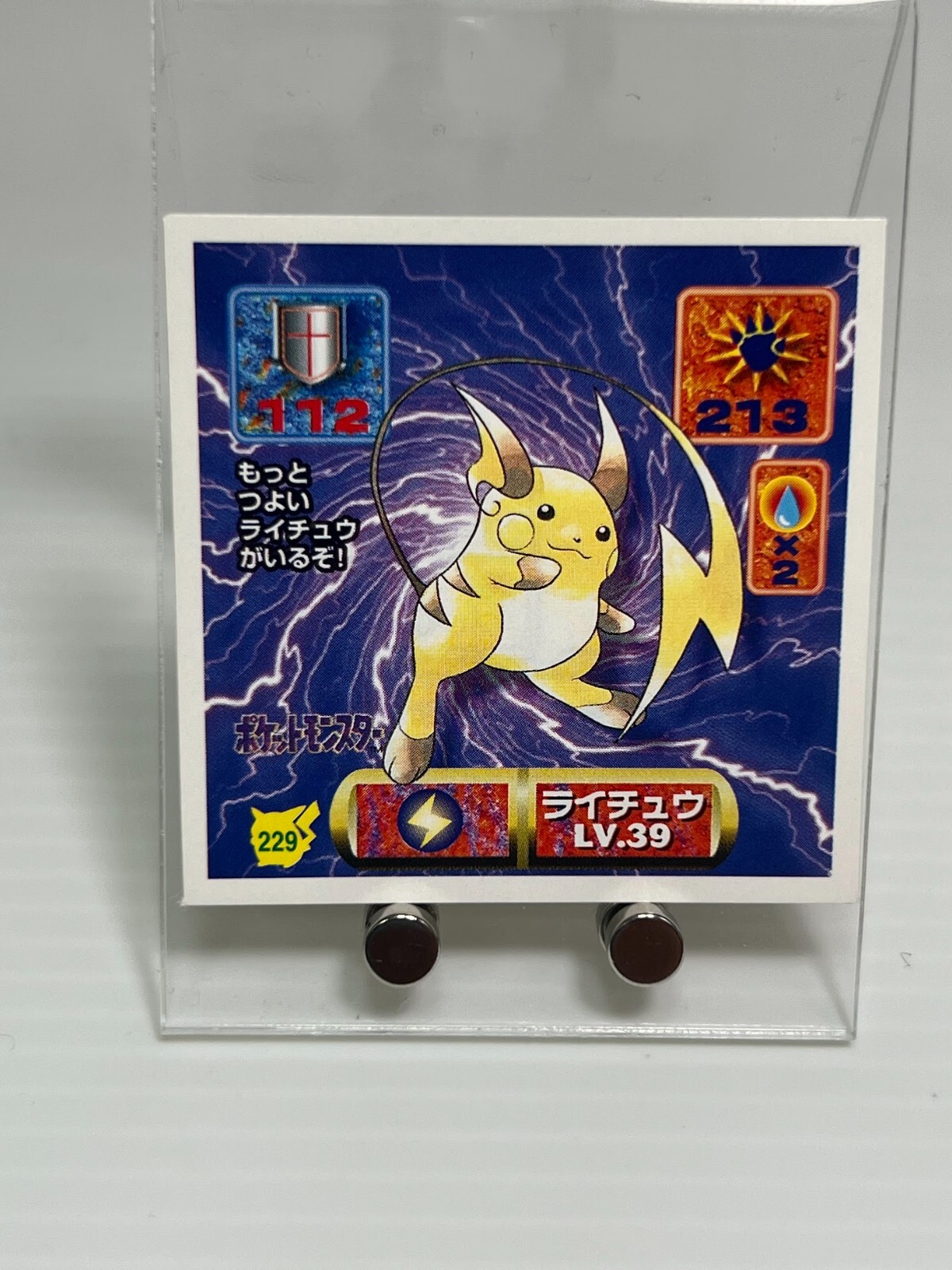
Raichu Sticker No.229 by Amada, 1997

A Sticker from the Pokemon Franchise’s Very First Year
In 1997, Amada produced this officially licensed paper sticker as part of a numbered Pokemon series. The serial number 229 is an internal sequence within the sticker line — separate from Raichu’s National Pokedex number, which is #26. The face of the sticker shows Raichu at Level 39 alongside a set of stat-style icons: a shield marked 112, a starburst marked 213, a droplet marked “x2,” and a lightning bolt. The layout borrows from the game’s battle statistics and type system, reworked into the sticker series’ own visual language. The droplet “x2” most likely represents a weakness multiplier, but electric-type Pokemon in the first-generation games were weak to ground rather than water — suggesting the series used its own icon conventions rather than strict game accuracy. The sticker also carries a tagline that translates roughly as “There’s an even stronger Raichu out there!” — a phrase not found in any official game text or Pokedex entry, and apparently original to this sticker series.
The Pokemon That Lives in Pikachu’s Shadow
Raichu is National Pokedex entry #26, an Electric-type and Pikachu’s final evolved form, reached by using a Thunder Stone. By raw stats, Raichu is clearly the stronger Pokemon. But because Pikachu became the franchise’s mascot, Raichu landed in an unusual position: the superior evolution that the series’ face chose never to take. That dynamic was given explicit narrative weight early in the anime. In episode 14 of the original Japanese broadcast — which aired the same year this sticker was produced — Pikachu faces a Raichu and declines to evolve even when doing so might have meant winning the fight. The episode made the pair’s relationship a recurring point of fan discussion. Among core Pokemon fans, Raichu’s standing as the evolution Pikachu refused has remained part of how the character is read, even as the franchise grew well beyond its first generation.
Amada Stickers and Japan’s 1990s Character Collectible Market
Amada was among Japan’s most active licensed character goods makers of the 1980s and 1990s, producing sticker sets, karuta, and paper goods for franchises including Dragon Ball, Sailor Moon, and Pokemon. Their products sold through candy shops, toy stores, and supermarket stationery sections, typically by the individual sticker or in packs. Because stickers were designed to be peeled off and used, examples that survive with backing intact are relatively uncommon. The Pokemon series numbered at least into the 200s based on this sticker’s serial number, though the full count and any sub-series structure are not confirmed. Amada also produced the same designs in multiple finishes — standard print, foil, and prism — though the exact treatment on this sticker cannot be identified from the listing image alone. This item dates to 1997, the year the Pokemon anime launched in Japan and one year after the Game Boy games debuted. Merchandise from this first domestic wave reached Western markets in far smaller numbers than the globally distributed toys and cards that followed during the franchise’s international expansion.

Found in Japan, packed by hand, sent worldwide
$7.86
Worldwide delivery from Japan • See the listing for condition and size