MIDORI Japan Miniature Gray Tabby Cat Refrigerator Magnet

A Yuru-Kawa Gray Tabby, Sculpted at 3.8 Centimeters
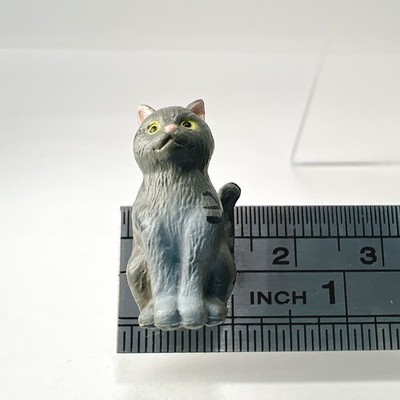
This is a small PVC refrigerator magnet from the Japanese brand MIDORI, shaped as a stylized gray tabby cat. The figure measures roughly 3.8 centimeters tall — compact enough to sit on a fingertip — and is molded in a sitting pose that has long been standard in Japanese cat-themed goods. Its design follows the yuru-kawa aesthetic: a “loosely cute” sensibility built around a rounded head, oversized eyes, and gently simplified proportions. On this piece, that translates to yellow eyes, a pink nose, pink inner-ear accents, and light striped markings across the back and tail.
The cat is not a licensed character from any anime, manga, or game. It’s an original MIDORI design, part of what appears to be a broader line of animal figures, though the formal series name has not been confirmed. For Japanese gift manufacturers, IP-free animal motifs like this offered practical advantages: they required no licensing, could be produced continuously across product lines, and were straightforward to sell across multiple retail channels — including, in many cases, the export souvenir trade.
How Japan’s Souvenir and Zakka Markets Shaped This Kind of Object
Japan has a well-established domestic market for small decorative refrigerator magnets, particularly as travel keepsakes. Tourists visiting different regions traditionally pick up lightweight, region-themed magnets — shaped like local landmarks, wildlife, or seasonal imagery — as souvenirs. Over time, this souvenir format expanded into the broader zakka (general goods) category, sold not only at tourist sites but also at gift floors in department stores and lifestyle retailers like Loft and Tokyu Hands.
MIDORI, a Japanese novelty and gift manufacturer, operated in this space. A note on the brand: multiple Japanese companies share the MIDORI name, the most prominent internationally being Designphil, known for stationery and travel notebooks. Which MIDORI produced this particular piece has not been confirmed from the available information alone.
The style of miniature PVC magnet this represents was widely produced by Japanese zakka manufacturers from the late 1990s through the 2010s. Alongside the souvenir trade, the 2000s saw growing interest in what Japanese consumers called natural zakka — everyday household objects chosen for their design quality as much as their function. A small cat figure that works both as decoration and as a working magnet sits naturally in that tradition.
Why Tabby Cat Figures from Japan Attract Collectors Worldwide
Cats occupy a distinctive place in Japanese material culture. The maneki-neko tradition has long made the cat one of Japan’s most recognized cultural exports, and tabby cats — with their immediately legible striped markings — hold broad, cross-cultural appeal. Among collectors of Japanese kawaii goods in Europe, North America, and across Asia, a well-made cat figure from a Japanese manufacturer carries a kind of origin-specific interest: it’s a tangible object shaped by a particular design tradition, not a global brand formula.
What draws attention to Japanese zakka at this scale is often the quality of detail packed into a small form. The painted accents on a 3.8-centimeter figure — yellow eyes, pink ears, stripe markings on the back — reflect the care that Japanese gift manufacturers brought even to modestly priced novelty pieces. Because this type of magnet was distributed primarily through domestic Japanese retail and tourist channels, regular international availability was limited, though the precise extent of that is difficult to gauge.


Boxed and cushioned for the trip from Japan
$14.07
International shipping available • Ask us anything before you buy