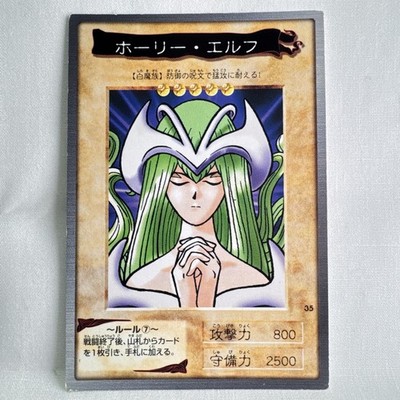
Bandai Carddass Yu-Gi-Oh No.35 Mystical Elf (1998)

A Trading Card from Before the Konami Era
The first thing to understand about this card is what it isn’t: it is not a Konami OCG card. In 1998, a full year before Konami launched the Yu-Gi-Oh Official Card Game in Japan, Bandai was already producing Yu-Gi-Oh trading cards under its Carddass line. This card — numbered 35 in the series — belongs to that earlier chapter: a separate product, from a separate manufacturer, built on an entirely different game system. The two are not compatible, and they were never meant to be.
Bandai’s version ran on a numbered rule framework. This particular card carries Rule ⑦, which states that after a battle ends, the player draws one card from the deck and adds it to their hand — a mechanic with no equivalent in the Konami OCG that would follow. The card’s border also appears to carry a metallic sheen consistent with the prism finish that Carddass collectors distinguish from standard prints: a reflective, higher-tier treatment within the line.
Mystical Elf and Her Place in the Original Story
Mystical Elf — whose name on the Japanese card is Holy Elf — appears in both Kazuki Takahashi’s original manga and the 1998 anime produced by Toei Animation, a 27-episode series that ran from April 1998. This is not the same as the far better-known Yu-Gi-Oh Duel Monsters series that aired from 2000 onward; the two productions differ substantially in content and tone, and it is the earlier Toei version whose world these Bandai cards reflect.
In that world, Mystical Elf is a card in protagonist Yugi Mutou’s deck, valued for her defensive profile: Attack 800, Defense 2500. The card’s own text captures the design philosophy directly — she endures fierce attacks through defensive spells. That combination of low offense and a high defensive wall made her a classic protective piece, and her visual matches the concept exactly: a female elf with long green hair and a white headpiece, hands clasped as if in prayer. The Bandai version uses its own monster-type classifications independent of Konami’s, so the type label printed here differs from the Spellcaster designation she carries in the later OCG.
Carddass, Vending Machines, and 1990s Japanese Collector Culture
Carddass was Bandai’s dedicated vending-machine trading card line, launched in 1988 with Dragon Ball cards and expanded through the 1990s to cover nearly every major anime franchise of the era. The format was simple: a machine installed in a convenience store, candy shop, or arcade dispensed one card at a time for a small coin. No packs, no guaranteed contents — just a single random card per play. Prism-finish cards, with their holographic treatment, appeared less frequently and were treated as the premium tier of any given series.
For collectors outside Japan, the Bandai Carddass Yu-Gi-Oh series carries a specific significance: it was distributed exclusively within Japan, and no English or international version was ever produced. These cards predate the global expansion of Yu-Gi-Oh entirely. The manga began serialization in Weekly Shonen Jump in 1996; Konami’s card game followed in February 1999; international markets came later still. A Bandai Carddass card from 1998 sits at the very beginning of that timeline, from a production run that ended when Konami took over the card game license — now roughly 27 years ago.


Sleeved and rigid-mailed before it leaves Japan
$8.82
Ships internationally • More photos on the eBay listing