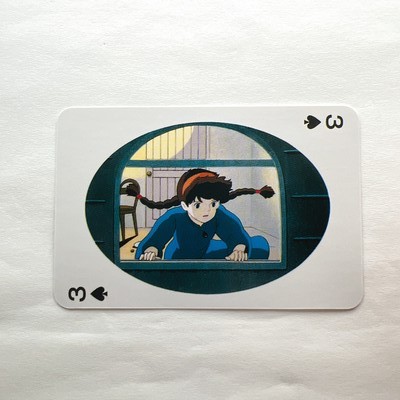
Laputa Playing Card, Spades 3 — Animage, Summer 1986

A Single Card, a Famous Face
This is a standard-sized playing card — the Three of Spades — printed with a full-color anime illustration of Pazu, the young male lead of Castle in the Sky (Laputa: Castle in the Sky). He appears in his recognizable blue work jacket, looking outward through an arched circular window, with a chair visible in the interior behind him. The suit and rank (♠3) are marked at the upper right and lower left corners in the conventional format, and the card has the rounded edges typical of the period. Whether this card was part of a complete 52-card deck or circulated as a standalone item is not confirmed by available records. What the labeling does confirm is its origin: an Animage Summer 1986 promotional item, distributed exclusively within Japan.
The Film Behind the Illustration
Castle in the Sky, directed by Hayao Miyazaki, opened in Japanese theaters on August 2, 1986. It was the first theatrical feature produced under the Studio Ghibli name — the studio had been founded in 1985 — following Nausicaa of the Valley of the Wind (1984), which was made under predecessor studio Topcraft. The story follows Pazu, an apprentice mechanic working in a mining town, and Sheeta, a girl who falls from the sky carrying a mysterious levitation stone. Together they seek Laputa, a legendary floating island, while pursued by both military forces and air pirates. The film blends steampunk machinery, aerial adventure, and a strong emotional core, and has remained one of the most frequently rebroadcast anime films in Japan across the decades since its release.
Pazu himself is defined by hard work and conviction. He builds things with his hands, carries his late father’s photograph as proof that Laputa exists, and refuses to abandon Sheeta no matter the odds. His blue jacket is one of the defining character looks of 1980s anime. The window scene illustrated on this card — while the specific moment in the film cannot be pinpointed with certainty — captures the contained, intimate side of a story that also fills the screen with vast skies and machines.
Animage, Tokuma Shoten, and the Era of Magazine Goods
Animage is a monthly anime magazine published by Tokuma Shoten, launched in 1978. Tokuma Shoten had a close relationship with Miyazaki and director Isao Takahata throughout the early 1980s, and the publisher played a significant role in supporting the founding of Studio Ghibli in 1985. This card bears the Animage name and was almost certainly produced as a Tokuma Shoten promotional item — whether as a magazine supplement, a reader premium, a subscription bonus, or an event giveaway isn’t definitively established from surviving records.
In the mid-1980s, home video had not yet made theatrical releases widely accessible outside cinemas, so anime magazines functioned as the primary information source for dedicated fans. Tokuma Shoten and publishers like it regularly produced playing cards, pencil boards, posters, and stickers as tie-ins to major releases — physical items that reached a limited audience of magazine subscribers and theater-going fans, and were rarely if ever reprinted. This card belongs to that tradition: a Japan-exclusive piece from the summer Ghibli’s public story began, when the studio’s name and its first original film were still brand new.


Shipped directly from Japan by a small shop
$8.82
Ships worldwide from Japan • Full photos and details on the listing