Saint Seiya Menko Card: A 1980s Japanese Collectible Featuring Virgo Shaka and Cancer Deathmask

What You’re Looking At: A Menko Card from the Golden Age of Showa Anime
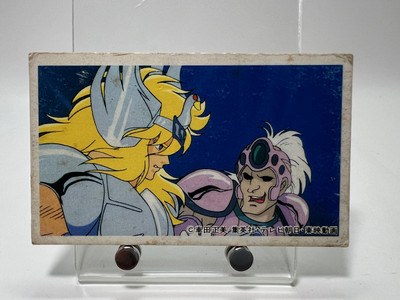
This card is a menko — a thick, rectangular piece of printed cardboard rooted in one of Japan’s oldest children’s games. Dating back to the Edo period, menko were traditionally slapped against the ground in a game where the goal was to flip your opponent’s card face-up. By the 1980s, the format had evolved into a canvas for full-color anime artwork, sold at candy shops and toy stores across Japan alongside snacks and stickers. This particular card features two of the most iconic warriors from Saint Seiya printed on a vivid blue background, and its copyright notice — crediting “Toei Doga” by the studio’s pre-1998 name — places its manufacture firmly between 1986 and 1998, most likely in the late 1980s during the height of the series’ popularity.
The Franchise and the Characters: Saint Seiya’s Gold Saints
Saint Seiya began as a manga by Masami Kurumada, serialized in Weekly Shonen Jump from December 1985 to November 1990. The anime adaptation aired on TV Asahi from October 1986 to April 1989, spanning 114 episodes and produced by Toei Doga (now Toei Animation). The story follows young warriors — the Saints — who don armor called Cloths, each modeled after a constellation, as they battle to protect the goddess Athena. The series blends Greek mythology, Buddhist imagery, and martial arts combat in a way that resonated deeply with boys growing up in 1980s Japan, and later found devoted followings in Brazil, France, Spain, Italy, and across Latin America.
This card showcases two of the Gold Saints — the twelve most powerful warriors in the series, each aligned with a sign of the Zodiac. Virgo Shaka, known within the story as “the man closest to God,” is depicted as a reincarnation of the Buddha, a contemplative figure with golden hair who famously keeps his eyes closed. Cancer Deathmask occupies the opposite end of the moral spectrum: a ruthless Gold Saint notorious for collecting the faces of his defeated enemies and displaying them on the walls of his castle. He is recognizable by his purple-toned Gold Cloth and the distinctive green jewel on his helmet. Together on a single card, these two characters represent a compelling contrast — the serene and the sinister — drawn from the Gold Saints arc that aired around 1987 to 1988.
Why Collectors Seek Out Menko from This Era
Menko are almost entirely absent from Western markets, making them a distinctly Japanese artifact for international collectors of Showa-era (1926–1989) pop culture. Unlike trading card games that emerged in the 1990s, menko predate that genre entirely — they are, in a sense, the cultural ancestor of the collectible card format in Japan. The visible edge wear on surviving examples like this one reflects genuine childhood use, which many collectors regard as evidence of authenticity rather than a flaw. The “Toei Doga” copyright credit is itself a period marker: the studio changed its name to Toei Animation in 1998, so any card bearing the older name is verifiably from the pre-1998 era. For fans of Saint Seiya — particularly those who grew up with the series in South America or Europe — a licensed card from the original broadcast years carries a direct connection to the moment the franchise first captured the world’s imagination.

Price: $7.67 | View on eBay