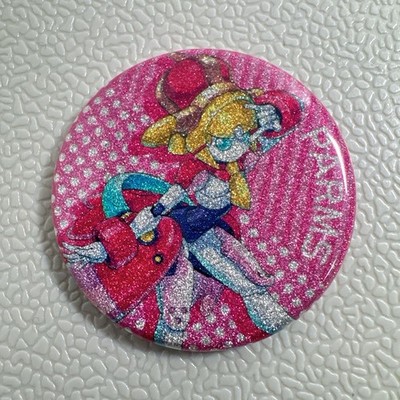
Parms Glitter Pin Badge from Medarot (Medabots)

Medarot: The Robot RPG That Crossed the Pacific
Medarot — known internationally as Medabots — is a robot battle RPG franchise developed by Imagineer, with its first Game Boy title releasing in 1997. The premise centers on “medals,” conscious entities that inhabit and pilot robotic bodies called Medarots, which players outfit with interchangeable parts across a series of battles. The concept had strong appeal with younger audiences in Japan, and its customization depth gave it staying power across multiple formats.
The television anime launched in July 1999 on TV Tokyo, running for 52 episodes, with a sequel series, Medarot Tamashii, airing from 2000 to 2001. A manga tie-in ran concurrently in Corocoro Comic, the magazine that served as a major franchise pipeline for elementary-school-aged boys throughout that era. Canadian distributor Nelvana brought the anime to English-speaking markets under the Medabots name, with toys handled by Hasbro and Takara, giving the franchise a genuine presence in North America and Australia.
A Badge from the Glitter Era of Anime Merchandise
The badge features Parms — identified by the text “PARMS” printed vertically along its right edge — depicted with blond hair, goggles, a red jacket, and a blue-and-white color scheme. Parms appears across the Medarot anime and games, though the character’s specific role within the franchise is better established from primary sources such as episode credits than from the badge alone.
As a physical object, this is a round pin badge with glitter finishing applied across its entire face, combined with what appears to be a holographic film or backing based on the listing description. That combination — glitter over a holographic surface — was a popular production technique for Japanese anime merchandise in the late 1990s and early 2000s. Badges of this type were typically sold through toy shops, candy stores, and capsule vending machines alongside bromide photo cards and printed stationery. While they were produced in quantity, glitter surfaces shed their metallic particles over time and are prone to discoloration, which makes well-preserved examples considerably less common today.
The specific release date for this badge has not been confirmed. The Medarot anime broadcast window between 1999 and 2001 is the most plausible production period, but a later reissue or event-exclusive origin cannot be ruled out. The manufacturer is also unknown based on available information; several companies, including Amada and Ensky, produced anime pin badges in this style during that era, and whether this is an officially licensed Imagineer product or otherwise is not determinable from the badge alone.
Why Collectors Outside Japan Seek Out This Kind of Merchandise
For English-speaking collectors, Medabots has a real nostalgic connection — it aired on television in North America and Australia and reached a genuine audience there. Japanese-market goods like this badge, however, were never part of that export. They were made for domestic distribution, carrying the visual language and retail format of late-1990s Japanese anime culture, which is itself an area of collector interest distinct from the franchise name alone.
Merchandise depth also plays a role. Production volume naturally favored protagonists and the most prominent characters, so goods featuring supporting cast members tend to surface less frequently in later years. Whether that applies precisely to Parms is difficult to confirm without production data, but the pattern holds consistently across anime collectibles from this period.


Comes straight from Japan — no middleman
$22.07
Ships internationally • More photos on the eBay listing