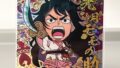
My Neighbor Totoro Official New Year Postcard for 2023 (Reiwa 5)

The Japanese Art of the Nengajo
Every autumn in Japan, printing companies, convenience stores, and post offices begin stocking nengajo — printed greeting cards sent to mark the arrival of the new year. The custom is deeply embedded in Japanese social life: people send them to family, friends, and colleagues, and recipients typically receive a stack of them on or around January 1st. Unlike a general-purpose holiday card, each nengajo is tied to the specific year ahead, and one of the most consistent design conventions is incorporating the upcoming year’s animal from the twelve-year Japanese zodiac cycle.
Character nengajo — cards bearing officially licensed anime or manga figures — are a mainstream category produced by print companies that hold rights from the originating studios. This card was produced by MYPRINT under an official Studio Ghibli license for the 2023 new year, recorded in Japan’s imperial calendar as Reiwa 5. It is a seasonal item by nature, distributed in the months preceding January 2023 and not reprinted afterward.
Totoro, the Trio, and the Year of the Rabbit
My Neighbor Totoro, directed by Hayao Miyazaki and released by Studio Ghibli in 1988, follows two sisters — Satsuki and Mei — who move to rural Japan and befriend a family of gentle forest spirits. The largest spirit, Ototoro, is a large blue-grey figure who became the studio’s most recognized character. Alongside him exist two smaller counterparts, including the tiny white Chibitoro. The film is among Ghibli’s most enduring properties, with merchandise produced continuously for more than three decades.
This card’s design is described as a Cute Trio composition: three figures sharing a single postcard face against a warm autumnal background of leaves and berries. Two of the three are identifiable as Ototoro and Chibitoro. The third is described as white and rabbit-like — and here the zodiac comes into play. Because 2023 is the Year of the Rabbit (Usagi), nengajo designers routinely work the zodiac animal into their artwork. Whether this third figure is Chuutoro (the mid-sized Totoro) reinterpreted in a rabbit-themed form, or a separate rabbit character altogether, is not definitively established. Either way, the connection to the Year of the Rabbit is intentional and follows the established grammar of nengajo design. The card also carries the printed wish “I hope this becomes a joyful year” — a phrase chosen to match the warmth of the Totoro world rather than a standard holiday formula.
A Paper Collectible at the Intersection of Two Traditions
For collectors outside Japan, nengajo occupy a genuinely unusual niche. They are official licensed goods — this card carries the Studio Ghibli copyright mark — but they belong to a format that has no real equivalent in most other countries. The nengajo is not a poster, not a trading card, and not a greeting card in the Western sense; it is a culturally specific artifact tied to one of Japan’s most important annual rituals.
The year-specific nature of the format also matters. A 2023 Reiwa 5 design exists because it was made for that year’s new year period. The zodiac animal rotates through a twelve-year cycle, so this particular combination of Totoro characters and rabbit motif will not appear again in the same form. For fans of My Neighbor Totoro and for collectors drawn to Japanese paper goods as a category, this kind of item sits at a distinct crossroads: officially licensed Ghibli merchandise that is also a document of Japanese seasonal culture.


Listed in our eBay store and sent from Japan
$10.11
International shipping available • Ask us anything before you buy