Ultra Q Gomez Menko Card: A Piece of Japan's First Kaiju Boom

What Is a Menko Card — and Why Does This One Matter?
This listing is for a vintage Japanese menko card featuring Gomez, the monster from the 1966 tokusatsu television series Ultra Q. Menko are small, thick cardboard cards with a history stretching back to the Edo period. By the time they were standardized into the rectangular format common today, they had become a staple of Japanese children’s street games: players would slap their cards against the ground, using the shockwave to flip an opponent’s card face-up, winning it in the process. Characters who looked powerful — monsters, wrestlers, baseball heroes — were the most sought-after, which made kaiju menko an easy sell during Japan’s first great monster craze.
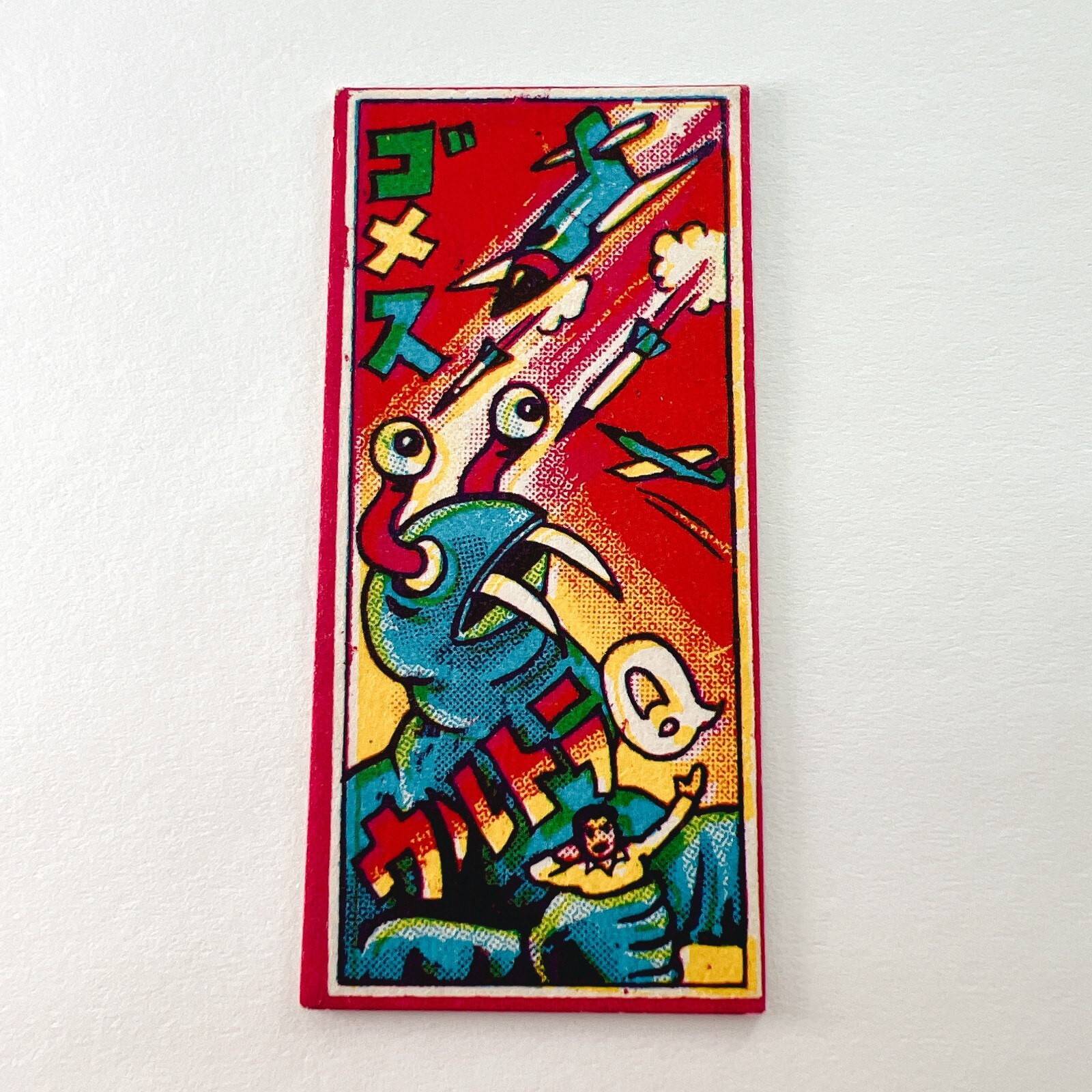
This card carries the bold graphic style typical of Showa-era mass printing: a red border, red background, blue-green monster illustration, and the katakana name “Gomez” printed large across the design. Combat aircraft and rockets appear alongside the creature — a scene pulled directly from the events of Ultra Q’s first episode. The halftone dot printing visible in the card’s artwork is characteristic of the cost-efficient, high-volume production methods used by the many small printing houses that flooded the market with character merchandise in the mid-1960s. The specific manufacturer has not been identified, which is common for items from this period: Tsuburaya Productions’ licensing oversight was considerably looser in its early years, and many manufacturers — large and small, licensed and otherwise — entered the market simultaneously.
Ultra Q, Gomez, and the Birth of the Ultra Series
Ultra Q premiered on TBS on January 2, 1966, produced by Tsuburaya Productions. Running 28 episodes in black-and-white, it was the first entry in what became the Ultra Series — the franchise that would soon introduce Ultraman (July 1966) and Ultra Seven (1967). Unlike those later shows, Ultra Q had no giant superhero; human characters used science and ingenuity to confront monsters and supernatural phenomena, in a style closer to science fiction anthology drama. Ratings routinely reached the 30% range, marking the series as a cultural phenomenon and the spark of Japan’s first large-scale kaiju boom.
Gomez holds a specific distinction within that history: he is the very first monster to appear in the Ultra Series, debuting in Episode 1, “Defeat Gomez!” A subterranean dinosaur-type creature, he surfaces through lava and withstands a sustained military assault before being defeated. From a production standpoint, Gomez is widely noted — with some variation in the details — as having been built from a modified existing Godzilla suit from Toho’s film library, which accounts for the visual similarities between the two monsters that kaiju enthusiasts often note.
Why Collectors Around the World Pay Attention to Items Like This
The Ultra Series has been broadcast across North America, Southeast Asia, and Europe, giving it genuine international recognition beyond Japan. Gomez draws particular interest from two overlapping audiences: fans of the Ultra franchise who recognize his place as the series’ first-ever monster, and tokusatsu researchers drawn to the documented connection to the Toho Godzilla suits. Beyond character identity, the card itself represents a specific visual and material culture. Showa-era menko were everyday, disposable children’s items — produced cheaply, played with hard, and rarely preserved carefully — which means examples that have survived nearly sixty years in presentable condition are genuinely uncommon. The graphic design sensibility of the period, with its vivid halftone printing and bold red-and-black layouts, has also found appreciation among collectors of Japanese pop art and mid-century ephemera in Western markets, where this style is increasingly recognized as a distinct aesthetic of the postwar Showa decades.


Price: $10.65 | View on eBay