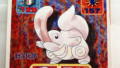
Ultraman Vintage Menko Card: A Showa-Era Japanese Kaiju Battle Collectible

What Is a Menko Card — and Why Ultraman?
This card is a menko — a thick, printed cardboard playing piece rooted in Japanese children’s culture stretching back to the Edo and Meiji periods. The game is simple: players slap their cards onto a surface, trying to flip their opponent’s cards face-up to win them. By the late 1950s and through the 1970s, character menko had become a phenomenon of their own, featuring sumo wrestlers, baseball stars, anime heroes, and — most visibly — the giants of tokusatsu television. This card belongs to that golden era, depicting Ultraman and kaiju imagery in the multicolor offset halftone printing that defined Japanese mass-print graphics of the 1960s and 1970s.
The katakana text reading “Ultra” is printed directly on the card, linking it clearly to the Ultraman franchise produced by Tsuburaya Productions. Based on the printing style and visual aging, the card is consistent with manufacture during the 1960s–70s Showa period, though pinpointing an exact year or manufacturer would require the reverse side’s publisher markings. Major producers of character menko in this era included Amada and Yamakatsu, among many smaller publishers and toy wholesalers who flooded the market during the franchise’s peak years. The specific series — whether the original Ultraman (1966–67) or one of its Showa successors — cannot be confirmed without additional card details, though the original series remains the most likely candidate.
The Ultraman Universe and the Kaiju That Defined It
The Ultraman franchise launched in July 1966 on TBS, following directly from Ultraman Q (known as Ultra Q), which had aired earlier that year. The original series ran 39 episodes and introduced one of tokusatsu’s most enduring figures: Ultraman, a 40-meter alien warrior from the Land of Light in Nebula M78, who merges with a member of the Science Patrol defense team named Hayata to battle threats to Earth. His color timer — the blinking light on his chest — signals dwindling energy, adding urgency to every fight. The series introduced more than 30 distinct kaiju across its run, including iconic creatures like Baltan, Red King, Gomora, and Zetton. The two figures in military-style uniforms visible on this card are consistent with members of a defense team, likely the Science Patrol or a counterpart from a later Showa series.
The franchise expanded across multiple Showa-era sequels: Ultraseven (1967–68), Return of Ultraman (1971–72), Ultraman Ace, Taro, Leo, and 80, among others. Each series deepened the lore and added new kaiju, fueling what became a genuine cultural phenomenon — a “kaiju boom” that drove demand for toys, stationery, food premiums, and paper goods including menko.
Why Collectors Around the World Seek These Out
Ultraman has maintained an international fanbase well beyond Japan, with dedicated tokusatsu collectors active across Southeast Asia, Taiwan, Korea, North America, and Europe. Showa-era paper goods like menko present a particular interest: sold primarily through small neighborhood candy shops called dagashi-ya, they were consumable, everyday items — not preserved as keepsakes — which means surviving examples in good condition are genuinely uncommon today. The halftone printing style carries a distinct retro Japanese graphic quality that resonates with collectors drawn to vintage Japanese pop culture aesthetics. For tokusatsu enthusiasts specifically, a kaiju battle composition is among the most visually striking formats menko imagery offered, capturing the defining dramatic tension of the entire franchise in a single small card.


Price: $10.39 | View on eBay