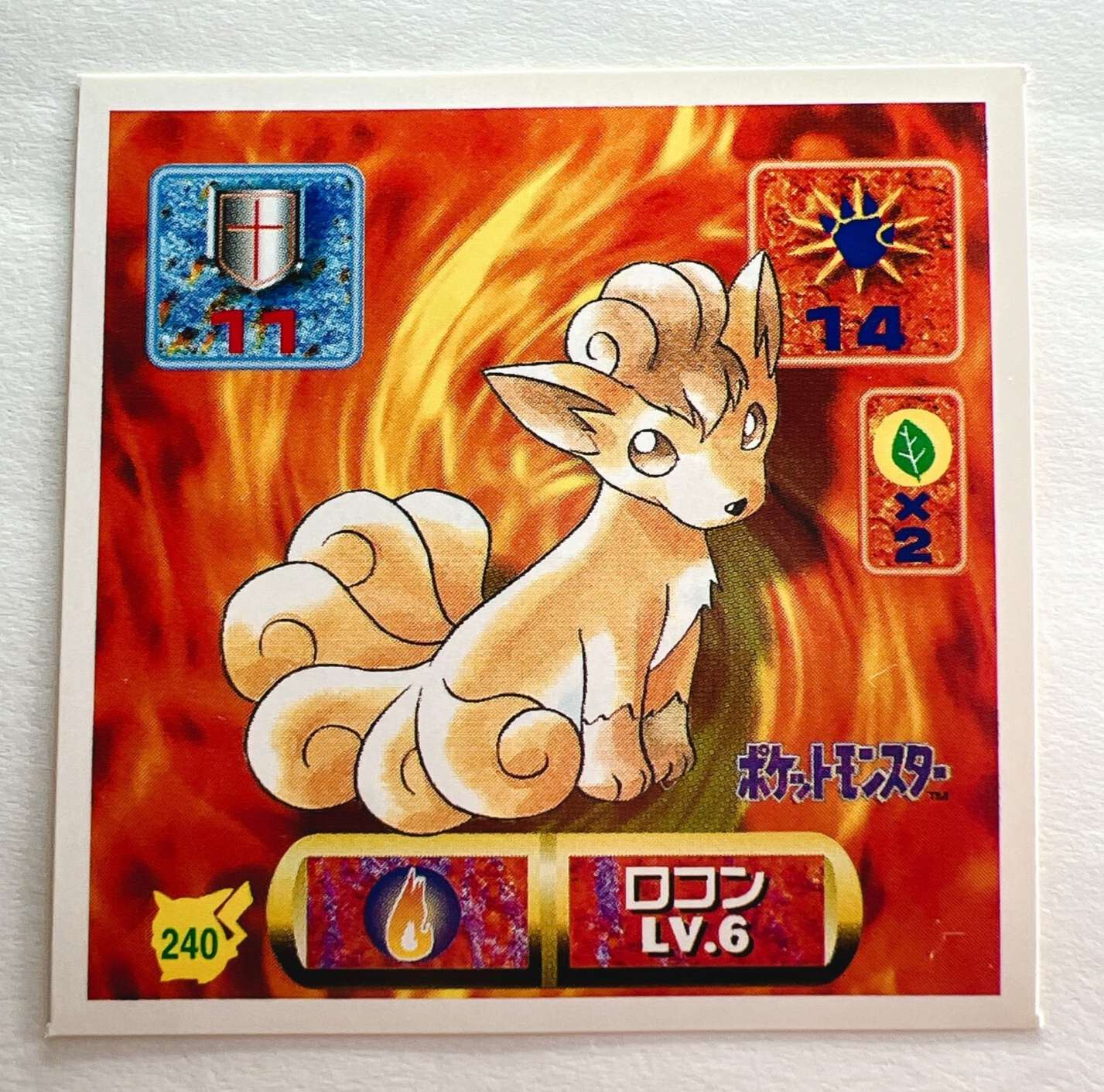
Vulpix No. 240: A 1997 Amada Pokemon Collector Sticker

Amada and the Art of the Collector Sticker
Before trading cards became the dominant Pokemon collectible in the West, Japan had a thriving culture of character stickers. Amada — a Japanese manufacturer known throughout the 1990s for licensing popular properties including Dragon Ball, Sailor Moon, and Neon Genesis Evangelion — produced some of the most recognizable of these. Their Pokemon sticker series combined the visual identity of the franchise with compact, card-like data displays: each sticker shows the Pokemon’s level, type symbol, and a set of numerical parameters unique to Amada’s own format. That data is not pulled directly from the Pokedex — it is a visual language Amada developed to give each sticker the feel of a stat card, printed on sticker material with a clean white border designed for the collector.
The “No. 240” designation marks this sticker’s position within Amada’s internal series numbering, not Vulpix’s Pokedex number, which is 37. A series reaching at least 240 entries signals a substantial lineup, most likely drawn from the original 151 Pokemon that defined the first generation of games — though whether the series numbering maps directly to Pokedex order remains uncertain. The Pikachu silhouette printed at the base of the sticker is a shared design element across the Amada series, functioning as a kind of visual signature for the product line.
Vulpix at the Height of the Pokemon Boom
Vulpix — known in Japan as Rokon — is a Fire-type Pokemon from the original Red and Green games, released in Japan on February 27, 1996. Fox-inspired in design, it features a red-brown body and a cluster of curled tails that eventually number nine upon evolution into Ninetales. As one of the original 151, Vulpix was present from the very beginning of the franchise. The anime gave the character an especially memorable moment: a Pokemon groomer named Suzie owns a Vulpix, and their partnership became a notable episode in the first series.
By 1997 — the year this sticker was manufactured — Pokemon had grown from a Game Boy title into a full commercial wave. The anime began airing on April 1, 1997, and the combination of games, animated series, and the trading card game (launched October 1996) created a feedback loop that drove an enormous expansion of licensed merchandise. Amada’s sticker series was one product among many entering the market that year, alongside offerings from Bandai and others, but it occupied a distinct category: a standalone collector sticker sold through toy shops, stationery stores, and candy retailers rather than bundled with food.
A Japanese Exclusive With a Global Following
Amada’s Pokemon stickers were sold through Japanese domestic channels and never officially distributed in English-speaking markets. Western fans of the same era were more likely to encounter Topps products, meaning the two markets developed in parallel with different manufacturers and aesthetics. For international collectors, Amada stickers offer a view into what Japanese fans were buying at the franchise’s commercial origins — a category of merchandise that existed entirely outside the Western release timeline.
Vulpix’s appeal among Pokemon fans has remained consistent across generations, and the character carries a strong following in both Japan and abroad. Sticker materials are susceptible to aging — yellowing, peeling, and creasing are common — and items from nearly three decades ago that have held their condition are increasingly hard to come by.


Comes straight from Japan — no middleman
$7.86
Ships internationally • More photos on the eBay listing