Coca-Cola Japan's Hajime Green Tea Farmhouse Mini Diorama

A Promotional Novelty Rooted in Japan’s Tea Culture
This small self-contained diorama is a promotional novelty item created in connection with a Coca-Cola Japan green tea beverage. The name “Hajime” — which appears in the listing — may refer to the green tea brand itself or to the name of the diorama series; the available information does not allow a definitive answer either way. What is clear is that this piece is not a licensed character figure tied to any anime, manga, or game franchise. It is an original work produced to support Coca-Cola Japan’s marketing efforts in the green tea beverage category.
Coca-Cola Japan has operated multiple tea-based drink brands since the early 1990s, including Sokenbicha (launched 1993) and Ayataka (launched 2007), and has a well-documented history of producing novelty giveaways to support those brands during the 2000s and 2010s. Whether this diorama was distributed as a purchase bonus, a point-redemption reward, or an event item is not confirmed — but its character as a corporate promotional piece rather than a retail product is consistent with the broader tradition of Japanese beverage novelties. The connection between a rural farmhouse setting and a green tea brand is deliberate: tea in Japan is grown in agricultural communities, and the imagery reinforces that origin story.
Life in the Farmhouse: What the Scene Depicts
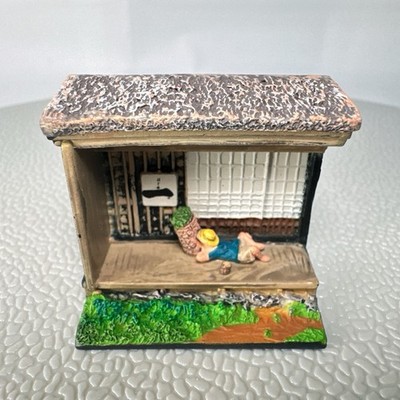
The diorama presents a quiet moment from traditional Japanese rural life. A figure dressed in blue clothing and a straw hat lies resting beside a thatched-roof farmhouse — an image that reads immediately as a summer afternoon break during the harvest season. Bundles of crops placed nearby deepen the agricultural context. The base combines grass and a dirt path, and the structure features shoji-style sliding windows alongside a characteristically rustic interior, pointing to a Japanese farming household from the pre-Showa era or earlier.
A black horizontal mark on the left wall — which could be a family crest, shop emblem, brand logo, or decorative motif — adds an element of ambiguity that the piece alone cannot resolve. The overall composition draws on a visual language that Japanese audiences recognize immediately: furusato imagery, the nostalgic warmth of a countryside that has largely given way to modern urbanization. That aesthetic, sometimes labeled “Showa retro” in Japanese collector circles, is precisely the emotional register the piece was designed to evoke.
Japanese Beverage Novelties and Their Place in Collector Culture
Japan has a long tradition of food and beverage companies producing collectible novelty figures as promotional items. The term shokugan technically refers to items packaged with candy or snacks, but beverage novelties like this diorama occupy an adjacent space that international collectors often group together under the label of “Japanese mini figures.” The manufacturing material appears to be a hard resin or ABS-type plastic, though this has not been officially confirmed, and the specific manufacturer is not identified in the available record.
Within collector communities, Coca-Cola Japan items occupy a distinct niche. Global Coca-Cola collectors have long sought out Japan-market exclusives, and pieces that combine the brand with traditional Japanese visual themes carry particular appeal for that audience. For miniature and diorama enthusiasts, the level of integration on display here — architecture, landscaping, a human figure, and props all unified on a single base — places this piece closer to scale modeling than to typical branded merchandise, broadening its interest beyond the beverage-collectible category alone.


Boxed and cushioned for the trip from Japan
$14.07
Ships worldwide from Japan • Full photos and details on the listing