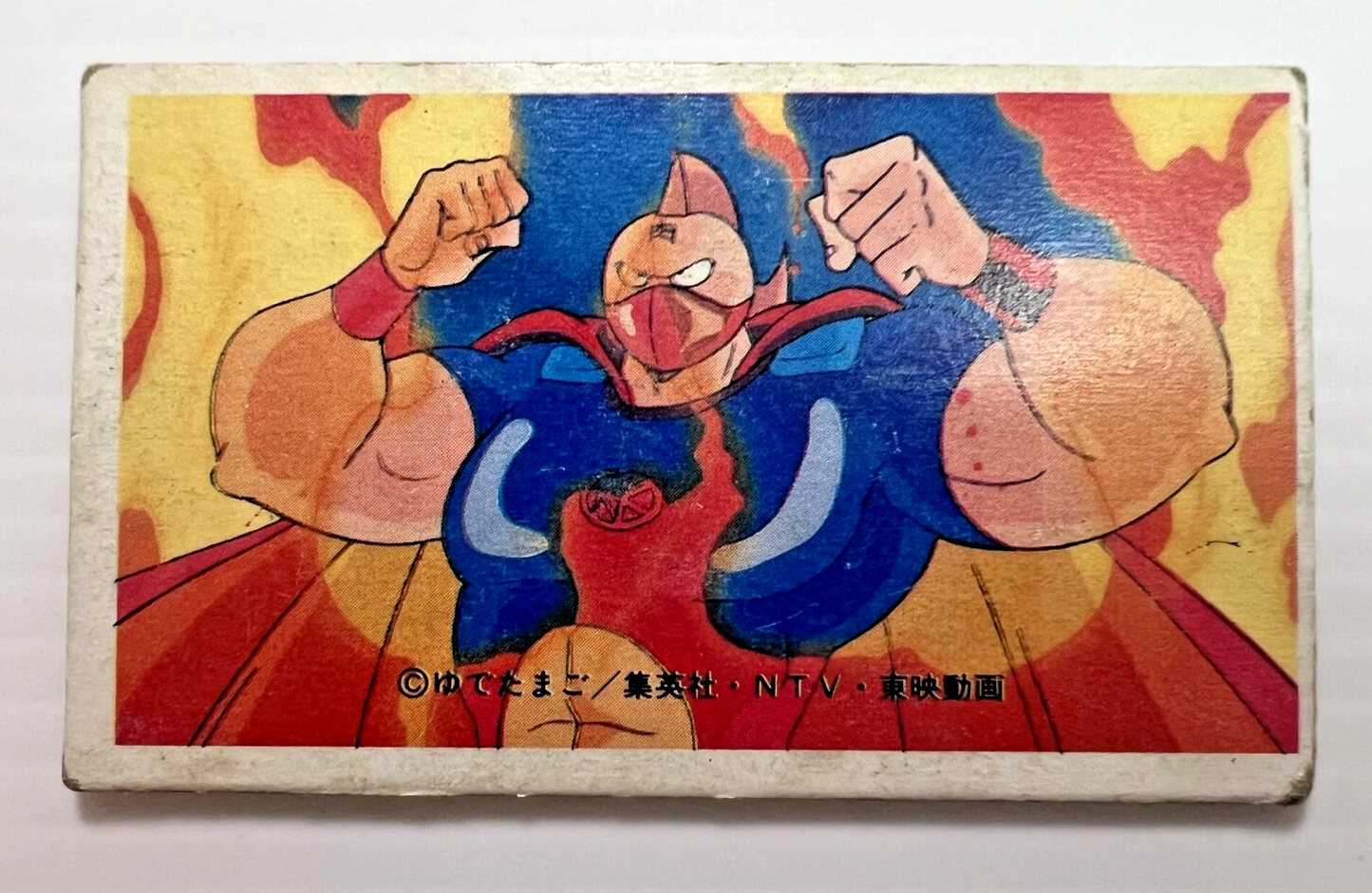
Kinnikuman Vintage Anime Menko Card, 1980s Japan

A Traditional Game Card Transformed by Anime
Menko are thick cardboard playing cards with roots in Japan’s Edo period. The game is physical and direct: players slam their cards against the ground, trying to flip an opponent’s card over to claim it. By the postwar Showa decades, manufacturers were printing menko with popular anime characters, sports stars, and heroes, selling them through dagashiya — the penny candy shops that anchored every Japanese neighborhood — as well as at stationery and toy stores. Priced for children’s pocket money, they were bought casually and played hard.
This card is an officially licensed Kinnikuman menko from the 1980s, confirmed by its copyright notice crediting Yudetamago, Shueisha, NTV, and Toei Animation. That combination of rights holders points directly to the television anime, which ran on NTV from 1983 to 1986. The menko format itself never traveled abroad the way some Japanese toys did — it remained entirely a domestic product — making it a Japan-only artifact of Showa pop culture.
Kinnikuman: The Bumbling Prince Who Became a Legend
The Kinnikuman franchise launched in 1979, when the manga duo Yudetamago — Yoshinori Nakai and Takashi Shimada — began serializing it in Weekly Shonen Jump. The premise blends superhero mythology with professional wrestling spectacle. Kinnikuman, whose real name is Kinniku Suguru, is the crown prince of a distant planet called Kinniku Star and Earth’s chosen hero chojin (superhuman). He fights through tournaments and tag-team arcs against a revolving cast of bizarre, imaginative opponents, each with their own signature move. Toei Animation brought the series to television across 126 episodes, and the broadcast years overlap precisely with this card’s production.
The figure depicted here is Kinnikuman himself, in his defining visual form: blue-and-red fighting suit, red cape, and the kanji for “meat” — pronounced niku — stamped on his forehead. That forehead mark is one of manga’s most enduring jokes: Kinnikuman began the series as a clumsy, reluctant hero whose planet of origin, whose name, and whose greatest obsession all center on meat. The mark became his signature, and any card or figure bearing it is immediately legible to fans. The yellow background with flame-like effects and a powerful pose reflects the high-energy register of the anime’s superhuman showdowns.
Why International Collectors Connect With This Era
For collectors outside Japan, the entry point is often M.U.S.C.L.E. — the line of small pink rubber figures that Mattel released in North America starting in 1985. Those figures were based directly on Kinkeshi, the eraser-like rubber figurines sold in Japan during the same broadcast years as the anime. Millions of Western children grew up with M.U.S.C.L.E. without ever knowing they were handling a localized version of a Japanese franchise. That generation has since traced the toys back to their source, and interest in original Japanese licensed merchandise from the period follows naturally.
A menko card sits in a category those collectors rarely encountered: a format exclusive to the Japanese market. Unlike the Kinkeshi, menko were never part of any international licensing arrangement. They are domestic artifacts from the height of the franchise’s cultural moment — the mid-1980s, when Kinnikuman merchandise filled dagashiya shelves alongside shaved ice and cheap candy. By the late 1980s, menko culture had already begun to fade, displaced by Bikkuriman stickers and the emerging Carddass card format. That shift gives surviving pieces from this period a particular place in the timeline of Showa children’s culture, marking the last years when the traditional game-card format held the center of the market.

Comes straight from Japan — no middleman
$7.86
Ships internationally • More photos on the eBay listing