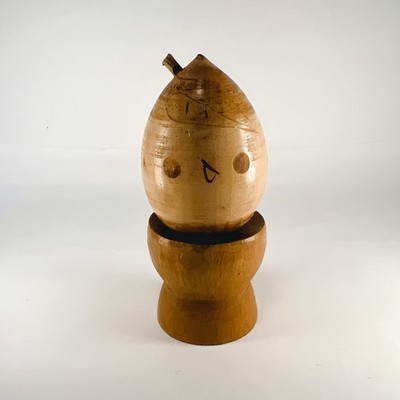
Onion-Shaped Kokeshi Mascot with Twig Top, Japanese Handpainted Folk Art

A Kokeshi Unlike the Standard Cylinder
A kokeshi is one of Japan’s most recognizable folk objects: a lathe-turned wooden figure with a simple round head and cylindrical body, its face reduced to a few painted strokes. This particular piece belongs to the subcategory known as a mascot kokeshi — a smaller, more freely interpreted version that circulated as a souvenir and decorative object throughout Japan. What distinguishes it is the form: rather than a cylinder, the body rounds into an onion shape, and a natural twig is fitted into the top to represent the vegetable’s stem. The face is simple and hand-painted — dot eyes, an inverted V for a mouth — applied over wood that shows its natural grain. The darker-toned cap at the crown may reflect a deliberate wood selection, scorching, or a separate coloring process; the exact technique cannot be confirmed from the piece alone.
In the vocabulary of kokeshi collectors, this kind of piece falls into the sosaku (creative) category, as opposed to the dentou (traditional) style that strictly follows regional conventions. A vegetable-form kokeshi with a real botanical detail sits comfortably in the work of folk artists who drew on local agriculture and the natural world for their subject matter. There is no connection to a specific media franchise, anime, or toy line — this is purely a craft object.
From Tohoku Spa Towns to the Wider Souvenir World
Kokeshi originated in the spa resort towns of Japan’s Tohoku region — Miyagi, Iwate, Yamagata, Fukushima, Akita, Aomori — during the late Edo and early Meiji periods, roughly the first half of the nineteenth century. The craftspeople who made them, kijishi, were woodworkers supplying bath-resort visitors with turned wooden goods; the small dolls became their most lasting souvenir. Regional styles diverged over generations into distinct schools, each with its own conventions for shape, face, and decoration.
The mascot kokeshi, with its looser take on the traditional form, spread widely during Japan’s Showa era (1926–1989), particularly through the postwar tourism boom and the economic growth of the 1950s–70s. The creative kokeshi movement built momentum from the 1960s onward, with individual artists producing dolls shaped after plants, animals, and regional foods. A vegetable-shaped piece with an agricultural motif fits squarely within that tradition.
No specific manufacturer, brand name, or production series is associated with this piece. Like many creative and mascot kokeshi, it appears to be the work of an individual folk artisan or small anonymous workshop. Whether it carries a maker’s mark or provenance certificate cannot be determined from the available information.
What Draws Collectors to Creative Kokeshi
For collectors of Japanese folk craft, a piece like this has several points of interest. Because the face is painted by hand and the body carved individually, no two examples from this tradition are identical — each carries the small variations that separate handmade objects from factory goods. The onion silhouette is genuinely uncommon: even within the broad world of mascot and creative kokeshi, a vegetable-form piece with an actual twig for a stem occupies unusual ground between folk toy and folk sculpture.
Kokeshi have attracted increasing international attention as Japan’s traditional crafts reach wider audiences. Twelve categories of traditional kokeshi carry national craft designation in Japan, and the form is one of the country’s most legible folk art exports, often introduced overseas simply as a “Japanese wooden doll.” A piece that sits at the intersection of that recognized tradition and the more individualistic creative kokeshi world offers international collectors something visually distinctive while remaining rooted in a genuine craft history.


Found in Japan, packed by hand, sent worldwide
$17.93
Worldwide delivery from Japan • See the listing for condition and size