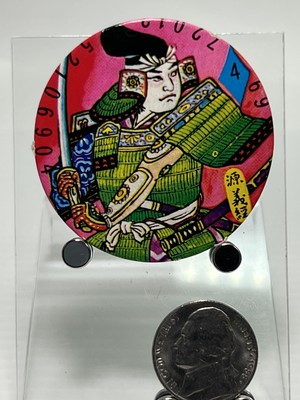
Yoshitsune Minamoto Round Menko Card

Menko: Japan’s Original Street Card Game
Menko are thick cardboard game cards that were a fixture of post-war Japanese childhood. The gameplay is elemental: players slam their cards face-down onto the ground, trying to flip the opponent’s card using the resulting air pressure or direct impact. Winning means keeping whatever you flip. Cards were sold a few at a time at dagashi-ya — small neighborhood candy-and-toy shops that defined street-level commerce across Showa-era Japan.
This card is round, a format known as maru-menko. Circular menko became especially common during the middle and later Showa period, roughly the 1950s through 1970s. The printing style, vivid primary colors against a pink background, is consistent with the multicolor lithography of that era. One genuine caveat worth knowing: the number “2010” printed on the card could be a Showa-era catalog or series code, but it cannot be ruled out that it refers to the year 2010, which would make this a later reprint rather than an original vintage card. That ambiguity is real, and no specific series name can be confirmed from the codes visible on the card.
Samurai subjects were staples of menko alongside baseball players, wrestlers, and anime characters — and Yoshitsune Minamoto was among the most frequently depicted figures of the entire genre.
The Legend of Yoshitsune Minamoto
Yoshitsune Minamoto (1159–1189) stands as one of the most compelling and widely retold figures in Japanese history. As the brilliant younger half-brother of Minamoto no Yoritomo, he commanded the military campaign that ended the Genpei War and destroyed the Taira clan. His victories at the battles of Ichi-no-Tani, Yashima, and Dan-no-Ura (1184–1185) were decisive turning points in the formation of Japan’s first samurai government.
His ending made him legendary in a different way. After those victories, Yoritomo turned against him, and Yoshitsune spent his final years as a fugitive pursued across the country. He died by his own hand at Hiraizumi in 1189, aged thirty. This arc — battlefield genius, political betrayal, early death — gave rise to the concept of hangan-biiki: the Japanese cultural reflex of deep sympathy for a talented person destroyed by circumstance. That identification has never faded.
Yoshitsune has been retold through Noh theater, Kabuki, puppet plays, NHK historical dramas, and anime across every era since. The visual conventions surrounding him are centuries old and largely fixed: green-and-gold armor, a slender build, a handsome face. This card follows that tradition exactly, depicting him in the stylized manner that Japanese audiences have recognized for generations.
Samurai Menko and the Collectors Who Seek Them
Menko never left Japan. Unlike trading cards designed for international markets, they were a purely domestic toy culture — sold at neighborhood shops, played in schoolyards, never exported. That makes surviving examples of particular interest to collectors looking for something genuinely outside the Pokemon and Magic: The Gathering traditions. The format itself, the gameplay, and the distribution chain were all specific to Japan.
Yoshitsune’s story also travels well beyond Japan’s borders. His reputation as a brilliant and doomed commander has drawn English-language novelists, historians, and game designers for decades, giving him a recognition level that few medieval Japanese figures can match internationally.
The Showa printing aesthetic — saturated primary colors, bold outlines, stylized figures on vivid grounds — has become a recognizable visual language among fans of vintage Japanese design. Whether this card dates to the height of the menko industry in the 1960s or to a later period, it carries that visual identity intact, alongside the story of one of Japan’s most enduring historical figures.

Shipped directly from Japan by a small shop
$7.86
Ships worldwide from Japan • Full photos and details on the listing