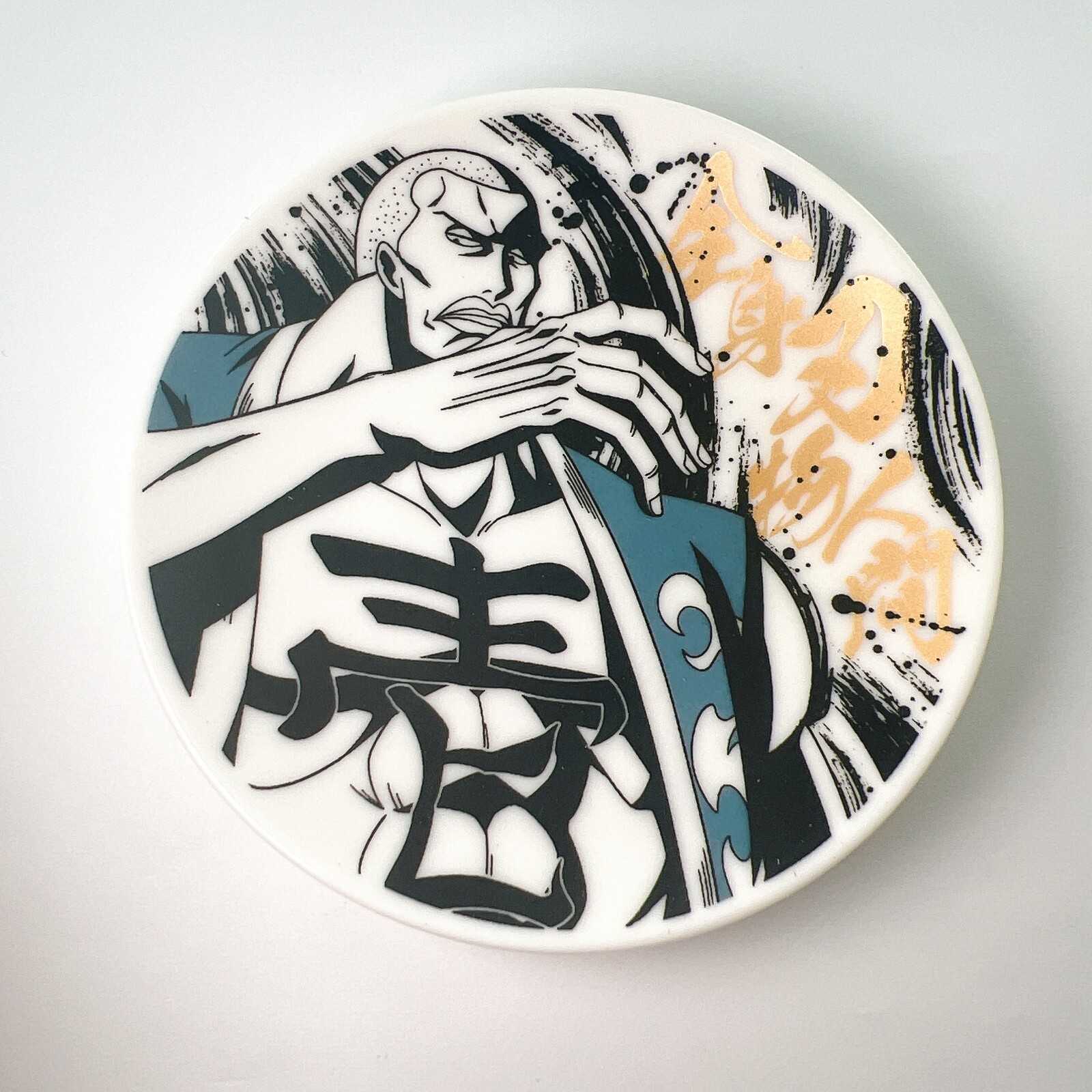
Daz Bones (Mr.1) Ichiban Kuji Prize I Small Plate by Bandai

Ichiban Kuji and How This Plate Came to Exist
Ichiban Kuji is Bandai’s official store-lottery merchandise line, sold one ticket at a time at convenience stores and hobby shops across Japan — Seven-Eleven, Lawson, and FamilyMart are among the primary retail partners. Each lottery assigns prizes by letter rank, typically from A through to a “Last One” grand prize, spanning product types as varied as large figures, towels, rubber straps, and small ceramic plates like this one.
This dish is a Prize I, which sits toward the later letters in the lineup. That position means it falls among the more readily available prizes within a given lottery run, though how many copies are distributed always depends on that specific lottery’s structure. The plate itself is round and ceramic, with a printed illustration of Daz Bones set against bold ink-brushstroke background elements and gold Japanese calligraphy reading “zantetsu” — loosely, “iron-cutting.” A large kanji character for “san” (three) appears prominently across the design as well. Its precise significance in this context is uncertain, but the overall aesthetic draws heavily on classical Japanese brushwork.
Because Ichiban Kuji runs exclusively through Japanese retail channels, there is no official path for international buyers to access these products at the point of sale. Outside Japan, they circulate primarily through importers and resellers.
Daz Bones and the Arc That Defined Him
One Piece has been running in Weekly Shonen Jump since 1997, created by Eiichiro Oda. The manga has surpassed 500 million copies in worldwide circulation — a Guinness World Records holder — and the anime adaptation, which began on Fuji TV in 1999, has built a following across North America, Europe, Southeast Asia, and Latin America.
Daz Bones, known within the criminal syndicate Baroque Works by the code designation Mr.1, is the organization’s strongest male agent. His Devil Fruit ability — the Dice-Dice Fruit — lets him transform any part of his body into steel blades. The calligraphy on the plate, “zantetsu,” refers directly to this power: blades capable of cutting through iron itself.
He appears during the Alabasta arc, which ran in the manga from roughly 1999 to 2002 (volumes 17–24) and aired in the anime around 2001–2002. His battle against Roronoa Zoro is widely regarded among One Piece fans as one of the series’ standout fights — the moment Zoro pushes past his limits and learns to cut steel, a turning point that Zoro fans cite frequently when tracing his growth as a swordsman. Which specific Ichiban Kuji series this plate belongs to, and when it was released, is not confirmed from available information.
The Broader Appeal of a Ceramic Collectible
Daz Bones is a secondary character, but one with an unusually strong visual identity: shaved head, impassive expression, and a body that becomes entirely blade. Within Baroque Works, he is the most physically formidable male agent, and his confrontation with Zoro stands out even in a series built around memorable battles.
Ceramic dishware occupies a different space in collecting than PVC figures. A plate can sit on a shelf, be mounted on a wall, or actually be used — a genuine dual-purpose object. The ink-and-gold calligraphy design also speaks to an audience interested in Japanese visual culture beyond anime fandom alone. And as an officially licensed Bandai product, it carries the manufacturing quality and design standards expected from a major character merchandise release.


Comes straight from Japan — no middleman
$14.07
Ships internationally • More photos on the eBay listing