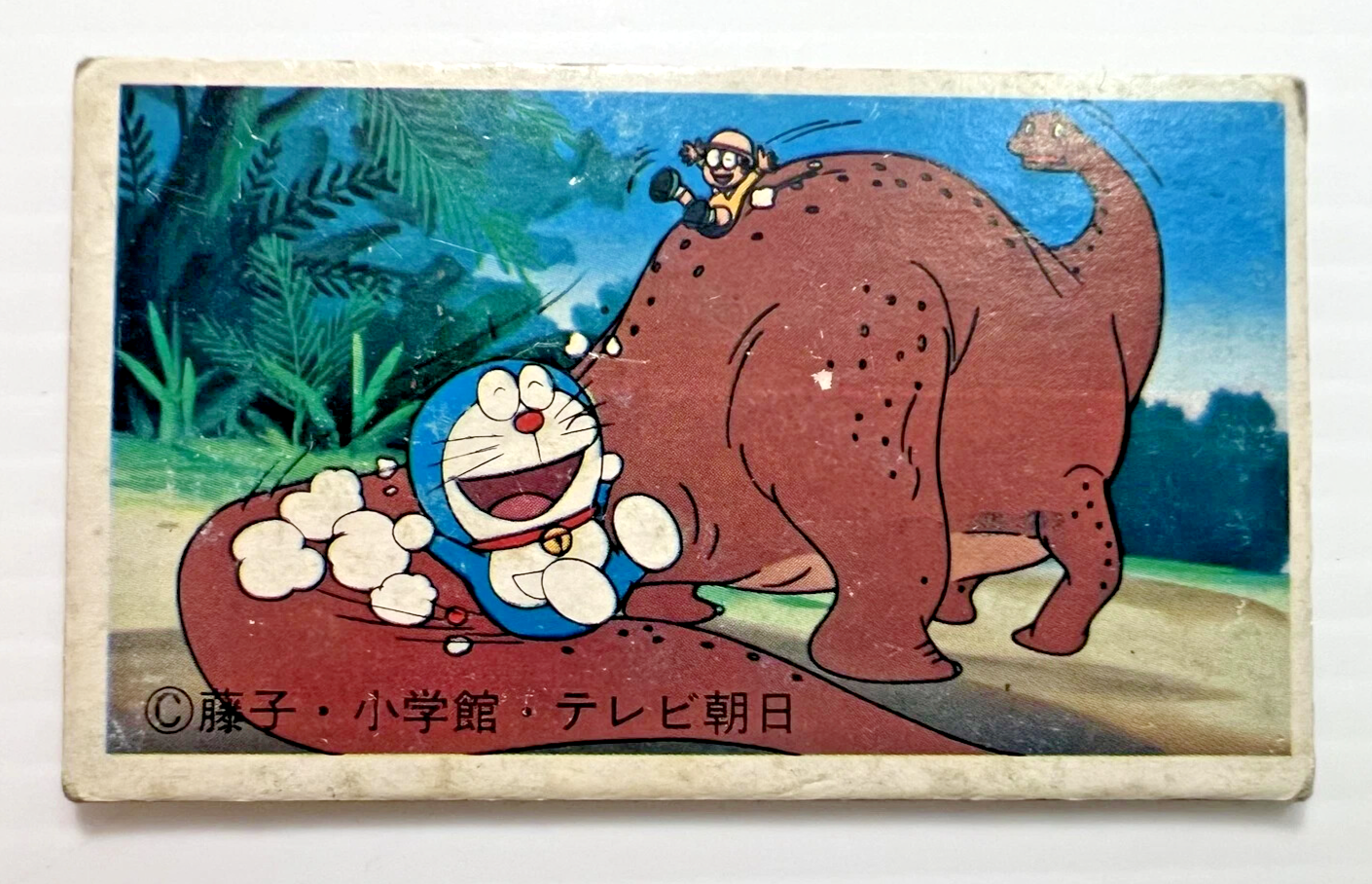
Doraemon Character Menko Card, 1980s

What Menko Cards Are and How They Were Played
Menko are flat, thick cardboard cards rooted in a Japanese children’s street game that dates back centuries. The rules are simple: players take turns slapping their card against a stack on the ground, and any card that flips over is theirs to keep. The physical force required means surviving menko often carry visible history — rounded corners, surface scuffs, faint soiling. On a card like this one, that kind of wear is consistent with actual gameplay, not poor storage.
By the late 1970s, toy makers were printing anime and manga characters onto menko in large quantities. They were sold at dagashi-ya (traditional Japanese candy stores), toy shops, and convenience stores — inexpensive, plentiful, and aimed squarely at children. The specific manufacturer of this card cannot be identified from the printing alone; the market included multiple producers such as Epoch, Bandai, Tenryu, and Maruka. What can be confirmed is the licensing: a copyright line credits Fujiko Pro, Shogakukan, and TV Asahi, establishing this as an officially licensed product rather than an unofficial reproduction.
Menko-playing declined sharply in the late 1980s as children’s entertainment shifted indoors. That relatively swift cultural disappearance is part of what draws collectors to surviving examples from this window in Showa-era Japanese toy history.
Doraemon’s TV Asahi Era and What This Card Represents
Doraemon was created by manga artist Fujiko F. Fujio — the pen name of Hiroshi Fujimoto — and first appeared in Shogakukan’s children’s magazines in 1969. The series follows Doraemon, a blue, earless cat-robot from the 22nd century, who travels back in time to help Nobita Nobi, an accident-prone elementary schoolboy. Doraemon assists by producing futuristic gadgets from the “four-dimensional pocket” on his belly, with results that are typically comic.
A short-lived adaptation aired in 1973, but the series that defined the franchise for a generation launched on TV Asahi in April 1979, produced by Shin-ei Animation. This run — with voice actress Nobuyo Oyama as Doraemon — continued until 2005 and is widely regarded as the series’ golden age in Japan. The three-party copyright on this card (Fujiko Pro, Shogakukan, TV Asahi) was the standard licensing format for officially sanctioned merchandise from that era, and the illustration style reflects the character artwork of the early 1980s — visibly different from the redesigned look the franchise adopted in 2005. Annual theatrical films began in 1980, and the merchandise market, including character menko, expanded significantly in parallel with that popularity surge.
The Dinosaur Illustration and Its Possible Connection to the Films
The card’s illustration shows Nobita riding atop a large, long-necked brown dinosaur in a jungle setting, with Doraemon positioned near the animal’s lower body. This image connects plausibly to Doraemon: Nobita’s Dinosaur (Nobita no Kyoryu), the first annual theatrical film, released in 1980. That film follows Nobita as he hatches a plesiosaur named Pisuke from a fossil egg and ultimately returns him to the prehistoric era.
One detail is worth noting honestly: Pisuke is a marine plesiosaur, while the card depicts what appears to be a land-dwelling sauropod against a jungle backdrop. Whether this represents a loose thematic adaptation of the film for merchandise, a general “dinosaur adventure” motif that menko illustrators used independently of any specific episode, or something else entirely, cannot be determined from the card alone. Character menko of this period frequently used imaginative composite illustrations rather than frame-accurate scene depictions.

Found in Japan, packed by hand, sent worldwide
$7.86
Worldwide delivery from Japan • See the listing for condition and size