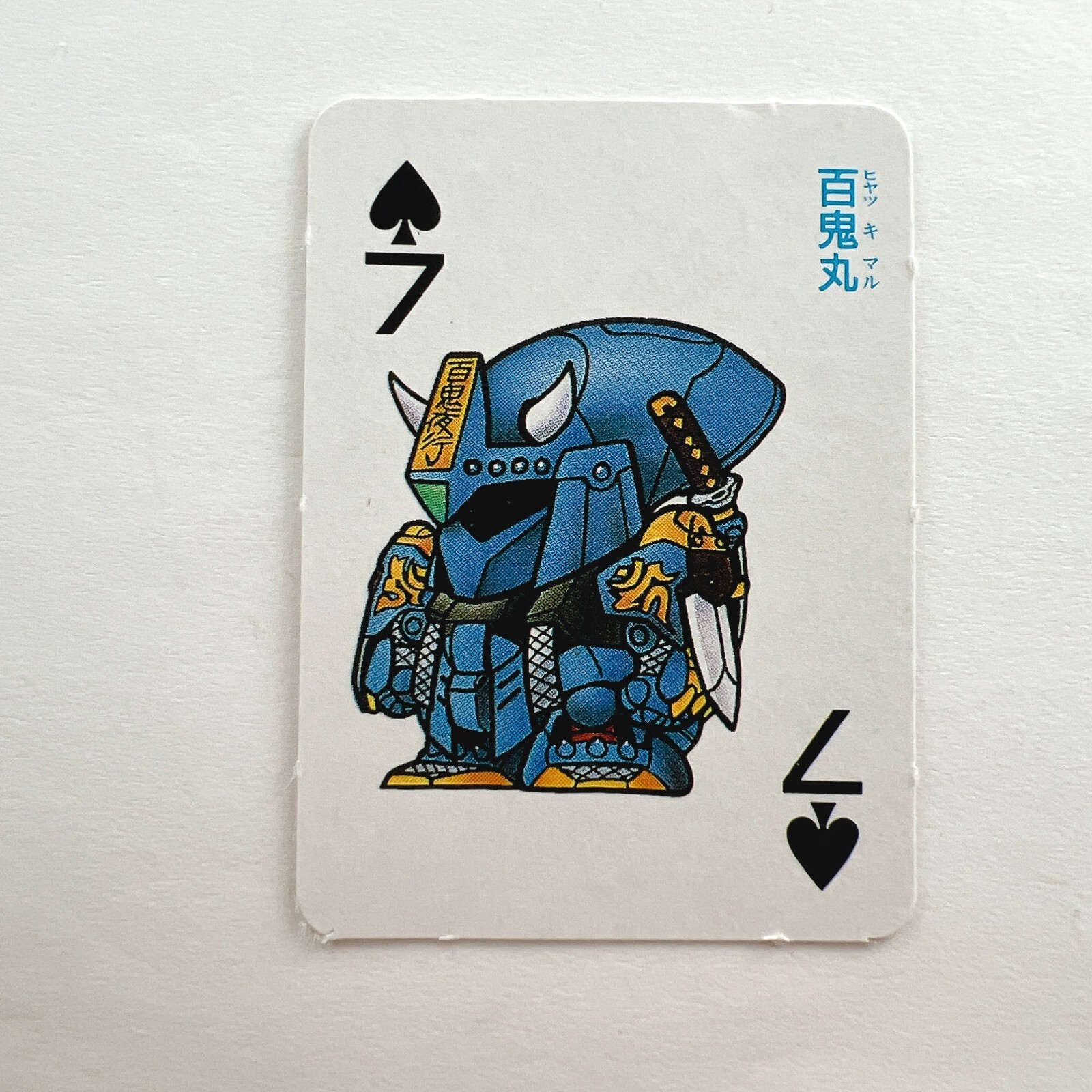
Hyakkimaru SD Gundam Playing Card — Comic BomBom February 1990 Furoku

SD Gundam and the Warrior Hyakkimaru
SD Gundam — Super Deformed Gundam — began as an unofficial fan parody in the mid-1980s, reimagining the towering mobile suits of Mobile Suit Gundam as small, round-headed, cute-proportioned robots. Bandai brought the concept into official production around 1988, and it quickly branched into distinct sub-series. Two of the most prominent were SD Gundam Gaiden, set in a Western fantasy-knight world, and the Musha Gundam series, which dressed characters in feudal Japanese samurai armor.
Hyakkimaru belongs to that second tradition in visual terms. The character wears blue, black, and gold armor, carries a sword, and sports horns on his helmet. His forehead bears an inscription referencing Hyakki Yagyo — an ancient Japanese folklore concept of a nocturnal procession of demons and monsters — the kind of imagery associated with antagonist warriors in the SD universe. Whether Hyakkimaru belongs specifically to the Musha Gundam line or represents a dark-knight character within SD Gundam Gaiden cannot be confirmed from available records, though his design points strongly toward the warrior tradition. He is an original SD Gundam creation with no connection to the identically-named protagonist of Osamu Tezuka’s manga Dororo.
Japan’s Furoku Tradition and This Card’s Origins
This card was never sold in a shop. It came bundled free with the February 1990 issue of Comic BomBom, a monthly boys’ manga magazine published by Kodansha from 1981 to 2007. Alongside CoroCoro Comic, BomBom was one of Japan’s two flagship hobby-and-toy magazines for children, covering model kits, video games, and the manga tie-ins that connected them throughout the 1980s and 1990s.
The bonus insert enclosed with each issue — called furoku — was a defining feature of Japanese magazine culture in that era. Stickers, game components, and playing cards were common formats. Furoku items were produced exclusively for the magazine and never retailed independently, giving them a non-retail status from the day they were printed. Playing card decks suited the format well: a 52-card set is a self-contained game, and each card can showcase a different character illustration. Decks frequently became separated over time, and individual cards entered circulation alone — the probable history of this 7 of Spades.
The February 1990 issue appeared at the height of the SD Gundam boom. Between 1989 and 1991, BB Senshi plastic model kits were a genuine cultural phenomenon in Japan, and Comic BomBom was serializing SD Gundam manga throughout the period.
The Appeal for International Gundam Collectors
SD Gundam has maintained dedicated collector communities across North America, Europe, and Asia for decades. Within those communities, the Musha and warrior-themed characters attract consistent attention: the fusion of robot design with samurai armor, horns, swords, and a Hyakki Yagyo inscription presents an aesthetic that feels intentionally and distinctly Japanese.
This card also sits apart from the Carddas vending-machine cards that Bandai produced during the same years. Furoku playing cards moved through a different channel entirely — distributed with magazine issues, not sought out by trading-card collectors — making them a distinct category within the broader landscape of 1990s SD Gundam paper collectibles.


Listed in our eBay store and sent from Japan
$8.82
International shipping available • Ask us anything before you buy