Super Mario Bros. Menko Card by Amada — A 1985 Famicom-Era Nintendo Collectible

What This Card Is
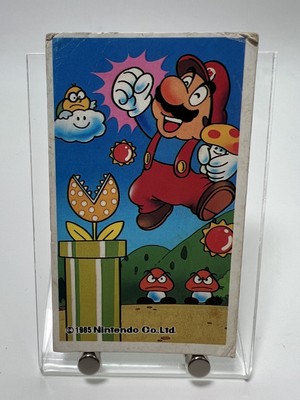
This is a menko card — a flat, thick-paper card produced in Japan as both a play item and a collectible. The card carries an official © 1985 Nintendo Co., Ltd. copyright notice, making it a licensed product from the very year Super Mario Bros. launched on the Famicom (Nintendo’s home console, known outside Japan as the NES). It was manufactured by Amada, a Japanese toy and stationery company active through the 1980s and 1990s that held licenses from Nintendo and many other major IP holders of the era. The #65 designation in the listing title suggests this card is number 65 within a numbered series, a format common to Amada’s menko sets.
The artwork depicts several characters and items drawn directly from the game: Mario himself, recognizable by his red cap and overalls; the Super Mushroom, the red-and-white power-up that transforms him into Super Mario; a Piranha Plant, the pipe-dwelling enemy with its characteristic open mouth; a Goomba, the round brown enemy that appears from the very first stage; a Fire Flower, the power-up that lets Mario throw fireballs; and what appears to be a Lakitu’s cloud with a Koopa Troopa shell — though the exact composition of that element is difficult to confirm definitively. The whole scene is rendered against a blue sky in the illustrated, slightly storybook style typical of official Japanese merchandise art from the 8-bit era.
The History Behind Menko and the Famicom Boom
Menko has roots stretching back to the Edo period. Traditionally made from lead or clay, the format shifted to printed cardboard during the Meiji and Taisho eras and became a fixture of Japanese childhood through much of the 20th century. The game itself is straightforward: players slap their card onto the ground near an opponent’s card, and if the resulting air pressure or impact flips the opponent’s card over, the winner claims it. By the postwar decades, menko featured baseball players, sumo wrestlers, movie stars, and anime characters. When video games exploded in popularity in the early 1980s, game characters followed naturally.
The Famicom launched in Japan in July 1983, and Super Mario Bros. arrived for it in September 1985 — immediately becoming one of the defining titles of the era and helping to establish the side-scrolling action genre. The surrounding licensed merchandise market expanded rapidly alongside the game’s success. Amada was among the manufacturers who moved quickly to produce menko sets, sticker collections, and similar items under official Nintendo license. By this period, menko had already evolved from a game primarily played outdoors into something closer to a trading card — collected, swapped between friends, and kept rather than staked in play.
Why International Collectors Take Notice
For collectors outside Japan, menko occupy an interesting cultural space. The format has no direct equivalent in North America or Europe — the closest analogy might be POGs, but menko predate that trend by several decades. A menko card from 1985 bearing Nintendo’s copyright sits at the intersection of two distinct areas of collector interest: early official Mario merchandise and Showa-era Japanese toy culture. Amada’s Famicom-themed menko sets are recognized as a distinct category among retro game collectors and Japanese pop culture enthusiasts, with specific series and card numbers sought out by those building complete sets. The artwork on items like this one also serves as a tangible record of how Nintendo’s characters were officially depicted in the months immediately following the franchise’s debut — a period before global standardization of the Mario visual identity.

Price: $7.67 | View on eBay