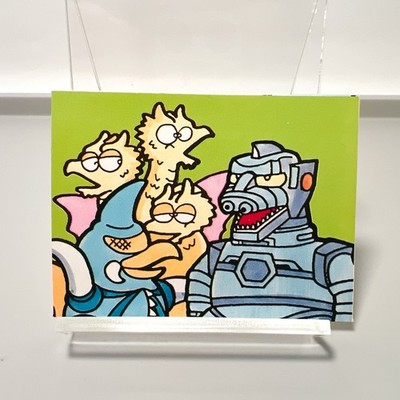
Godzilland No. 64: The Story Behind TOHO's Chibi Kaiju Sticker Series

What This Sticker Is and Where It Comes From
This is a numbered sticker — No. 64 — from a series of printed flat stickers produced under TOHO’s official license, featuring characters from the Godzilla franchise rendered in a chibi, or Super-Deformed (SD) style. Against a lime-green background, several of TOHO’s most iconic kaiju appear in that distinctively compact, big-headed form that was everywhere in 1980s Japanese character merchandise. The listing dates it to 1984, a significant year in Godzilla history: that December, TOHO released The Return of Godzilla — the first Godzilla film in nearly nine years, marking the franchise’s 30th anniversary — and it was accompanied by a wide wave of officially licensed merchandise.
The brand name “Godzilland” refers to a spin-off concept that reimagined TOHO’s kaiju roster in a child-friendly, SD format, separate from the serious tokusatsu films. Whether the specific “Godzilland” name appeared on this sticker’s original packaging or is a later categorical label is not certain, but the visual language — cheerful, cartoonish monsters in bright colors — is consistent with that tradition. The numbered format (No. 64) strongly suggests this was part of a large series, with dozens of individual stickers sharing the same design system.
The Kaiju on the Sticker
King Ghidorah made his debut in the 1964 film Ghidorah, the Three-Headed Monster. A golden, three-headed space dragon with two tails and massive wings, he became Godzilla’s most enduring and recognizable rival. Rodan originated in TOHO’s 1956 standalone film before being folded into the main Godzilla series; a pterosaur-type flying monster, he’s one of the franchise’s oldest supporting players. Mechagodzilla arrived in 1974’s Godzilla vs. Mechagodzilla as a silver mechanical duplicate of Godzilla, initially built by alien invaders — and has remained a fan favorite, particularly among collectors drawn to the robot and mecha aesthetic. Seeing all three rendered as small, round-faced chibi figures is a notable contrast to their imposing screen personas.
The Culture Behind Japanese Character Stickers of the 1980s
In 1980s Japan, character sticker collecting was a mainstream childhood hobby. Stickers were commonly inserted as extras into snack and candy packaging — a tradition sometimes called “shokugan” (food-toy) culture — or sold as standalone sets. Landmark examples from the era include the Kamen Rider cards by Calbee and the Bikkuri Man sticker series. The SD art style was a deliberate design strategy: it softened the more frightening aspects of monsters and villains, making them accessible to younger audiences while keeping the franchise characters recognizable.
Because these items circulated primarily within Japan at the time, they had limited distribution in overseas markets. All three kaiju featured here — King Ghidorah, Rodan, and Mechagodzilla — appeared in the 2019 MonsterVerse film Godzilla: King of the Monsters, which has introduced a new generation of international fans to these classic characters. For collectors interested in the longer history of Godzilla merchandise, a numbered SD sticker from this period represents a particular chapter of that story: the era when TOHO’s monsters went from theater screens to schoolchildren’s pencil cases.


Price: $8.63 | View on eBay

