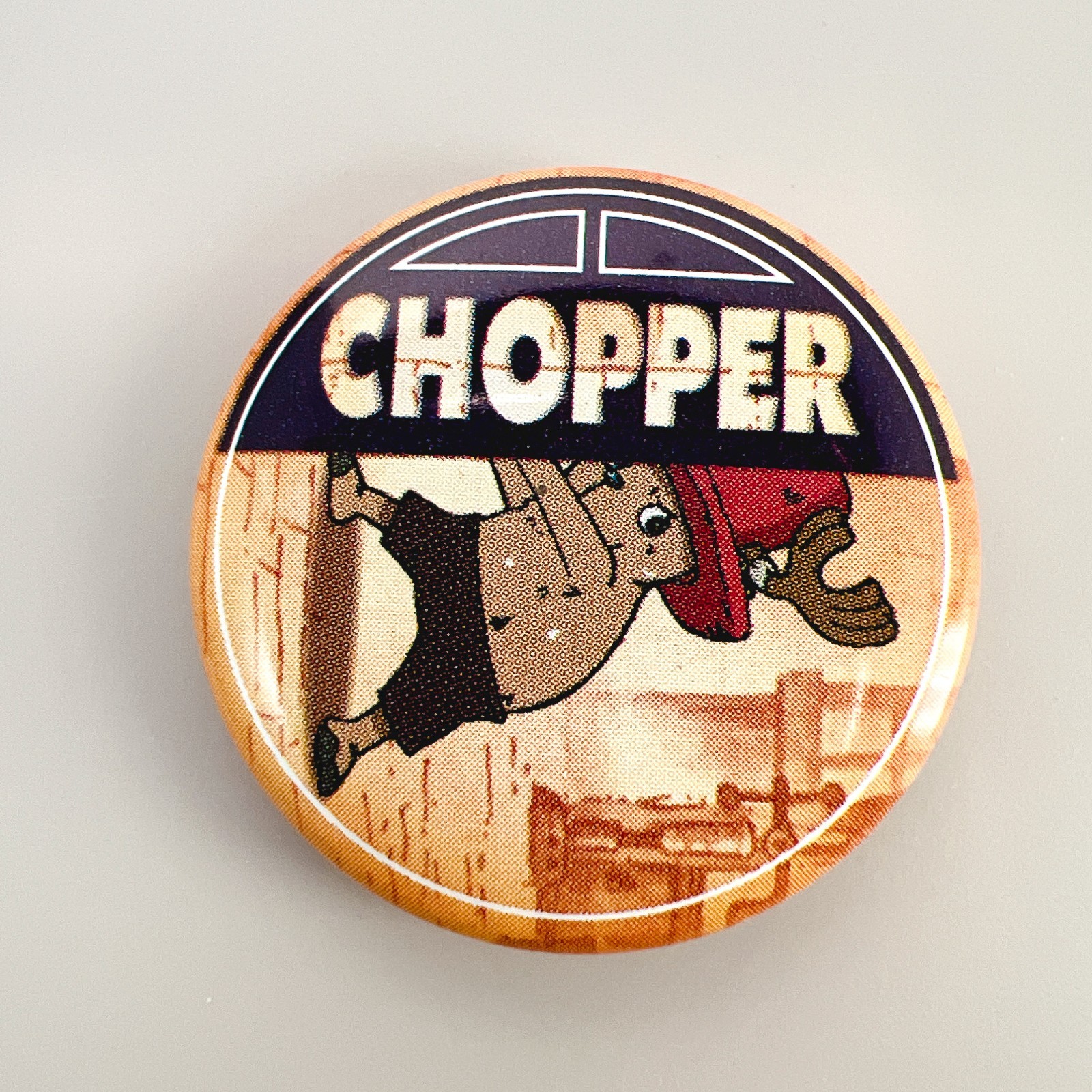
Tony Tony Chopper One Piece Pin-Back Badge, circa 2002

A Snapshot of One Piece at Its Very Beginning
One Piece — Eiichiro Oda’s pirate adventure manga — launched in Weekly Shonen Jump (Shueisha) in 1997, and its anime adaptation followed on Fuji TV in October 1999, produced by Toei Animation. By 2002, the series was roughly three years into its broadcast run and gaining momentum fast within Japan. The global audience that would eventually help One Piece set a Guinness World Record — over 500 million manga volumes printed worldwide by 2022, the highest ever recorded for a single manga title — was still years away from forming. In 2002, the franchise belonged almost entirely to Japan, which gives the merchandise of that moment a character quite distinct from the mass-produced goods that followed once the series found an international following.
Chopper: The Reindeer Who Became the Crew’s Most Recognizable Face
Tony Tony Chopper is the Straw Hat crew’s ship’s doctor — a reindeer who ate the Hito Hito no Mi (Human-Human Fruit), a Devil Fruit that granted him human intelligence and the ability to speak. He made his manga debut in the Drum Island arc (roughly volumes 15–17) and appeared in the anime around episodes 78–91, which aired in 2001. His appearance is easy to place: a compact build, brown short-sleeved top and shorts, a blue nose, and the small red hat the story calls the Doctor’s Top Hat. That combination of an animal silhouette and openly expressive emotions helped Chopper become one of the series’ most heavily merchandised characters almost immediately after his debut. By 2002, single-character goods — badge pins, plush toys, clear files — were already in circulation, even though his introduction to audiences had happened less than a year before.
Pin-Back Badges and Their Place in Japan’s Anime Goods Culture
The item itself is a pin-back button — in Japan the format is called a kan-badge: a round metal disc with a printed face under a gloss coating and a safety-pin clasp on the reverse. The format grew rapidly across Japan’s anime, game, and idol merchandise scene during the late 1990s and into the 2000s. Distribution channels varied widely: specialist shops like Animate sold them individually, capsule-toy (gashapon) machines offered them as prizes, and they were sometimes bundled with food toys such as candy or ramune, or produced as event exclusives. Which of those routes applies here isn’t certain without physical evidence. The halftone dot printing on this badge and the sepia-toned background with navy banner lettering are consistent with offset-printed anime badges produced by Japanese manufacturers of that era. Multiple licensed producers were active at the time — Bandai most prominently, with others including Epoch, Media Factory, and Broccoli also in the market — though the specific maker cannot be confirmed without examining the reverse of the badge. Whatever the production route, the visual and material style places it squarely within early-2000s Japanese anime merchandise.


Listed in our eBay store and sent from Japan
$14.07
International shipping available • Ask us anything before you buy

