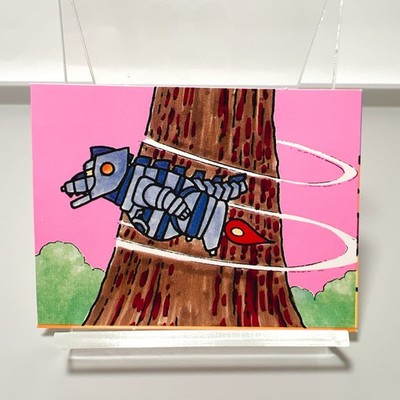
Godzilland No.109 Sticker Featuring Mechagodzilla (TOHO, 1984)

Godzilland and What It Was
Godzilland is an officially licensed TOHO spinoff that reimagined the monsters of the Godzilla franchise in a super-deformed, or “chibi,” art style. Where the original films built their reputation on terror and city-scale destruction, Godzilland leaned into rounded shapes, bright colors, and a visual warmth that made the same characters approachable for a younger audience. TOHO used this style widely across merchandise — toys, stationery, and sticker sets — from the 1980s onward, predating the Godzilland OVA anime series that arrived in the early 1990s.
This sticker is numbered No.109, and that number tells a story of its own. A run reaching into the triple digits points to a large, structured series designed around a clear collecting goal: find them all. The format was standard for Japanese collector stickers of the era — small adhesive-backed sheets in paper or thin card stock, sold through candy shops, stationery stores, and toy retailers. The numbering was the hook; completionism was the point.
Mechagodzilla and the Year Godzilla Came Back
The character shown here is Mechagodzilla, depicted in Godzilland’s chibi style with a grey-blue mechanical body, a single orange eye, and red flames trailing behind it in flight. The original Mechagodzilla debuted in the 1974 TOHO film Godzilla vs. Mechagodzilla as a robot built by aliens to impersonate and destroy Godzilla, returning the following year in Terror of Mechagodzilla (1975). Its multi-weapon, fully mechanical design made it one of the franchise’s most distinctive supporting monsters — heavily armed, entirely artificial, and visually unlike anything else in the kaiju lineup.
The year 1984 carries its own significance in Godzilla history. It marked the franchise’s 30th anniversary and the release of a new feature film after nearly a decade without one — known outside Japan as The Return of Godzilla. That film was a deliberate reset toward darker, more serious storytelling, and it arrived alongside a significant wave of licensed merchandise. Stickers and small collectibles produced in this period occupy the final chapter of the Showa-era Godzilla run, giving them a documentary quality for franchise historians alongside their appeal as physical objects.
Japan’s Sticker Culture and Godzilla’s Global Reach
Numbered collector sticker sets were a defined part of Japan’s toy and novelty market in the 1980s. Sold at accessible price points through candy and general stores, they were designed to be collected, traded, and stored in dedicated sticker albums. The numbered format — with each release pushing buyers toward a complete run — was central to the format’s commercial logic. Paper-based adhesive stickers from this era are susceptible to aging, and after more than forty years, examples that have survived in solid condition are naturally fewer than they once were.
Godzilla’s global recognition sets it apart from most Japanese character franchises. The series has defined the kaiju genre for international audiences since the 1950s, and Mechagodzilla in particular has remained one of its most enduring figures, reappearing across multiple films and reboots with consistently strong recognition for its mechanical design. The Godzilland art style adds a dimension that collectors outside Japan often find unexpected: a deliberately comic, pop-art interpretation of characters otherwise associated with scale and catastrophe. That contrast — between the source material and this cheerful, simplified version of it — is a significant part of what makes this category of merchandise visually arresting to an international eye.


Listed in our eBay store and sent from Japan
$8.82
International shipping available • Ask us anything before you buy