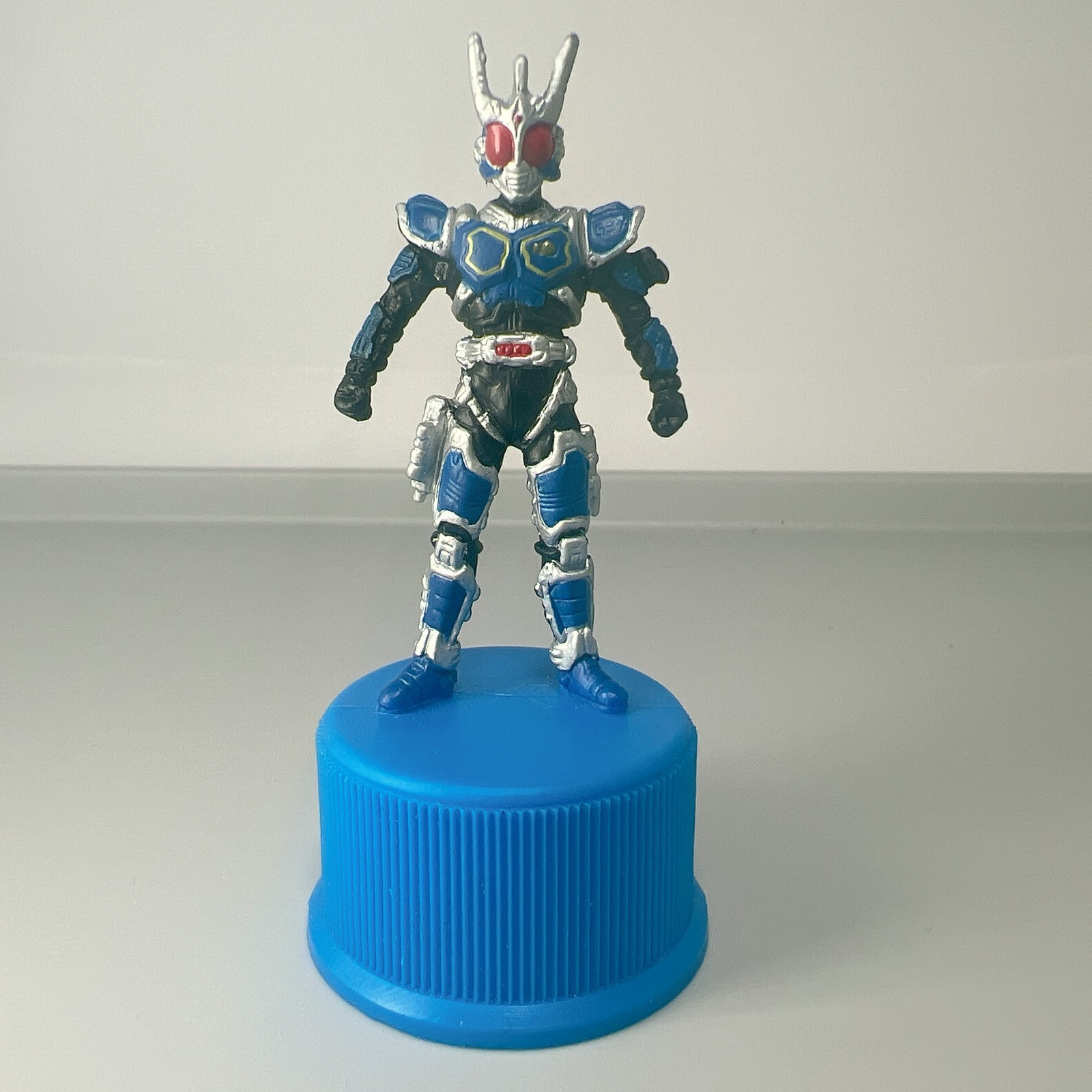
Kamen Rider G3-X Bottle Cap Figure, Seven-Eleven Japan, 2004

A Police Armor Suit From One of Heisei Kamen Rider’s Finest Hours
Kamen Rider Agito ran for 51 episodes on TV Asahi from January 2001 to January 2002, the second Heisei-era series produced by Toei following Kamen Rider Kuuga. It helped define how the revived franchise would operate — multiple Riders sharing one series, a police force entangled with superhuman heroes, and storylines that balanced drama alongside the action. Among international fans of tokusatsu, the genre of Japanese live-action fantasy built around elaborate practical-effects suits, Agito remains one of the era’s most respected entries.
G3-X is the police-developed power suit at the heart of that dynamic. The name is explicit: G3 refers to the Metropolitan Police’s Guard armor program, third generation, and the X marks an upgrade designed to correct the physical strain the original G3 placed on its wearer. Detective Makoto Hikawa operates the suit in the series. The design is deliberately mechanical — blue, silver, and black with red accents, three angular protrusions on the helmet, red eye sensors, and weapons that include the GX-05 Kerberos machine cannon and the GM-01 Scorpion sidearm. It reads more like tactical military equipment than anything organic or supernatural, which gives it a distinct place in the franchise’s visual vocabulary.
Bottle Cap Figures and the Convenience Store Collectible Boom
The bottle cap figure was a format specific to early 2000s Japan. Fully painted, non-poseable miniatures sit atop a circular base modeled after a plastic bottle cap — sometimes functional as one. The format peaked during these years, and Japanese convenience stores were central to how these items reached collectors. Seven-Eleven Japan, then the country’s largest convenience store chain, became an important channel for limited promotional collectibles tied to anime, tokusatsu, and similar franchises. Items distributed this way were available only within Japan, at specific stores, for a limited window, and were not sold through any official international channel.
This figure dates to 2004, two to three years after Agito’s television run ended. Kamen Rider Blade was the broadcast series at that point, meaning Agito merchandise had already shifted into a back-catalog role. A Seven-Eleven exclusive issued at that moment was serving an audience with an established connection to the series, not riding the momentum of an active broadcast.
What Draws Collectors to G3-X
Among Agito’s suits, G3-X tends to attract particular attention from fans who favor armor-focused designs. Its near-military aesthetic sets it apart from the biological and elemental looks found elsewhere in the Heisei lineup. The character’s narrative position also gives it weight — a police officer wielding state-developed technology, operating alongside Riders whose abilities come from entirely different sources, working both with and against them as the story demands.
Bottle cap figures from this period hold ongoing interest for collectors of early 2000s Japanese promotional items precisely because the format has almost no equivalent outside Japan. It grew from a retail ecosystem — convenience store campaigns, candy toy tie-ins, drink-purchase premiums — that differed substantially from how collectibles were sold in other markets. A Seven-Eleven Japan exclusive from 2004 is a small, physical artifact of how that ecosystem worked during one of its most active years.


Boxed and cushioned for the trip from Japan
$14.07
International shipping available • Ask us anything before you buy