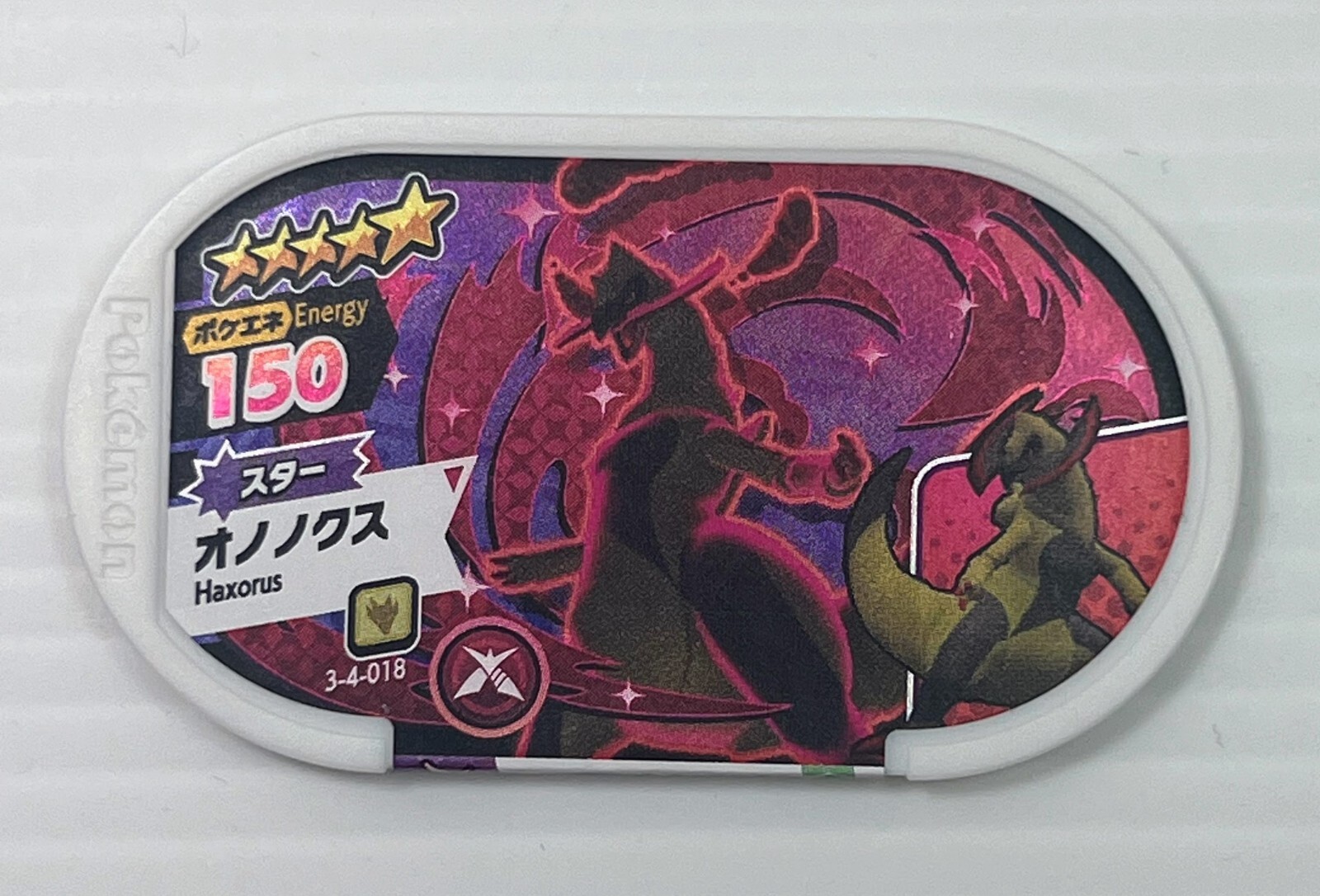
Haxorus Pokemon Mezastar Arcade Tag, Four Stars, No. 3-4-018

A Pokemon Arcade Tag, Not a Card
The item here is a Mezastar tag — a thick, oval plastic token produced by TAKARA TOMY A.R.T.S. for the Pokemon Mezastar arcade game series. These are not trading cards. They are rigid plastic, medal-like in form, with a glossy printed face and the word “Pokemon” embossed along one edge. This specific tag carries identification number 3-4-018, features Haxorus as a Dragon-type with an Energy stat of 150, and is marked with four gold stars at the top — placing it in the upper tier of the Mezastar rarity scale, which runs from one to four stars.
Haxorus debuted in Pokemon Black and White (2010), the fifth-generation main series games. It is the final stage of a three-step evolution line, distinguished by large axe-like tusks flanking its jaw. In competitive Pokemon it is recognized as a dedicated physical attacker. The tag’s artwork appears to show a large, shadowed figure alongside a standard-size Haxorus — most likely a visual representation of a battle move or special effect within the Mezastar game itself, though the precise nature of the image has not been independently confirmed.
The Arcade Culture Behind Mezastar
Pokemon Mezastar launched in Japanese arcades in September 2020, developed and operated by TAKARA TOMY A.R.T.S. under license from The Pokemon Company. It is the direct successor to Pokemon Tretta, a similar arcade tag game that ran from roughly 2012 to 2016. Players insert a tag into a cabinet to battle, and after each session the machine dispenses a new tag at random — a mechanic with clear ties to Japan’s capsule toy culture, where the randomness of the outcome is itself part of the collecting experience.
The numbering 3-4-018 likely places this tag in the third series of Mezastar releases, suggesting production around 2021, though the exact interpretation of that numbering system has not been definitively confirmed. Mezastar cabinets operate exclusively within Japanese arcades. The game is inaccessible outside Japan, which means the physical tags are the only aspect of the experience that can cross borders.
Why the Haxorus Tag Draws Collector Interest
Pokemon commands one of the largest collector communities in the world, and Haxorus occupies a specific niche within it. The fifth generation — the Black and White era — has a dedicated following, and Haxorus is among the more visually aggressive designs from that period, which contributes to its lasting appeal among fans of that generation.
The Mezastar format is itself unusual outside Japan. The thick plastic oval, the arcade-game context, and the fact that these tags can only be obtained through play in a Japanese game center give them a distinctly different character from trading cards or standard gashapon toys. The tag also carries both the Japanese-language name and “Haxorus” in English — a standard feature of official Pokemon merchandise that makes the item immediately legible to international buyers without losing the original Japanese presentation.

Shipped directly from Japan by a small shop
$8.82
Ships worldwide from Japan • Full photos and details on the listing