Amada's 1997 Primeape Pokemon Collector Sticker, No.260

A Card-Style Sticker from Pokemon’s Earliest Wave
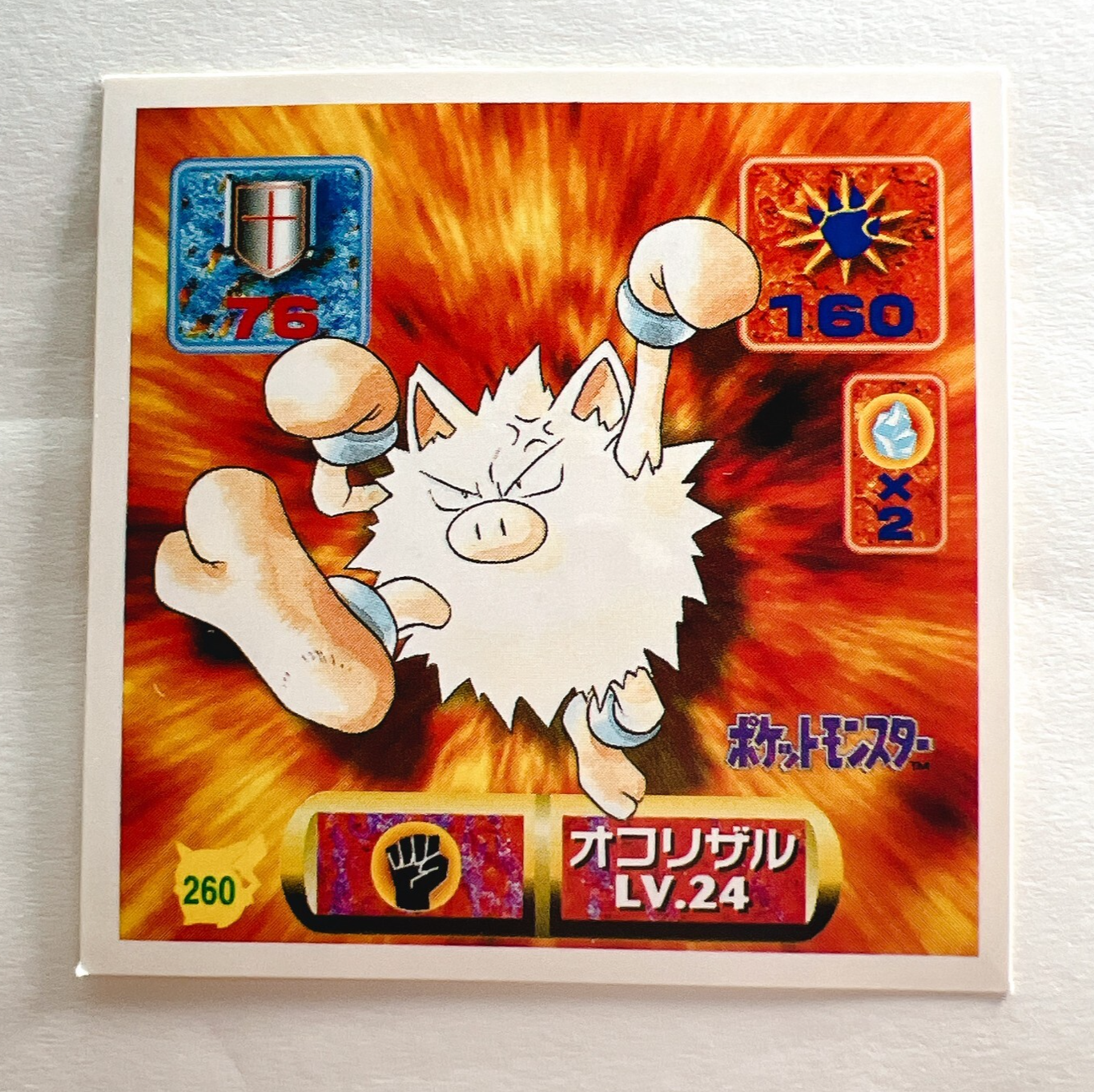
This is an official licensed Pokemon collector sticker manufactured by Amada in 1997, featuring Primeape — the Fighting-type Pokemon known in Japan as Okorizaru. It carries collection number No.260 within Amada’s sticker series, a number that hints at just how expansive this run of merchandise was.
The sticker has a distinctive layout: a single white-bordered sticker set against a bold orange and yellow burst background, with the character’s name, level, and a set of numerical stats arranged in a card-game style. The values shown — “LV.24,” a blue shield marked “76,” a blue claw symbol adjacent to “160,” and a “×2” ice-crystal notation — follow Amada’s own display format. What each figure represents precisely (HP, attack power, weakness multiplier, or something else entirely) is not formally documented, and the system appears to operate independently from the games themselves: in the Game Boy titles, Mankey actually evolves into Primeape at level 28, making the sticker’s “LV.24” a product of Amada’s own stat conventions rather than a direct in-game reference. The visual language clearly draws from the Pokemon Trading Card Game, which had launched in Japan in October 1996.
Primeape and the World It Came From
Primeape is National Pokedex entry #57, a pure Fighting-type that evolves from Mankey (#56). Its design — white fur, a permanently furious expression, and limbs shaped like boxing gloves — makes anger its defining characteristic, and both the games and anime lean into that concept. The anime series, which began airing on TV Tokyo on April 1, 1997, featured Primeape in notable early episodes, giving international audiences a strong first impression of the character under its English name.
Pokemon itself launched on February 27, 1996, as a pair of Game Boy RPGs developed by Game Freak and published by Nintendo. By 1997, when this sticker was produced, the first generation of 151 Pokemon was at its cultural peak in Japan — games, the new card game, and licensed merchandise were all accelerating at the same time. This sticker belongs to that opening wave.
Sticker Collecting and the Scale of Amada’s Pokemon Output
Amada was one of the most active producers of licensed sticker merchandise in 1990s Japan, releasing sets for major franchises including Dragon Ball and Sailor Moon alongside Pokemon. Their Pokemon output spanned multiple formats — prism stickers (often called PP cards), standard stickers, and stat-display stickers like this one. The existence of No.260 alone signals that this was a deep series; Amada was operating at significant scale.
Sticker collecting was a well-established hobby culture among children in Japan during this era. Amada’s packs were sold through toy stores, convenience stores, and dagashi-ya — small candy and snack shops that served as after-school destinations. Trading stickers at school was commonplace. Production documentation for these series was less rigorous than modern standards, which means piecing together a complete picture of any given Amada run often falls to dedicated collector communities.
Because Amada manufactured these stickers for the Japanese domestic market and did not distribute them internationally, they have remained a Japan-only category. For collectors focused on first-generation Pokemon merchandise, a 1997 Amada sticker with a clear collection number and a well-known character like Primeape represents a firmly dated, identifiable piece of that original era.


Listed in our eBay store and sent from Japan
$7.86
International shipping available • Ask us anything before you buy