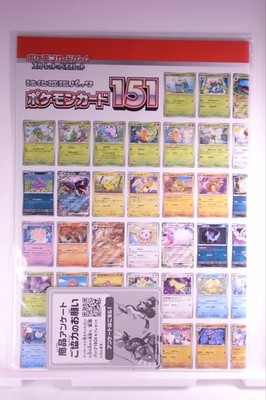
Pokemon Card 151 Kanto Starter Set Card List Poster

Sixty Cards, One Grid: What This Poster Shows
This flat poster is built around a simple idea: display every card in a deck at once. Against a white background with a red top border, a large “151” graphic anchors the center, and sixty miniature card images fill the space below in a clean grid. A small silver card — printed with Japanese text covering purchase bonus information and product details, plus a QR code — is placed over the poster, and the whole item ships protected inside a clear sleeve.
The sixty cards shown correspond to a single sixty-card deck from the Kanto Starter Set ex, a three-deck product released alongside Pokemon Card 151 on June 16, 2023. That starter set contained decks built around Ivysaur ex, Charmeleon ex, and Wartortle ex, each running exactly sixty cards — which aligns precisely with the grid displayed here.
The First-Generation Revival Behind the Number 151
Pokemon Card 151 belongs to the Scarlet & Violet series of the official Pokemon Trading Card Game. Its focus is deliberately narrow: every card in the set covers one of the 151 original Kanto-region Pokemon, running from Bulbasaur (#001) through Mew (#151). No later-generation Pokemon appear in the main set.
The number 151 carries immediate recognition for anyone who grew up with the franchise. The original Pokemon Red and Green launched in Japan in 1996, and this set arrived approximately 27 years later as an openly nostalgic first-generation revival — while still operating under the current Scarlet & Violet competitive rules. That combination means the set speaks to both active TCG players and fans who connected with the original 151 in the late 1990s across North America, Europe, and Asia.
Characters visible across the poster’s grid include Pikachu, Raichu, Clefable, Arcanine, Kadabra, Gengar, and the three Kanto starter lines through their evolutions — all original Kanto Pokedex entries. The small silver overlay card features what appears to be a Mewtwo-like figure alongside a second character tentatively described as resembling Mega Rayquaza. That second identification is uncertain, since Mega Rayquaza originates from the Hoenn region rather than Kanto; whether it reflects image-recognition ambiguity or a specific promotional design choice is unclear from the available information.
Japan’s Purchase Bonus Tradition
In Japan’s retail market, purchase bonuses are a standard part of TCG product releases. Buying a specific item at a participating store during a campaign window often comes with supplementary materials — posters, checklists, sleeves, playmats — distributed alongside the main product and not available through general inventory. This poster carries that structure: the Japanese text identifies it explicitly as a purchase bonus, indicating it reached consumers through a specific retail channel rather than as a standalone sale.
For collectors outside Japan, that distribution context shapes what they’re looking at. The item’s Japanese text, the domestic-format “Pokemon Card” logo, and the QR code all reflect a product designed for the Japanese market that does not carry over into English-language releases. The grid format itself — sixty cards arranged as a single visual catalog — also functions naturally as a display piece, the kind of flat printed item that translates cleanly into a framed addition to a card collection.


Sleeved and rigid-mailed before it leaves Japan
$11.95
Ships worldwide from Japan • Full photos and details on the listing