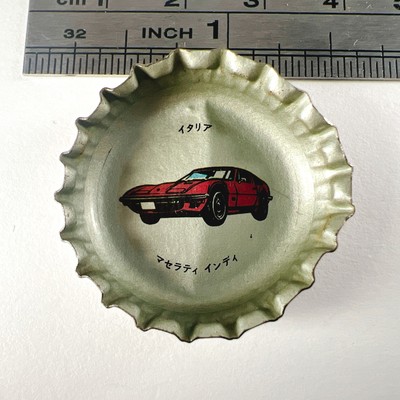
Maserati Indy Crown Cap from Coca-Cola Japan's Automobile Series, circa 1970s

A Bottle Cap, a Promotional Campaign, and an Italian Grand Tourer
This small metal disc — a standard crown cap, roughly 3.2 centimeters across — carries a color illustration on its interior face: a red Maserati Indy, labeled with “Maserati Indy” below and “Italy” above, both rendered in Japanese katakana. That country-plus-model layout is a clear structural clue. The cap belongs to what appears to be an automobile-themed series produced by Coca-Cola Japan, most likely in the early-to-mid 1970s, in which cars were organized by country of manufacture. The Italy entry in that series is the Maserati Indy.
The precise series name cannot be confirmed from the cap alone — markings on the underside or original promotional materials from the period would be needed to establish that — but the organized “nation + model” structure visible on the face is consistent with the serialized collector campaigns Coca-Cola Japan ran throughout this era, covering themes from sports to wildlife to international automobiles.
The Maserati Indy: Named for a Race, Built for the Road
The Maserati Indy was produced between 1969 and 1975, making it a direct contemporary of this bottle cap campaign. Despite its name — taken from the Indianapolis 500 — the Indy was not a competition vehicle. It was a four-seat grand tourer, styled by Carrozzeria Vignale, the Italian coachbuilder, and fitted with either a 4.2-liter or 4.7-liter V8 engine. Approximately 1,000 examples were built in total, though the precise figure varies depending on the source.
In postwar Japan, Italian and other European luxury cars carried a particular cultural weight. The country was in the late stages of its high-growth economic period, and foreign automobiles — especially those from Italy — had become shorthand for aspiration and global sophistication. A Maserati appearing on a Coca-Cola crown cap was not arbitrary: it placed one of Italy’s most recognized luxury marques directly in the hands of everyday consumers, most of them young, in a form they could collect and trade.
Crown Cap Collecting and the Crossroads of Two Collector Communities
Postwar Japan developed a distinct culture around collecting bottle crown caps — the pressed-metal closures used on glass beverage bottles. Manufacturers printed illustrations, numbers, or serialized images on the interior face, turning an otherwise disposable item into something worth accumulating. Coca-Cola Japan was among the companies that leaned into this format during the 1960s and 1970s, producing sets designed to encourage repeat purchases and complete-series chasing. In retrospect, these crown cap series functioned as forerunners to the food-toy (shokugan) and capsule-toy (gachapon) formats that followed — though they occupy their own category, inseparable from the bottle itself rather than packaged as a standalone product insert.
Because these caps circulated as everyday promotional goods rather than intentional collectibles, surviving examples in good condition have grown uncommon. The Maserati Indy cap sits at the intersection of two distinct collector communities: those focused on Coca-Cola memorabilia and advertising ephemera, and those drawn to vintage automotive brand merchandise. The Japanese text on its face also gives it a regional specificity that sets it clearly apart from the Coca-Cola promotional items more commonly found in Western markets — a document, in metal, of where and when it was made.


Found in Japan, packed by hand, sent worldwide
$17.01
Worldwide delivery from Japan • See the listing for condition and size