Balrog (M. Bison) Street Fighter II Rubber Mascot Figure

The Fighter Behind the Figure
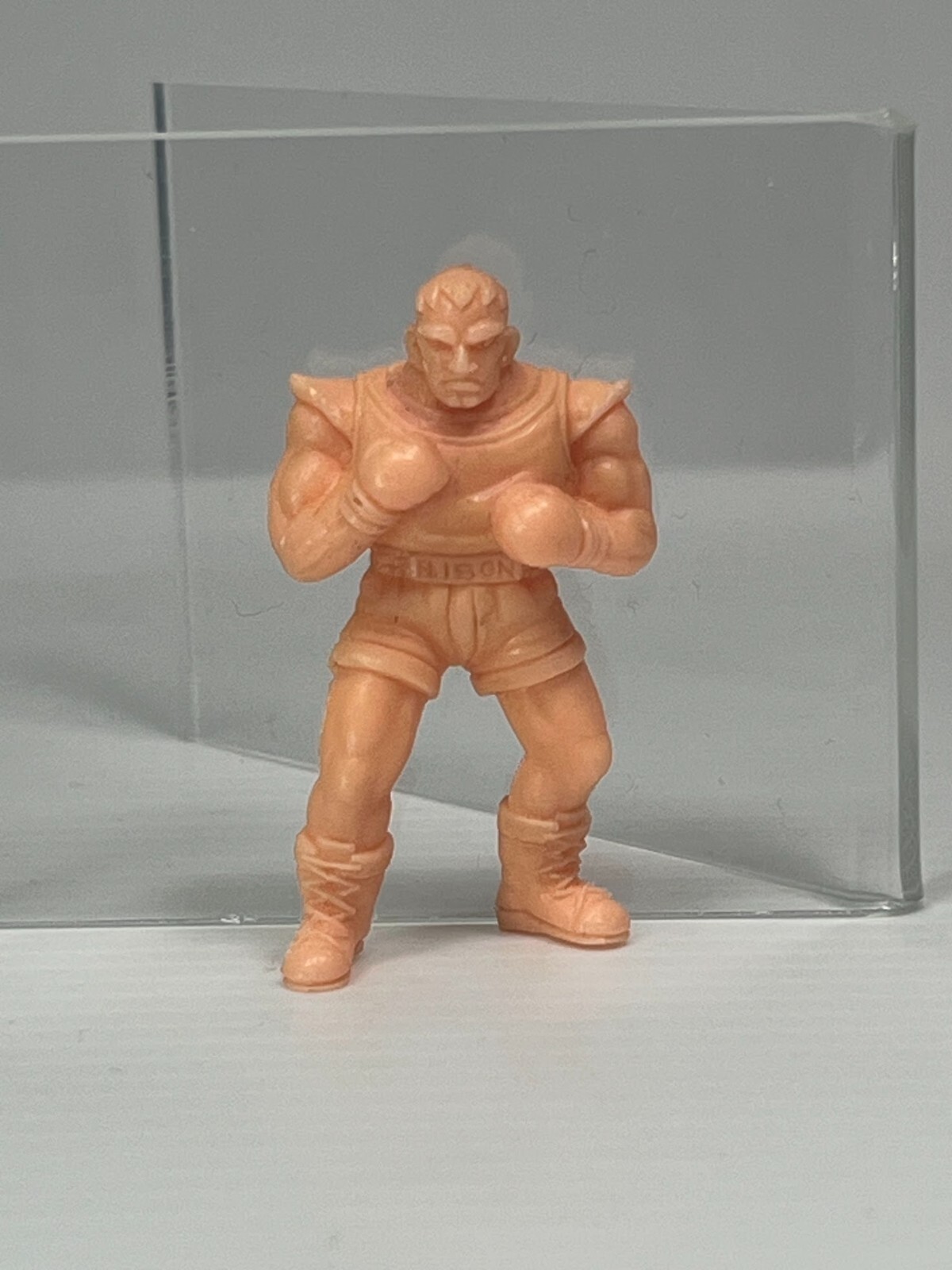
This is a keshi gomu — a Japanese rubber mascot figure — depicting Balrog from Capcom’s Street Fighter II. Known in Japan as M. Bison, Balrog is one of the most recognized characters in fighting game history: a massive American heavyweight boxer and one of the four grand masters of Shadaloo, the criminal organization at the heart of the Street Fighter storyline. His fighting style is built entirely on punching power, with the infamous Turn Punch — a charged, spinning blow — as his signature technique. Molded in uncolored peach-toned rubber with no paint, the figure captures him in a fighting stance, complete with boxing gloves, a sleeveless top, distinctive shoulder pads, lace-up boots, and a championship belt inscribed with the name “BISON.”
Street Fighter debuted as an arcade game in 1987, but it was Street Fighter II: The World Warrior, released in arcades in February 1991, that became a cultural phenomenon. Its international roster of fighters, tight competitive mechanics, and the novelty of direct head-to-head play made it one of the defining games of its era. Ports to the Super Famicom and Mega Drive brought it into Japanese homes, and the series continued to expand with Champion Edition (1992) and Super Street Fighter II (1993).
Japan’s Keshi Gomu Tradition
Keshi gomu — literally “eraser rubber” — refers to a category of small, solid, single-color rubber figures that became enormously popular in Japan during the 1980s. Despite the name, these figures generally do not function as actual erasers; the term stuck as a description of their material and scale. Characters from Kinnikuman, Dragon Ball, SD Gundam, and countless other franchises were produced in this format and distributed through gashapon (capsule toy) machines, dagashi-ya (traditional candy and toy shops), and as shokugan — toys bundled with small snacks or candy.
When Street Fighter II exploded in Japan after 1991, licensed merchandise followed quickly. The most likely production window for a keshi gomu like this one is the early-to-mid 1990s, at the height of SF II’s popularity. The actual manufacturer cannot be confirmed from the available information — companies including Bandai, Takara, and Epoch were all active in the SF II licensing space during this period — but the item is clearly a Capcom-licensed product.
The “BISON” Belt and What It Tells You
One of the most telling details on this figure is the belt inscription: “BISON.” That is how the character was known in Japan. In North America and Europe, Capcom renamed the character Balrog during localization — part of a broader reshuffling of character names between regions. Merchandise produced for the Japanese domestic market therefore carries the Japanese name, and that belt inscription is a tangible marker of where this figure was manufactured and sold.
For collectors interested in vintage Japanese gaming merchandise, this distinction is meaningful. It places the figure firmly within the Japanese market, separating it from North American licensed products of the same era. The keshi gomu format itself has developed a dedicated international collector community, where the genre is often called simply “keshi” — appreciated for the charm of its simple, unpainted molded forms and as a record of 1980s and 1990s Japanese toy culture. When the character depicted is as universally known as a Street Fighter II main, that existing interest only runs deeper.

Boxed and cushioned for the trip from Japan
$12.54
International shipping available • Ask us anything before you buy