Exodia the Forbidden One — Bandai's 1999 Capsule Monster Figure

What Is a Capsule Monster Eraser?
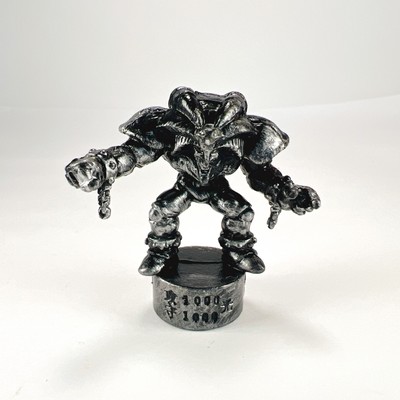
The “eraser” in the name is a holdover from Japanese toy tradition, not a description of function. These figures — keshigomu in Japanese — are solid miniature pieces molded from PVC or a firm rubber-like resin. The name traces back to a 1980s toy genre modeled after the shape of stationery erasers, and it stuck as a generic term for the category long after the link to actual erasers became irrelevant. Bandai produced this type of item for gashapon: capsule vending machines installed in department stores, toy shops, and arcades across Japan. A single pull cost around 100 to 200 yen, and the capsule contents were randomized — you did not choose what you received. That blind format turned collecting a full character run into a game in itself. The base of this piece is stamped “1999” and “Bandai,” confirming both the manufacturer and the year of production.
Exodia and the Start of the Yu-Gi-Oh Card Game Era
Yu-Gi-Oh! began as a manga by Kazuki Takahashi, serialized in Weekly Shonen Jump from September 1996. The story cycled through several game formats before the fictional card game Duel Monsters became its defining element — which led directly to the real-world trading card game that Konami launched in Japan in February 1999. This figure dates to that same year, placing it at the very start of Yu-Gi-Oh’s licensed merchandise era.
Within that card game, Exodia the Forbidden One occupies a category of its own. The monster is divided across five separate cards — head, left arm, right arm, left leg, right foot — and holding all five simultaneously triggers an immediate win condition, the only such mechanic in the game’s history. The head card carries base stats of 1000 ATK and 1000 DEF, which likely explains the “1000” and “千” (the kanji for “thousand”) stamped on this figure’s base. The sculpt follows the original card artwork closely: heavy layered armor, a prominent horn, large shoulder guards, the left fist thrust forward, and a chain at the wrist. Toei Animation had produced an earlier Yu-Gi-Oh anime that aired in 1998, but the far more widely seen Yu-Gi-Oh! Duel Monsters series did not begin until April 2000. This figure was made in the interval between the two, placing it in the absolute earliest tier of Yu-Gi-Oh character goods.
How Exodia Became Known to the International Yu-Gi-Oh Audience
When 4Kids brought the Duel Monsters anime to English-speaking audiences in 2001, Exodia appeared in the very first episode as a force that ends a duel the instant its five parts are assembled. That opening made a lasting impression on a generation of viewers who had never heard of the monster before. The English trading card game followed, and Exodia became one of the most recognized names in the franchise worldwide.
The Bandai Capsule Monster figures, by contrast, were produced entirely for Japan’s domestic market and saw no official overseas distribution. The keshigomu format was largely invisible to the international audience that found Yu-Gi-Oh through the 4Kids broadcast. Yu-Gi-Oh’s 25th anniversary, celebrated around 2021 and 2022, brought renewed attention to the franchise’s origins and to the earliest Japanese-market goods that predated the global rollout. A figure of Exodia produced in 1999 — when the card game itself was just months old — represents a specific and early moment in that history.


Boxed and cushioned for the trip from Japan
$24.37
Ships worldwide from Japan • Full photos and details on the listing