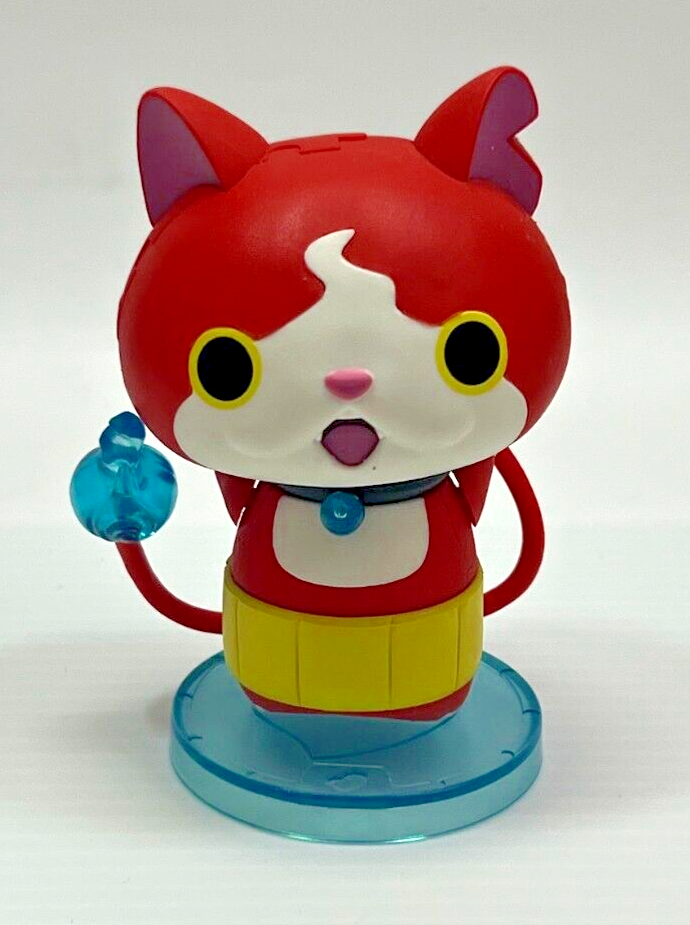
Jibanyan Kumkum Puzzle 3D Figure, 37 Pieces

What a Kumkum Puzzle Actually Is
The Kumkum Puzzle line is widely attributed to Yanoman, a Japanese puzzle maker established in 1965 that built its reputation on jigsaw puzzles before expanding into licensed character goods. A Kumkum Puzzle sits in its own category: it is neither a pre-assembled figure nor a flat jigsaw, but a set of interlocking plastic pieces — 37 in this case — that fit together to form a three-dimensional character figure designed to stand on a shelf. This piece includes a clear blue circular base that holds the finished figure upright.
The completed figure keeps the visible evidence of its own construction. Segmentation lines run along the character’s natural contours where the pieces meet, and that structural honesty — the assembled seams left in plain sight rather than hidden — is a defining visual trait of the format. It reads differently from a standard injection-molded toy precisely because you built it and it shows. The 37-piece count sits on the compact end of the Kumkum line; other releases in the series use higher piece counts.
Jibanyan and the Years Yo-kai Watch Took Over Japan
Yo-kai Watch began as a Nintendo 3DS game developed by Level-5, released in Japan in July 2013. An anime adaptation produced by OLM followed in January 2014, broadcast on TV Tokyo. Within months, the franchise had become a cultural moment: merchandise filled toy shop shelves, convenience stores ran tie-in promotions, and the demand for Bandai’s Yo-kai medal toys — used with a device called the DX Yo-kai Watch — reportedly caused nationwide shortages at the end of 2014. The period between 2014 and 2016 is broadly regarded as the franchise’s domestic peak; the series continued after that, but the intensity settled.
Jibanyan is the mascot at the center of all of it, appearing from the earliest moments of both the game and the anime. He is a cat-type yokai, red and white in color, with yellow-rimmed eyes, a pink nose, and a blue collar bearing a pale blue charm called an omitama. A yellow segmented band rings his torso. His backstory is that he was once an ordinary house cat named Akinyan who died in a traffic accident and became a bound spirit — a jibakurei — which is where his name comes from. The figure depicts him with arms extended toward a blue sphere, a pose that appears to reference one of his in-game or animated techniques, though which specific move it represents cannot be confirmed from the figure alone.
Why International Fans Connect With This Subject
Yo-kai Watch reached North America and parts of Europe around 2015 and 2016 through localized game and anime releases, but the franchise never achieved the same saturation outside Japan that it had at home. As a result, the bulk of Yo-kai Watch merchandise was developed for the Japanese domestic market and never sold through standard retail abroad — which is the natural context for items like this one.
Among the characters in the series, Jibanyan has the widest international name recognition. His design is distinctive enough that fans who know the franchise at all tend to know him first. A three-dimensional assembled figure also offers something that a flat keychain or rubber strap cannot: a fully viewable object from any angle, with the added dimension of the build process itself. For collectors drawn to Japanese character goods from the mid-2010s, a domestic-market item from the franchise’s peak window carries clear provenance as a Japan-only release.
Because this is a used item, buyers should review the listing photos and any accompanying notes carefully for details on assembly status and piece completeness before purchasing.


Listed in our eBay store and sent from Japan
$10.86
International shipping available • Ask us anything before you buy