A Silver Metal Token from the Dragon Ball Janken Club Series

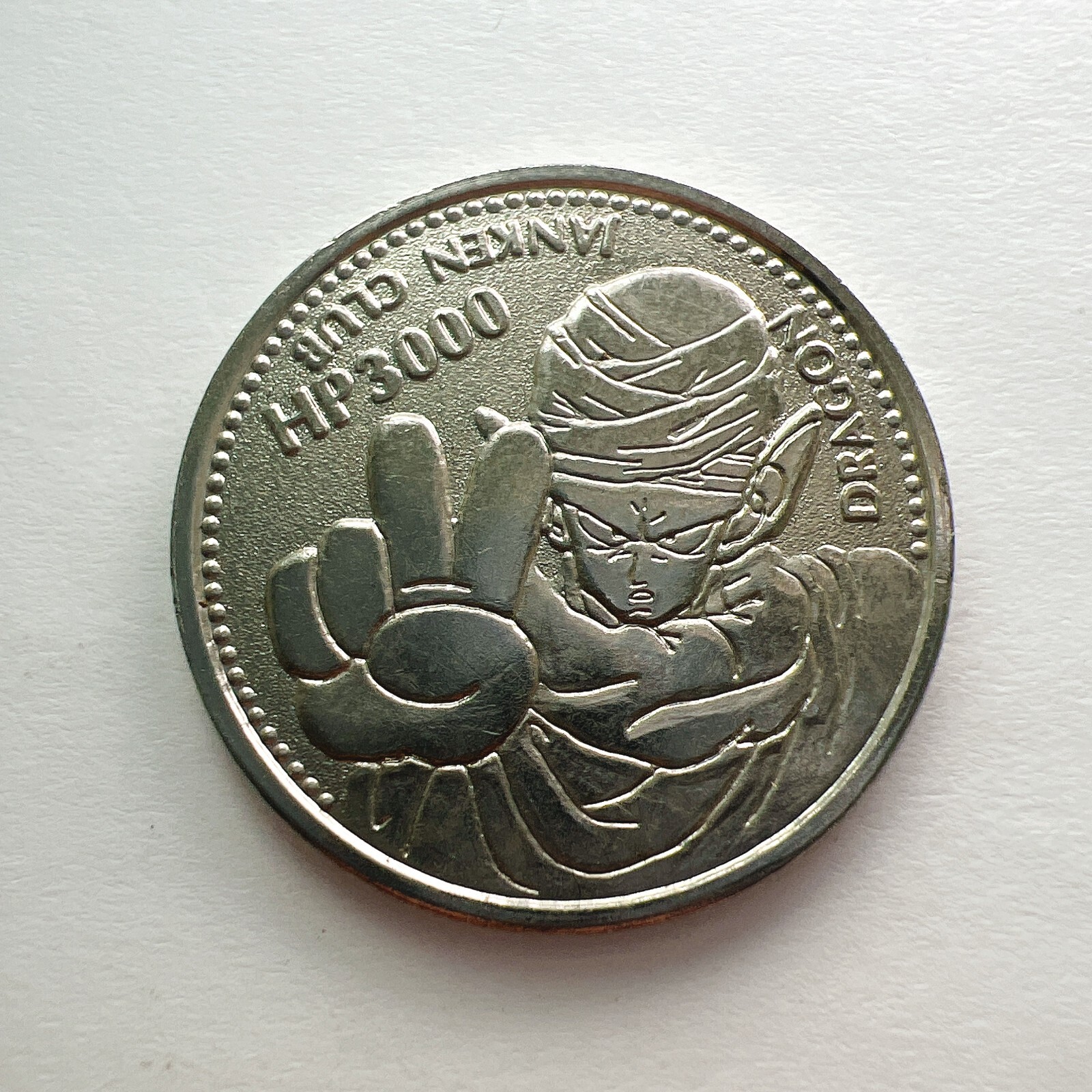
This circular silver token is made from metal and carries an embossed image on its face: Piccolo, one of Dragon Ball Z’s most iconic characters, raising two fingers in the stance fans worldwide recognize as the charging pose for his signature technique, the Makankosappo — known in dubbed versions as the Special Beam Cannon. The text “JANKEN CLUB,” “HP3000,” and “DRAGON BALL” are stamped into the metal alongside the character relief.
The HP designation stands for Hit Points, the numerical value used in RPGs and battle games to represent a character’s health. This labeling suggests the Janken Club line was a structured collectible series in which different characters appeared on separate tokens, each assigned a distinct HP value. “Janken” is the Japanese word for rock-paper-scissors, pointing to a game format where players likely battled using their tokens. The specific rules of play aren’t documented in surviving sources, but the format was well suited to the playground culture of the era.
Piccolo’s Place in the Dragon Ball Universe
Akira Toriyama’s Dragon Ball began serialization in Weekly Shonen Jump in 1984 and ran until 1995. Its television adaptations — the original Dragon Ball anime from 1986 to 1989, followed by Dragon Ball Z from 1989 to 1996, both produced by Toei Animation — made it one of the most widely broadcast anime franchises in history, reaching audiences across more than 80 countries.
Piccolo’s story spans both series. He first appeared as the villain Maajunior in the original Dragon Ball, but his arc shifted dramatically in DBZ, where he becomes the trainer of Goku’s son Gohan and gradually transitions into one of the series’ most trusted heroes. His appearance — green skin, pointed ears, white turban, and a flowing dark cape — is one of Dragon Ball’s most recognizable visual signatures, and all of those details are visible in the token’s embossed relief. The two-finger charging pose depicted here is closely identified with Piccolo specifically and has been reproduced across merchandise and game art for decades. Because Piccolo became a central figure from the DBZ era onward, this token most likely dates from the early-to-mid 1990s, though a precise manufacture date hasn’t been confirmed.
Japan’s Character Medal Culture and Where This Token Fits
In 1980s and 1990s Japan, small metal character tokens occupied a specific niche in children’s toy culture — distinct from arcade medal machines, these hand-held “play medals” circulated through toy shops, stationery stores, and dagashiya, the candy-and-cheap-toy shops that were a fixture of Japanese neighborhoods. They also appeared as food toy inserts and prize items. Metal construction made them more durable than the paper Carddass cards that dominated the same era, and they were designed to be played with as well as collected.
Dragon Ball was one of the flagship franchises driving this entire category of merchandise. Alongside Carddass vending machine cards and gashapon capsule figures, metal tokens formed part of the wide range of affordable collectibles that reached Japanese children during DBZ’s broadcast years. The specific manufacturer behind the Janken Club line isn’t confirmed by available records: while Bandai was the primary Dragon Ball licensee, other companies also held rights to produce goods during this period.
Items from this kind of small-format, Japan-domestic merchandise were never distributed internationally. More than three decades have passed since they circulated through neighborhood toy shops, and intact examples are now uncommon outside Japan — particularly for a character like Piccolo, whose reputation as the franchise’s defining mentor figure has only grown among collectors who came of age with DBZ.


Comes straight from Japan — no middleman
$24.37
Ships internationally • More photos on the eBay listing