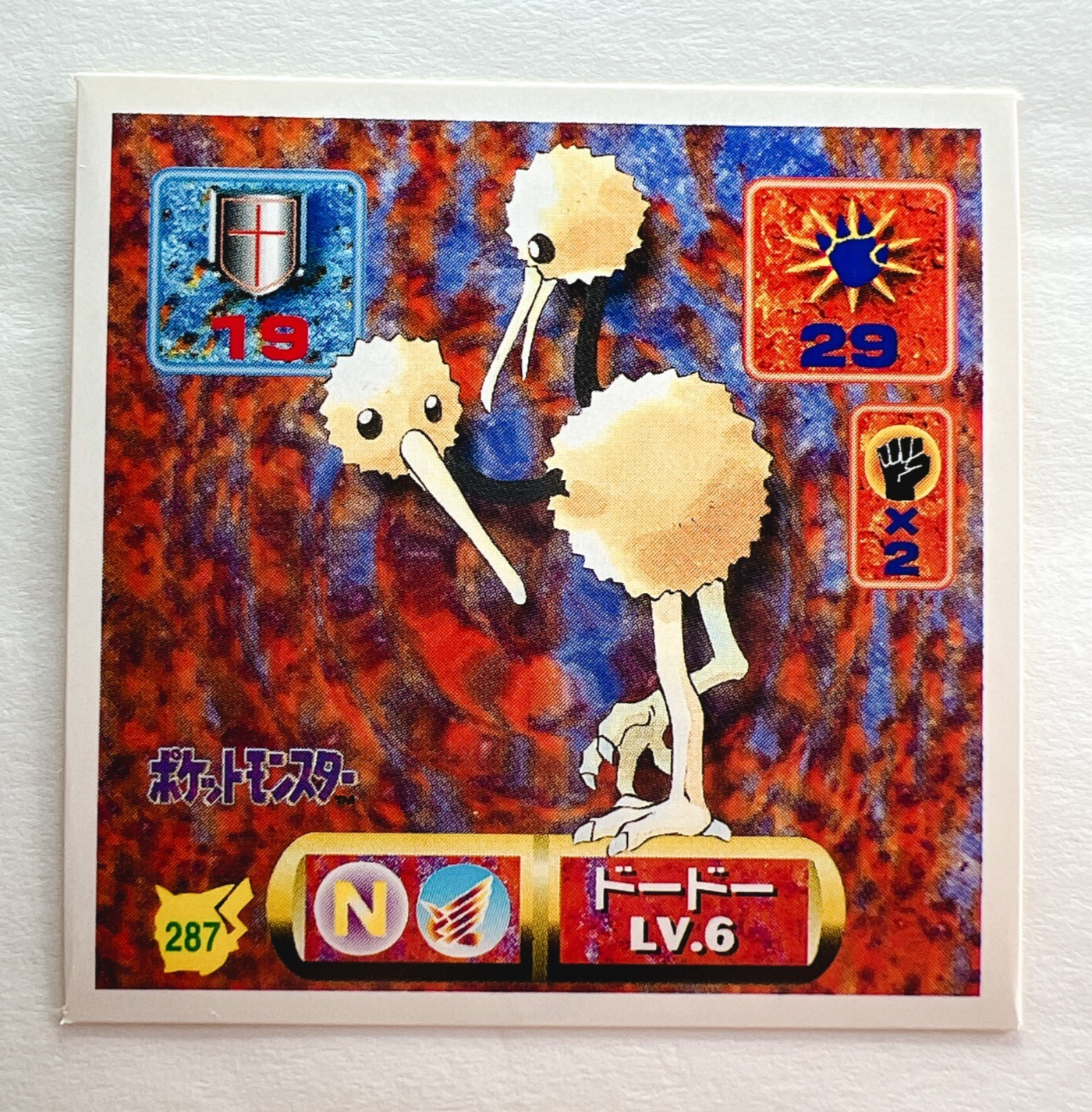
Doduo No.287: An Amada Pokemon Sticker from 1997

Doduo, the Twin-Headed Bird of the Original 151
Doduo is No.84 in the National Pokedex — a two-headed, flightless bird from the first generation of Pokemon. Despite having no functional wings, it carries both a Normal and a Flying-type classification, an intentional quirk of its design that has puzzled and charmed fans since the original Game Boy games. The two type icons printed on this sticker reflect exactly that dual designation.
The number 287 on this sticker is Amada’s own internal series numbering, not Doduo’s Pokedex entry. The sticker face also displays a level (LV.6) and two stat values (19 and 29), along with what appears to be a weakness multiplier. The exact logic of Amada’s stat system is not fully documented from primary sources, but the numerical layout closely echoes the readouts players encountered in the Game Boy games that inspired the whole product line.
Amada and the Trading Sticker Culture of 1990s Japan
Amada was a Kanagawa-based toy and sticker manufacturer active throughout the 1980s and 1990s, producing licensed sticker series for Dragon Ball, Saint Seiya, Sailor Moon, and eventually Pokemon. Their products were sold through stationery shops, toy stores, and small neighborhood candy shops — informal trading grounds where children bought, collected, and swapped stickers as a matter of daily routine. The format built directly on the Bikkuri Man sticker craze of the previous decade, carrying that collecting habit into the anime booms of the 1990s.
By 1997, Amada had expanded their Pokemon sticker catalog across hundreds of designs covering the original 151 species. The No.287 series number on this sticker reflects the scale of that lineup. Whether this piece belongs to Amada’s PP Card format or a separate sticker run is difficult to confirm from the sticker face alone, but the “Pocket Monsters” text printed in Japanese along the bottom makes clear it was produced for the Japanese domestic market. Amada’s business changed considerably after this era, giving the company’s 1990s licensed output a defined place in the history of Japanese pop-culture merchandise.
A First-Generation Piece From Before Pokemon Went Global
Pokemon’s Game Boy games launched in Japan on February 27, 1996. The anime followed on April 1, 1997. By the time Amada produced this sticker, Japan was already deep in a Pokemon phenomenon — but North American players would not see the games until September 1998. Amada’s 1997 production sits squarely in that pre-international window, which places stickers like this one in Pokemon’s Japanese origin period rather than the global brand era that followed.
For collectors focused on first-generation material, that distinction carries weight. The Japanese text, the domestic-market design, and the Amada name give this sticker an identity that the English-language Western releases of the same years never replicated. Amada is recognized among vintage Japanese merchandise collectors internationally, and its 1990s sticker runs are understood as a specific chapter in that collecting history. Doduo may not be among the franchise’s most prominent mascots, but as one of the original 151, it holds a permanent place in the lore — and its lower profile relative to marquee characters means Amada stickers featuring it appear with less frequency than those showing Pikachu or Eevee.


Comes straight from Japan — no middleman
$7.86
Ships internationally • More photos on the eBay listing