1950s Japanese Mini Round Menko Card Featuring Wimpy

What Is a Menko Card — and Who Is Wimpy?
Menko are traditional Japanese paper cards built around a simple street game: slam a card face-down onto your opponent’s, and if the force flips it over, you claim it. The format dates to the Edo period but peaked in popularity during the postwar Showa era, when children bought cards one at a time from dagashiya — the small neighborhood penny-candy shops that anchored Japanese street culture. Menko came in rectangular, square, and round forms; this one is a maru-menko, the circular variant, and notably smaller than the standard size even within that category.
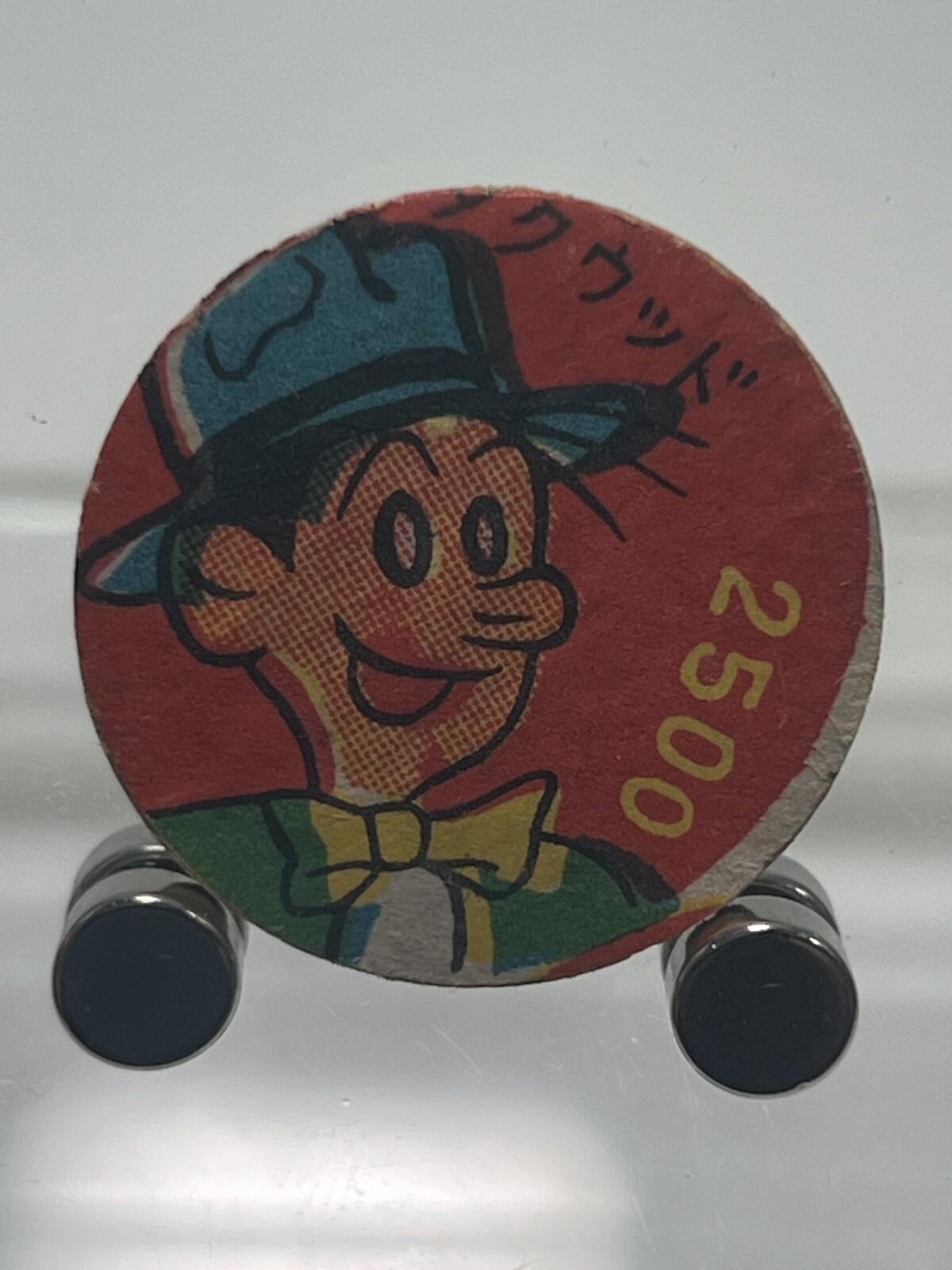
The front shows a character illustration on a red background, with the number 2500 printed vertically along the right edge — almost certainly a point value used in the game’s scoring rules. An arc of katakana text reading “Kuuddo” curves along the upper right; this may represent a maker’s name or brand, but the identification cannot be confirmed with certainty.
The character depicted is J. Wellington Wimpy, the stout, derby-hatted companion of Popeye the Sailor. Wimpy first appeared in E.C. Segar’s comic strip “Thimble Theatre” in 1931, distinguished by his green jacket, bow tie, and limitless appetite for hamburgers — the source of his most famous line, “I’ll gladly pay you Tuesday for a hamburger today.” The Popeye franchise itself began with Segar’s 1929 strip and expanded into worldwide animation through Fleischer Studios from 1933 onward. Rights to the franchise are held by King Features Syndicate.
Postwar Japan and the Americanization of the Dagashiya
The 1950s were the decade when American popular culture saturated Japanese everyday life. Following the occupation period and the 1952 peace treaty, U.S. films, comics, and cartoon characters entered the stream of Japanese consumer goods. Toy and stationery makers — including the many small regional printers who supplied dagashiya shops — responded by putting American characters onto formats children already knew.
Menko were a natural vehicle. Cheap to produce, easy to sell by the single card, and collected enthusiastically, they became a medium that absorbed baseball players, pro wrestlers, kaiju, anime figures, and foreign comic characters side by side on the same rack. A Wimpy menko from this period is a direct material record of that cultural crossing: an American comic strip character rendered through Japanese letterpress or lithographic printing and embedded in a game with centuries of domestic history.
The halftone dot pattern visible on the card’s surface is consistent with 1950s Japanese printing methods. Who manufactured the card remains uncertain, and whether it was produced under license from King Features Syndicate is also unknown — unlicensed character merchandise was widespread in Japan during this era.
What Draws Collectors to This Kind of Card
Three things set this menko apart from the broader field of Showa-era paper ephemera. First, the subject: Wimpy is a supporting character, not Popeye himself. A card that places a secondary figure at center stage is less predictable, and for collectors focused on franchise depth rather than headline names, that distinction carries weight.
Second, the format. Round menko exist in smaller numbers and variety than rectangular ones, and the unusually compact size adds another visual distinction that separates it from standard examples of the type.
Third, the cultural position. A card that places a 1930s American comic strip figure inside a traditional Japanese children’s game — manufactured in 1950s Japan with the printing technology of that exact moment — occupies an intersection that neither a straightforward American Popeye collectible nor a generic menko card could represent on its own. That specificity is what tends to drive interest in vintage paper items among both Japanese Showa collectors and Popeye franchise enthusiasts alike.


Comes straight from Japan — no middleman
$7.86
Ships internationally • More photos on the eBay listing