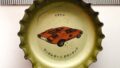
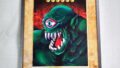
Space Invaders Menko Card, TAITO, 1985

A Japanese Card Game Piece Turned Gaming Artifact
This is a menko card — a small, stiff rectangle of card stock belonging to a traditional Japanese children’s game with roots stretching back centuries. What makes this particular example significant is its subject matter: the alien formations and mystery ship from Taito’s landmark arcade game Space Invaders, printed against a blue background with a “© TAITO CORP. 1985” copyright notice in the lower right corner. That imprint confirms both the year of manufacture and the official licensing — this card was produced under Taito’s direct authorization.
The artwork closely mirrors what players saw on an arcade screen in the late 1970s and early 1980s: rows of pixel-style alien invaders arranged across the card in the distinctive formation the game made famous, with the squid-, crab-, and octopus-shaped creatures occupying different rows, each with a slightly different silhouette. On the left side sits a large blue-and-red disc representing the UFO, or Mystery Ship — the craft that crosses the very top of the screen in unpredictable intervals and yields a points total that remains unknown until it’s shot. One area of the artwork features what appears to be a slightly yellower alien in the second row; whether this reflects an intentional design detail or is the result of printing variation and decades of aging is difficult to determine with certainty from the card’s current state.
Seven Years After the Arcade, Still Going Strong
Space Invaders launched in Japanese arcades in 1978, designed by Tomohiro Nishikado at Taito Corporation. Within months it had crossed the Pacific and become a defining moment for the video game industry worldwide. The format it established — waves of descending aliens, a lone cannon at the bottom, a mounting sense of urgency as the invaders closed in — became foundational to an entire generation of games that followed, and Space Invaders entered the broader cultural vocabulary far beyond gaming circles.
By 1985, the game was seven years old. The Famicom was driving a new wave of game-related merchandise across Japan, and Taito remained a major force in the industry. This menko card was manufactured in that environment: Space Invaders had graduated from new release to cultural institution, and licensed goods carrying its artwork were appearing in toy shops, candy stores, and market stalls across the country. Producing a menko card based on it in 1985 was not nostalgia — it was simply good business built on a brand that showed no signs of fading.
How Menko Shaped Japan’s Collector Culture
Menko as a game format has existed in Japan since at least the Edo period. The core mechanic is elemental: players take turns slamming their card onto the ground next to a target card, trying to flip it over or knock it clear to claim it. The cards themselves were the prize, which meant that having better cards — rarer ones, ones featuring more popular characters — mattered in the schoolyard economy.
From the 1960s through the 1980s, licensed character menko bearing anime heroes, baseball stars, tokusatsu characters, and eventually video game art were staples of the dagashiya — the small neighborhood candy-and-toy shops that were a fixture of postwar Japanese childhood. They were sold in multi-card bags or individually, traded and collected by children who had no equivalent in Western toy culture. In that sense, menko are a direct predecessor of the trading card collecting tradition that followed.
By the late 1980s, Bikkuri Man stickers and Carddas cards had largely displaced traditional menko in the collectibles market. That shift means well-preserved licensed menko from the Showa era now represent a specific and finite window into an earlier chapter of Japanese pop-culture collecting — one where arcade games, dagashiya, and a centuries-old children’s game briefly occupied the same physical object. A 1985 Space Invaders card, officially licensed by Taito, sits precisely at that intersection.

Shipped from Japan, tested where noted in the listing
$7.86
Ships worldwide from Japan • Full photos and details on the listing