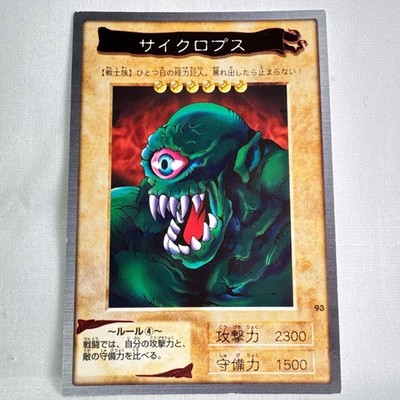
Bandai Carddass Yu-Gi-Oh No.93 Hitotsu-Me Giant, Part 3 (1999)

Japan’s Vending Machine Card Tradition
Bandai’s Carddass system began around 1988: branded dispensing machines installed in toy shops, candy stores, and arcades across Japan, releasing small licensed trading cards for roughly 20 yen each. Over the years the lineup expanded through properties like Dragon Ball and Saint Seiya, and by the late 1990s Yu-Gi-Oh had joined it. The format was built around collecting rather than competition — the appeal was finding cards, comparing them, and trading with friends. A game system did exist, and the “Rule 4” notation printed on this card references Bandai’s own ruleset, but the depth of play was secondary to the experience of accumulating and owning the cards themselves.
This card is No.93 from Part 3 of the Bandai Yu-Gi-Oh Carddass series, dating to around 1999. Its metallic frame treatment places it among the higher-tier releases in the Carddass lineup, though the precise rarity structure of the full series is not thoroughly documented.
Hitotsu-Me Giant: A Monster From the Earliest Pages
The creature depicted here — Hitotsu-Me Giant, sometimes rendered in English as “Cyclops” — is a Warrior-type monster shown as a towering, green-skinned figure with a single large red eye, jagged teeth, and an open jaw. In Kazuki Takahashi’s original manga, serialized in Weekly Shonen Jump from 1996 to 2004, it appears among the cards belonging to Yugi’s grandfather, Sugoroku Muto, placing it in the story’s earliest chapters rather than among the high-profile monsters introduced later.
This card connects to the first Yu-Gi-Oh television anime, produced by Toei Animation, which aired from April to October 1998 across 27 episodes. That production — a separate work from the Studio Gallop series that began in 2000 and reached international audiences — placed more emphasis on the mystery of the Millennium Puzzle and its cast of characters than on card dueling. Bandai’s Carddass line was developed in parallel with this Toei anime, reflecting the standard media tie-in practice of the era.
Before the Konami Card Game Took Over
In February 1999, Konami released its Official Card Game, and the structured, tournament-backed format it offered gradually absorbed the market. Bandai’s Carddass line, without the infrastructure of organized competitive play, became a shorter chapter in the franchise’s history — and the two systems were never compatible with each other.
The design difference shows up directly on the card. Hitotsu-Me Giant carries ATK 2300 / DEF 1500 in the Bandai version, while the same monster in Konami’s OCG has ATK 1200 / DEF 1000. Both figures reflect independent design choices, built for systems that had no connection to one another.
Bandai’s Yu-Gi-Oh Carddass was produced for the Japanese domestic market only, with no official distribution in North America or Europe. For collectors outside Japan, it represents the franchise in the period just before the trading card game that defined it worldwide — a distinct ruleset, a different set of monsters, and an earlier moment in a long story that most international fans encountered only from the middle.


Sleeved and rigid-mailed before it leaves Japan
$8.82
Ships internationally • More photos on the eBay listing