A Showa-Era Menko Card from the Gegege no Kitaro Series

What Menko Cards Are and How They Were Played
Menko are thick cardboard pieces whose origins are traced to the Edo period. The game is straightforward: players slap their cards against the ground and use the resulting air pressure to flip an opponent’s card face-up — whoever manages that wins the card. In post-war Japan, the format surged when manufacturers began printing anime characters, professional wrestlers, and baseball players on them. By the late 1960s, menko were a staple of the dagashi-ya, the small neighborhood candy-and-toy shops where children spent their pocket change.
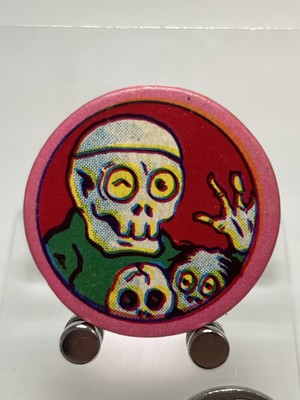
This card is circular — one of several formats that coexisted alongside rectangular and square variants. Its halftone dot printing is characteristic of the mass-produced graphic goods of the Showa era (1926–1989), when cards like this were made and sold for just a few yen apiece. The manufacturer is unknown; a number of small and mid-size producers made character menko during this period, and licensing practices were considerably less formalized than they are today.
Gegege no Kitaro and the Artist Who Created It
Mizuki Shigeru (1922–2015) developed his yokai hero Kitaro from a rental-manga series called Hakaba no Kitaro in the early 1960s. In 1967 the character moved to Weekly Shonen Magazine under the title Gegege no Kitaro, reaching a mass readership for the first time. A black-and-white anime followed in 1968, a color series in 1971–72, and a third television run from 1985 to 1988 — with further series continuing into the 2010s. Few anime franchises have run as long or been revived as often.
Kitaro is the half-ghost son of a small spirit called Medama-oyaji, who takes the form of a tiny sentient eyeball. The series drew on Japanese regional folklore and ghost traditions, presenting yokai not as pure monsters but as beings with their own cultures. That blend of folklore, humor, and occasional horror gave the franchise a distinctive tone that set it apart from most children’s entertainment of the era.
Why Kitaro’s Yokai World Reaches a Global Audience
The illustrated character on this card has a skeletal, green-bodied appearance with a single winking eye, yellow outlines, and two small heads beneath its arms. The design bears some visual resemblance to Gashadokuro, the giant skeleton spirit of Japanese legend, but the exact identity is difficult to confirm — character designs varied considerably across Kitaro’s different production eras. The two small subsidiary figures could be Medama-oyaji, though that also remains uncertain.
Mizuki’s influence has extended well beyond Japan. In 2013 he received a special honor at the Angouleme International Comics Festival in France, reflecting broader international recognition of his work in yokai mythology. For collectors tracing the lineage that runs from Kitaro through later franchise phenomena like Pokemon and Yokai Watch, Showa-era material like this represents an early chapter in that tradition. Menko also carry a cultural specificity of their own: they were playing pieces, not collectibles, which makes surviving examples part of a format that no longer exists in modern Japanese toy culture.


Listed in our eBay store and sent from Japan
$7.86
International shipping available • Ask us anything before you buy