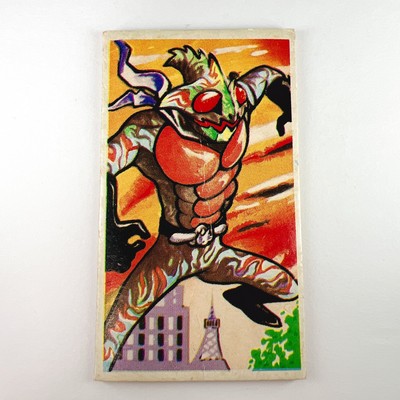
Kamen Rider Amazon Menko Card, 1970s Tokusatsu

Japan’s Wildest Kamen Rider and His Place in the Showa Lineup
Kamen Rider Amazon is the fourth entry in Toei’s long-running Kamen Rider franchise, based on the original manga by Shotaro Ishinomori. The series aired on NET — now TV Asahi — from October 1974 through March 1975, running for 24 episodes. It followed Kamen Rider X and came just before Kamen Rider Stronger.
The story centers on Daisuke Yamamoto, a young man raised deep in the South American Amazon jungle by indigenous people. His transformed identity as Kamen Rider Amazon reflects that origin directly: where earlier riders leaned into a sleek, mechanical aesthetic, Amazon’s suit is emphatically organic — a mottled green-and-brown pattern, a red chest armor, a blue-purple scarf, and an insectoid helmet with compound eyes and visible fangs. His transformation item is the Gigi Armlet, later joined by the Giri Armlet, and his signature finishing move is the Big Chop. The enemy organizations he battles are Geddon and the Garanda Empire.
Even within the Showa-era Kamen Rider catalog, Amazon stands apart. Its tone is noticeably darker and more feral than its predecessors, a quality that has kept it distinct in both franchise history and fan discussion.
Menko: The Schoolyard Game Behind the Card Format
Menko are small, thick cardboard game cards with roots going back to Japan’s Edo period. The gameplay is straightforward: players slap cards against the ground, using force or displaced air to flip an opponent’s card face-up. It is a physical, competitive pastime that spread through schoolyards and dagashiya — the small neighborhood candy-and-toy shops that anchored Japanese children’s daily life in the Showa era.
By the 1970s, menko had shifted decisively toward character printing. Baseball players, pro wrestlers, and tokusatsu heroes were the dominant subjects. This card belongs to that character menko tradition, and it is worth noting that it is a different object from the Calbee Kamen Rider snack cards of the same era — those came packaged with chips and became a nationwide collecting phenomenon. Menko typically circulated as standalone toy items, sold singly or in small sets at dagashiya for just a few yen.
The early-to-mid 1970s were the peak of Japan’s Kamen Rider boom, and demand for character merchandise was enormous across every accessible format. Multiple small toy manufacturers and printers produced character menko under licenses from Toei’s agency, though the specific maker of this card cannot be confirmed from available markings. Since the Heisei era, trading card games have largely replaced menko as a format, which is why original Showa-period examples have become a recognized category among retro toy collectors in Japan.
Why the International Tokusatsu Community Takes Notice
Kamen Rider has built a genuine following among tokusatsu fans across North America, Southeast Asia, and Europe. Within that community, Amazon holds a specific place: its dark mythology, jungle-origin premise, and creature-like suit design make it a visually striking outlier even among Showa-era riders, and it is frequently cited in fan discussions about the franchise’s range.
A 1970s menko like this one carries the physical qualities of its period — printing techniques, paper stock, and hand-drawn-style artwork that are characteristic of the era and differ meaningfully from modern reproductions. For collectors interested in Showa-era merchandise as cultural artifacts, menko also represent a format with no real equivalent outside Japan, lending the object an additional layer of specificity that purely digital or reprint items cannot replicate.


Shipped directly from Japan by a small shop
$7.86
Ships worldwide from Japan • Full photos and details on the listing