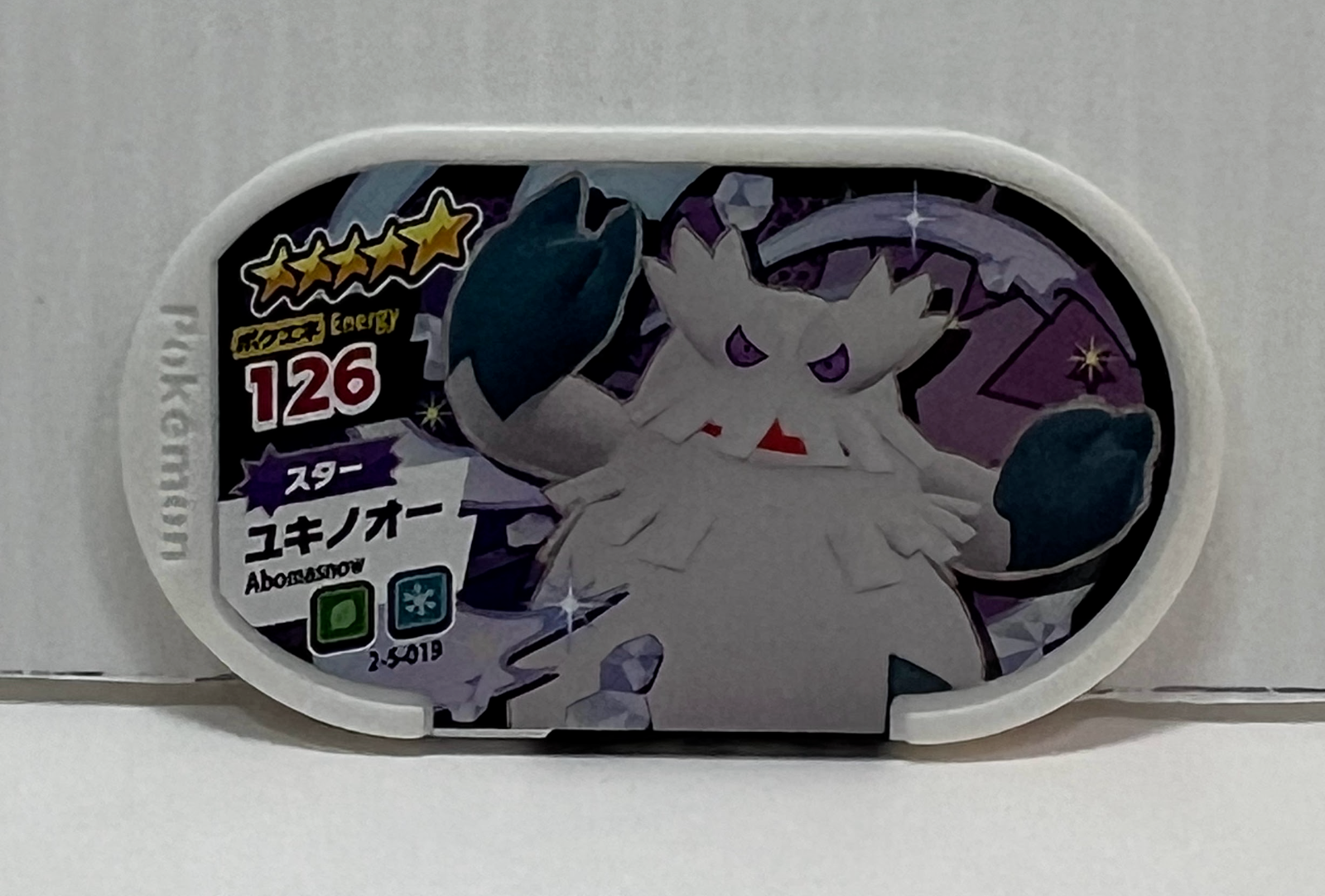
Abomasnow Pokemon Mezastar Arcade Tag, Series 2, Five-Star Rarity

A Collectible Born in the Japanese Arcade
Pokemon Mezastar is an arcade game series run by Bandai Namco Amusement under license from The Pokemon Company. It launched in Japanese game centers in September 2020, continuing a lineage that stretches back through Pokemon Tretta (2012) and Pokemon Ga-Ole (2016). Each generation updated the tag’s physical format: the earlier series used round discs, while Mezastar switched to an oval NFC-chip tag — the format used here.
The gameplay loop is straightforward: a player inserts a coin, battles on the arcade machine, and receives one tag when the round ends. The tags work inside the machine during play, calling on each Pokemon’s printed statistics, but they also circulate on their own as physical collectibles. This tag is numbered 2-5-019, where “2” marks it as part of Series 2 (released around 2021), “5” places it at the top of the one-to-five-star rarity scale, and “019” is its sequence number within that tier. Its in-game stat reads Pokemon Energy 126, and both a Grass-type leaf icon and an Ice-type snowflake icon appear on the face of the tag, reflecting Abomasnow’s dual typing.
Abomasnow and Its Roots in the Sinnoh Region
Abomasnow — known in Japanese as Yukino-o — made its debut in Pokemon Diamond and Pearl in 2006, the games that introduced the fourth generation of the series and the Sinnoh region. It holds National Pokedex number 460 and is the final evolved form of Snover. The design draws on the imagery of a yeti or snowman, merging white fur with patches of green plant matter in a way that sets it apart from most other Pokemon of comparable size.
A Mega Evolution form was added in Pokemon X and Y in 2013. Whether this specific tag illustrates the base form or the Mega form is not entirely settled; research notes suggest it is likely the standard form, but the illustration itself would confirm that detail. From a type-matchup standpoint, the Grass/Ice combination carries seven weaknesses — an unusually high number — which has shaped how competitive players approach the Pokemon. Despite that, the unusual typing and the distinctive visual design have given Abomasnow a lasting following, particularly among players who first encountered it in Diamond and Pearl.
Japan-Only Origins and the Diamond/Pearl Revival
Mezastar operates entirely through physical arcade infrastructure in Japan. There is no international distribution, so collectors outside Japan can only source tags through personal imports or resellers who obtain them directly from Japanese game centers. That separation from international retail is part of what defines the series for overseas collectors — it represents a corner of Pokemon culture that does not reach standard storefronts.
The timing of renewed interest also matters. Pokemon Brilliant Diamond and Shining Pearl — remakes of the 2006 originals — launched in late 2021, bringing the Sinnoh generation back into active conversation. Players who first met Abomasnow in 2006 are now in their late twenties and thirties, and the remakes reignited attention across the fourth-generation Pokemon roster. For collectors tracking that generation, a five-star Mezastar tag featuring a Sinnoh Pokemon sits at an intersection of arcade history and franchise nostalgia. Mezastar tags also occupy a distinct space from the Pokemon Trading Card Game, which has long had international distribution: these are an arcade-native, Japan-specific format with their own design language, rarity structure, and gameplay context.

Comes straight from Japan — no middleman
$8.82
Ships internationally • More photos on the eBay listing